What if the software holding your business back is actually costing you more in hidden licence fees than it would to build a proprietary asset from the ground up? Many South African leaders find themselves trapped between high international costs and platforms that simply don’t scale with national expansion. It’s a common frustration to feel that your digital tools are a constraint rather than a catalyst for growth.
We understand that you’re looking for more than just a vendor; you’re looking for a partner to help you navigate the complexities of custom software development south africa in 2026. In this guide, you’ll discover how bespoke engineering, AI-driven automation, and cloud-native solutions are transforming the local landscape. We’ll explore the shift toward delivery maturity and how owning your digital IP provides the stability needed for long-term success. By the end of this article, you’ll have a clear path toward achieving operational efficiency whilst securing a scalable platform that supports your unique business journey.
Key Takeaways
Learn why South African enterprises are moving away from restrictive international licences in favour of custom software development south africa to secure long-term digital IP.
Understand how integrating AI-driven automation and cloud-native architecture ensures your platform remains scalable and efficient in a competitive market.
Discover how a rigorous Discovery phase and Agile methodology mitigate project risks whilst ensuring your software aligns perfectly with complex business logic.
Evaluate the cost-benefit ratio of bespoke tools compared to off-the-shelf packages, focusing on long-term operational savings and enhanced productivity.
Explore how a flexible partnership model, including staff augmentation, allows you to extend your internal team’s capabilities whilst maintaining project momentum.
The Landscape of Custom Software Development in South Africa (2026)
In 2026, custom software development south africa is no longer just about building apps; it’s about engineering strategic assets that align with unique business logic. Whilst off-the-shelf solutions offer a quick start, they often fail to capture the specific nuances of the local market. Local enterprises are increasingly viewing digital transformation as a necessary evolution rather than a luxury. Within the 2026 South African digital economy, custom software development is defined as the creation of high-precision, cloud-native tools that transform operational friction into a competitive advantage.
Choosing local engineering over international SaaS allows businesses to bypass the volatility of exchange rates and rigid global frameworks. By focusing on bespoke builds, organisations ensure their technology scales alongside their national footprint. This shift represents a move toward stability and long-term resilience in a landscape where agility is the primary currency for success.
To better understand the practical side of engineering in our local context, watch this helpful video:
Addressing Local Operational Challenges
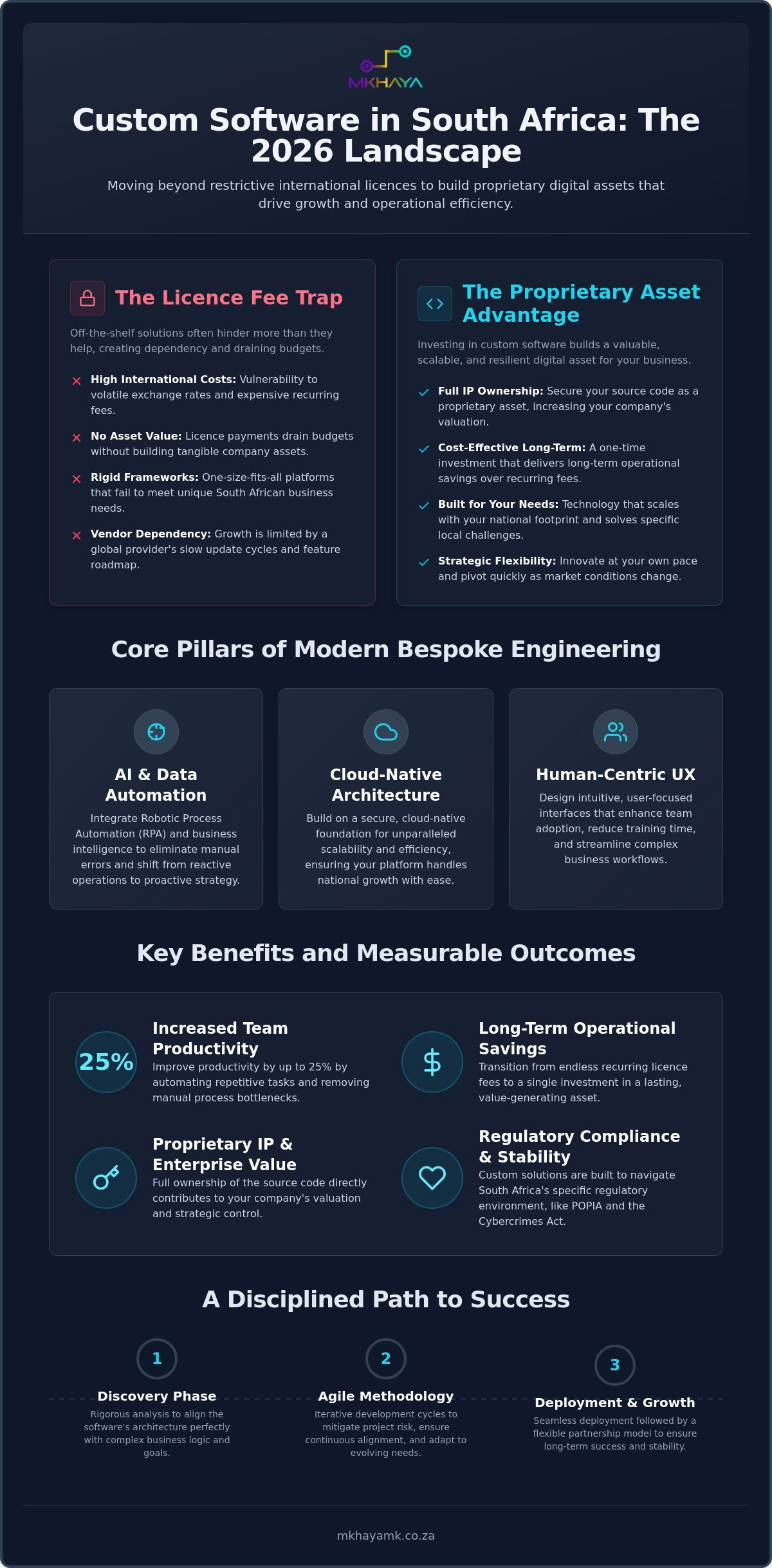
Fragmented legacy systems continue to hinder productivity for many established firms. Modern software engineering provides a bridge, integrating disparate processes into a unified, high-performing workflow. This approach is vital for navigating South Africa’s strict regulatory environment, including POPIA and the Cybercrimes Act. Industry benchmarks suggest that bespoke tools can improve team productivity by up to 25% by removing manual bottlenecks and automating repetitive tasks. Following a structured approach to The Software Development Lifecycle ensures that these solutions remain robust, compliant, and ready for future expansion from the very first day of deployment.
The Move Towards Proprietary Intellectual Property
Many businesses are waking up to the “licence fee trap” associated with international software packages. These recurring costs often drain budgets without adding to the company’s tangible asset value. By investing in software engineering, a business secures full ownership of its source code. This proprietary IP increases the overall valuation of the enterprise and provides the strategic flexibility to pivot quickly when market conditions change. Owning the platform means you aren’t waiting for a global provider to update a feature; you have the power to innovate and refine your tools at your own pace, ensuring your technology remains a stable anchor for your growth.
Core Pillars of Modern Bespoke Engineering: AI, Cloud, and UX
The technical foundation of any digital asset determines its lifespan and its ability to return value. In 2026, custom software development south africa has evolved beyond simple coding to encompass a sophisticated blend of intelligence, scalability, and human-centric design. These pillars ensure that a platform doesn’t just function; it thrives within the unique economic context of The South African Software Industry. By building on these core strengths, organisations create tools that are resilient enough to handle national growth whilst remaining agile enough to adapt to local market shifts.
AI and Data Automation Integration
Artificial intelligence is no longer a futuristic add-on; it’s a standard requirement for modern builds. Implementing AI automation solutions south africa allows businesses to move from reactive operations to proactive strategy. Robotic Process Automation (RPA) is frequently integrated within custom workflows to eliminate manual errors in data entry and processing. This precision is backed by business intelligence tools that provide real-time oversight. When your software can predict bottlenecks before they occur, your leadership team can focus on growth rather than fire-fighting.
Cloud Solutions and DevOps Excellence
Scalability across provinces requires a robust infrastructure that only cloud-native architecture can provide. Utilising cloud migration services south africa is essential for businesses looking to shed the weight of physical servers and local hardware limitations. DevOps practices further accelerate this by creating a continuous loop of refinement and deployment. This methodology ensures that security updates and new features reach users without downtime. It also keeps your organisation compliant with national data protection laws, such as POPIA, by embedding security protocols directly into the development pipeline.
Specialised Business Systems
Generic software often fails to meet the specific demands of regulated sectors. For instance, a bespoke loan management system south africa provides the exact compliance and reporting features required by local financial authorities. Similarly, custom tools for learner management and facility oversight allow organisations to organise their internal logic without compromise. Custom ERP solutions are designed to adapt to your existing business behaviour rather than forcing your staff to learn a foreign, rigid system. If you’re ready to build a system that truly fits your operations, you might consider how tailored engineering services can refine your current processes.
User experience remains the final, critical pillar. Even the most advanced AI or cloud system will fail if employees find it difficult to use. Prioritising UI/UX design ensures high adoption rates, making the transition to new technology a smooth and supportive experience for your entire team.
Strategic Benefits: Why South African Enterprises Favour Bespoke Tools
Strategic value in 2026 is measured by how well your technology serves your specific business behaviour. Whilst many leaders initially consider off-the-shelf packages for their perceived speed, they often encounter the “80/20” rule. This is where a generic platform meets 80% of your requirements but leaves the most critical 20% of your unique logic unsupported. Choosing custom software development south africa ensures that your digital tools are a 100% fit, eliminating the workarounds that typically stifle productivity.
The shift toward bespoke engineering is driven by a desire for stability and control. Instead of being a tenant on a global SaaS platform, you become the owner of a proprietary asset. This transition from recurring monthly subscription costs to capital investment in your own source code significantly enhances the long-term valuation of your enterprise. It also provides a level of agility that international software simply cannot match. When your market changes, you have the power to refine your platform instantly without waiting for a global update cycle.
Custom vs. Off-the-Shelf: A 2026 Comparison
The difference between these two paths often comes down to the quality of the partnership. Generic software users frequently find themselves stuck in international ticket systems, waiting days for a response from a remote support centre. In contrast, bespoke engineering offers direct access to local engineers who understand the South African business context. This proximity ensures that support is not just technical, but strategic. Additionally, custom builds allow for seamless integration with your existing legacy hardware and APIs, ensuring that your new system works in harmony with your current infrastructure rather than requiring a total overhaul.
Security and Data Sovereignty
Compliance with POPIA is a non-negotiable priority for any organisation handling personal data. Bespoke systems allow you to keep data strictly within South African borders, ensuring full data sovereignty. You can build custom security protocols that address the specific risks inherent to your industry, rather than relying on a one-size-fits-all security patch. There is also a distinct advantage in “security through obscurity”. Whilst generic tools are high-profile targets for global cyberattacks, a custom-built system is far less likely to be targeted by automated hacking scripts designed for mass-market software.
A key differentiator in managing project risk is the ability to extend your team’s capabilities through staff augmentation. This model allows you to maintain momentum by bringing in specialised expertise exactly when it’s needed. It bridges the gap between hiring a full-time team and outsourcing entirely, providing a flexible way to scale your software engineering efforts. By combining this flexible talent model with a custom architecture, you create a platform that is ready to support national growth and future innovation.
The Software Development Lifecycle: From Discovery to Deployment
Building a high-performing digital asset requires a methodical and transparent approach. Success in custom software development south africa depends on more than just technical skill; it relies on a structured lifecycle that prioritises clarity and partnership at every stage. By following a rhythmic momentum from strategy to execution, we ensure that the final product isn’t just a piece of software, but a stable anchor for your business operations. This process transforms abstract goals into concrete, scalable platforms that deliver a measurable return on investment.
Discovery and Business Analysis
The Discovery phase is arguably the most critical part of the entire journey. We begin with collaborative workshops designed to map out intricate user journeys and define the technical architecture. This isn’t just about planning; it’s about deep alignment between your business logic and our engineering strategy. Integrating professional UI UX design services south africa during this stage ensures that the software remains intuitive and supportive for the people who will use it daily. We establish clear KPIs before development begins, providing a shared definition of success that guides every subsequent decision.
Agile Development and Deployment
Agile methodologies keep you at the heart of the build process. By breaking the project into manageable sprints, we create frequent feedback loops that allow for refinements in real-time. This iterative approach significantly reduces project risk, as any deviations from the original vision are caught and corrected early. We utilise Continuous Integration and Deployment (CI/CD) pipelines to manage updates seamlessly, ensuring that new features are integrated without disrupting your existing workflows. Transitioning from development to a live production environment is handled with precision to avoid downtime, maintaining your operational momentum throughout the launch.
Stability is never an accident; it’s the result of rigorous Quality Assurance (QA). Every line of code undergoes thorough testing to ensure it meets enterprise-grade standards for security and performance. Even after deployment, our commitment continues through dedicated maintenance and support. Software is a living asset that must evolve alongside your business. If you’re ready to see how a structured approach can secure your digital future, you can explore our development process in more detail. This long-term perspective ensures your platform remains a reliable tool for national expansion and sustained efficiency.
Partnering for Growth: Mkhaya MK’s Integrated Development Model
Choosing a partner for custom software development south africa is a decision that shapes your organisation’s long-term stability. At Mkhaya MK, we don’t just deliver code; we build collaborative relationships designed to bridge the gap between high-level business strategy and precise technical execution. Our integrated model offers the flexibility you need to navigate a rapidly changing technological landscape whilst ensuring your digital assets remain secure and scalable. By acting as a stable anchor for your growth, we help you transform ambitious visions into practical, operational realities.
Working with a national partner means you’re collaborating with a team that truly understands the South African business context. We’re deeply invested in your personal journey and the success of your national expansion. This local expertise ensures that your technology isn’t just modern; it’s relevant to the specific challenges and opportunities within our borders. It’s about moving forward with a sense of quiet confidence, knowing that your software is built on a foundation of integrity and commitment.
Staff Augmentation: Scaling Your Team on Demand
One of the greatest challenges in 2026 is accessing niche technical expertise without the heavy overhead of permanent hiring. Our IT staff augmentation services allow you to extend your internal team seamlessly. Whether you need to hire dedicated developers south africa for a specific sprint or bring in long-term specialists, this model ensures you maintain project momentum. It’s an agile way to scale that keeps you in control of your workflows. You get the benefit of senior-level skills whilst avoiding the complexities of traditional recruitment, allowing your core team to focus on their primary objectives.
End-to-End Digital Transformation
Our approach goes beyond simple engineering to provide comprehensive digital transformation consulting south africa. We look at your entire business ecosystem to identify where automation and cloud-native tools can create the most value. For businesses in the financial sector, leveraging our proprietary Loan Management System offers a faster return on investment by providing a pre-validated framework that can be customised to your specific logic. This blend of bespoke engineering and specialised platforms ensures that your technology is always fit for purpose.
The Mkhaya MK promise is to provide a visionary yet practical guide that empowers your business to lead with confidence. We value transparency and methodical execution over flashy claims, ensuring that every step of our engagement is clearly articulated. As you look toward 2026 and beyond, we’re ready to help you build the stable, high-performing platforms your future demands. Together, we can create a technological landscape that supports your ambition and secures your legacy.
Securing Your Digital Legacy in 2026
The transition from restrictive international licences to proprietary digital assets marks a turning point for any ambitious organisation. By embracing custom software development south africa, you secure the ownership of your source code whilst ensuring your technology aligns perfectly with your business logic. We’ve explored how integrating AI-driven automation and cloud-native architecture provides the scalability required for national expansion. From the initial Discovery phase to the final deployment, a structured approach ensures that every line of code serves a strategic purpose.
Mkhaya MK brings a polished, professional team with national coverage to every project. Whether you require specialised systems for Loan, Facility, or Learner Management, our end-to-end service covers everything from UI/UX design to complex Cloud DevOps. We’re here to act as your stable anchor in a rapidly changing landscape, providing the technical precision and visionary guidance needed to succeed. Start your digital transformation journey with Mkhaya MK today and build a platform that grows with your ambition. Your path toward operational excellence is a partnership we value deeply, and we look forward to building a resilient, high-performing future together.
Frequently Asked Questions
How much does custom software development cost in South Africa?
Market benchmarks for custom software development south africa in 2026 typically start from R27,000 for specialised applications, whilst complex mobile platforms can range from R50,000 to over R1,500,000. These figures depend heavily on the specific feature set and integration requirements of your project. Ongoing application maintenance usually adds an annual expense of 15% to 20% of the initial development cost to ensure the platform remains stable and secure.
How long does it typically take to build a bespoke business application?
Building a bespoke business application generally takes between three and nine months, depending on the complexity of the requirements. A focused tool with limited integrations might reach deployment in twelve weeks, whereas an enterprise-grade system requires a longer timeline for rigorous testing. Following an Agile methodology allows for iterative releases, meaning your staff can often begin using core features whilst the rest of the platform is being constructed.
What is the difference between project-based development and staff augmentation?
Project-based development involves a defined scope where the service provider manages the entire delivery from discovery to launch. Staff augmentation allows you to extend your internal team by bringing in specialised developers to work directly under your management. This flexible model is ideal for maintaining project momentum during rapid growth phases without the long-term overhead of permanent hiring, providing access to niche technical skills on demand.
Can custom software be integrated with my existing legacy systems?
Yes, custom software is designed to integrate seamlessly with your existing legacy systems through secure APIs and custom middleware. This approach allows you to modernise your workflows without needing to replace your entire hardware infrastructure. By building bridges between old and new technology, you can protect your previous investments whilst gaining the efficiency benefits of modern, cloud-native engineering and automated data flows.
Who owns the intellectual property (IP) of the developed software?
Standard practice ensures that the client owns the full intellectual property and source code upon completion of the project. It’s vital to have a written IP assignment clause in your development agreement to confirm this ownership from the outset. Owning your digital assets increases the overall valuation of your enterprise and provides the freedom to refine your platform without being beholden to a third-party vendor’s restrictive roadmap.
Is bespoke software more secure than off-the-shelf alternatives?
Bespoke software is often more secure because it isn’t a high-profile target for automated global hacking scripts designed for mass-market tools. Custom systems allow for the construction of specific security protocols tailored to your industry’s unique risks and regulatory requirements. This “security through obscurity” is reinforced by embedding compliance with POPIA and the Cybercrimes Act directly into the software architecture during the development process.
What industries in South Africa benefit most from custom software?
Industries such as FinTech, logistics, and education benefit significantly from custom software development south africa due to their complex operational needs. For example, financial institutions require specialised loan management tools, whilst educational organisations rely on bespoke learner management systems to organise student data. Any sector where generic software fails to capture unique business logic will find a competitive advantage in building a proprietary, scalable platform.
How do I choose the right software development company in South Africa?
Choosing the right partner requires looking beyond technical skills to find “delivery maturity” and a deep understanding of the local business context. You should prioritise a company that values transparency and offers a clear, step-by-step explanation of their engagement process. Look for a visionary guide that remains invested in your personal journey and is capable of providing end-to-end support from UI/UX design to cloud-native deployment.
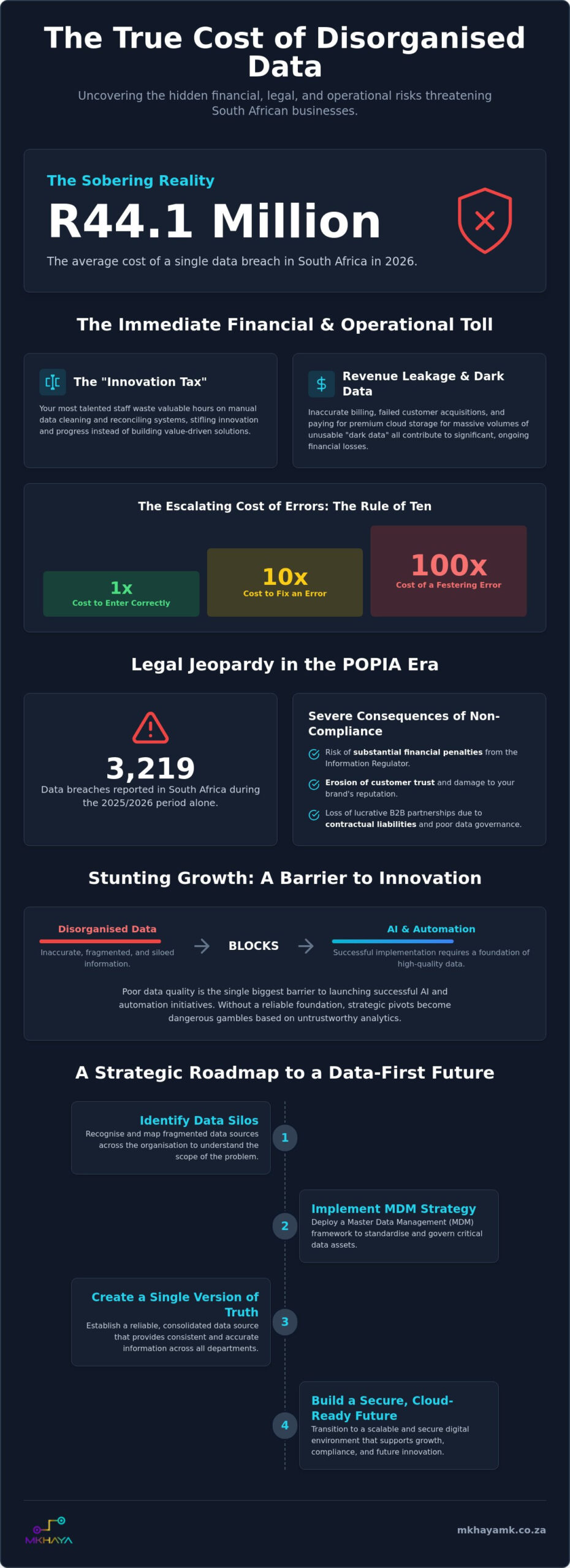
Did you know that the average cost of a single data breach in South Africa has reached R44.1 million in 2026? It’s a sobering figure that highlights why the consequences of poor data management are no longer just an IT headache but a fundamental risk to your business survival. You’ve likely felt the strain of high operational overhead from manual data cleaning, or perhaps you’re feeling the weight of anxiety over POPIA compliance as the Information Regulator adopts a more proactive stance.
We understand that you want to move beyond these hurdles and finally unlock the potential of AI and automation. In this article, you’ll discover the hidden financial and legal risks of disorganised data and learn the strategic steps to secure your digital future. We provide a clear roadmap to help you justify the necessary investment for data projects, moving your organisation from a state of chaos to being fully prepared for the next wave of technological innovation.
Understand how manual data cleaning acts as a hidden tax on your team’s productivity and learn how to quantify these operational losses.
Explore the severe legal consequences of poor data management under the latest POPIA enforcement standards, including the risk of substantial financial penalties.
Discover why high-quality, organised data is the non-negotiable foundation for launching successful AI and automation initiatives.
Learn how to implement a Master Data Management strategy that creates a reliable, single version of truth across your entire enterprise.
Identify the strategic roadmap required to transition from fragmented data silos to a secure, cloud-ready digital environment that scales with your ambition.
At its core, poor data management represents a fundamental failure to accurately capture, store, and utilise the information assets that drive your business. It isn’t just about messy spreadsheets; it’s a structural flaw that prevents your organisation from reaching its full potential. Robust data management ensures that every piece of information is a reliable asset rather than a liability. When this foundation is weak, the consequences of poor data management ripple through every department, creating a heavy “Innovation Tax”. Your most talented staff end up spending their hours manually correcting errors or reconciling systems instead of building new solutions that move the needle.
To better understand the tangible impact of data quality on your business, watch this helpful video:
Beyond the drain on human capital, disorganised systems lead to immediate revenue leakage. Inaccurate billing cycles or failed customer acquisitions often stem from duplicated contact details or lost purchase histories. There’s also the silent, ongoing cost of “Dark Data”. Many South African enterprises pay for premium cloud storage for massive volumes of unlabelled, unusable information. This data provides zero value whilst increasing your digital footprint and storage overheads every month.
Inaccurate Decision-Making and Skewed Analytics
Strategic pivots become dangerous gambles when your dashboards are untrustworthy. When the numbers don’t add up, leadership teams often revert to “gut feelings” rather than data-driven insights. This reliance on intuition over evidence leads to flawed forecasting. You might find your business overstocking inventory based on ghost demand or missing out on critical market shifts because the data was too outdated to signal a change. Strategic agility requires a foundation of precision that messy data simply cannot provide.
The Escalating Cost of Operational Inefficiency
The “Rule of Ten” remains a stark reminder of operational reality. It costs ten times more to fix a record than it does to enter it correctly at the start, and a hundred times more if that error is left to fester. For customer service centres, the lack of a single source of truth means agents struggle to resolve queries, leading to frustrated clients and higher churn. Fragmented IT systems also require redundant maintenance and custom patches to talk to one another. By exploring AI and data automation, you can begin to bridge these silos and turn your data into a streamlined driver of growth.
In South Africa, the legal landscape has shifted dramatically. The Protection of Personal Information Act (POPIA) is no longer a distant requirement; it’s a daily operational reality. The Information Regulator reported 3,219 data breaches in the 2025/2026 period alone, a figure that represents a sharp increase from previous years. This surge highlights the severe consequences of non-compliance with POPIA for those who fail to secure their digital estates. Disorganised data often acts as the primary catalyst for these incidents. When information is scattered across unmanaged silos, maintaining strict access controls becomes nearly impossible. This lack of oversight leads to accidental leaks or unauthorised entry, placing your entire organisation in jeopardy.
It’s vital to remember that POPIA protects juristic persons as well as individuals. This means your business-to-business data is under the same scrutiny as consumer information. Poorly managed data creates contractual liabilities with partners who demand high governance standards. If you can’t prove how you handle sensitive third-party information, you risk losing lucrative partnerships. This erosion of professional standing is one of the most overlooked consequences of poor data management in the current enterprise environment. Without a clear handle on where your data lives, you simply cannot guarantee its safety to those who trust you with their business.
Regulatory Fines and Legal Sanctions
The financial sting of a POPIA violation is significant and multi-layered. The Information Regulator has moved beyond reacting to complaints; they now conduct proactive compliance assessments and can issue administrative fines of up to ZAR 10 million. For the most serious offences, directors may face personal liability and criminal penalties, including imprisonment for up to 10 years. Beyond the fine, your business must bear the cost of mandatory forensic audits and public notifications. These expenses quickly escalate, particularly when you consider that the average cost of a data breach in South Africa has climbed to R44.1 million in 2026.
The Long-Term Cost of Customer Churn
Legal fees and fines are only part of the story. Trust is the currency of the digital economy, and it’s easily spent. Some industry professionals report that up to 60% of customers will leave a brand after a single security incident. Rebuilding that reputation in a competitive market is a gruelling, multi-year process. Additionally, poor data quality leads to “unprofessional” customer interactions, such as sending marketing emails with incorrect names or expired offers. These small frictions erode loyalty long before a major breach even occurs. Transitioning to managed cloud solutions can provide the secure, organised infrastructure needed to protect both your clients and your brand’s future.
Whilst previous sections detailed the financial and legal penalties of messy records, the long-term consequences of poor data management are perhaps most visible in your inability to scale. AI and automation are no longer optional extras for South African enterprises; they’re the engines of modern competitiveness. However, these engines require high-octane fuel. When your data is fragmented, inconsistent, or unverified, you’re essentially feeding “garbage” into sophisticated systems. The “Garbage In, Garbage Out” (GIGO) principle remains the ultimate truth in machine learning. If your foundational data is flawed, your AI outputs will be equally unreliable, rendering your technological investments useless.
This friction is particularly evident when implementing Robotic Process Automation (RPA). Robots thrive on predictability. If your data formats vary across different departments, such as inconsistent date structures or varying currency codes, the automation breaks. Instead of a streamlined workflow, you end up with a system that requires constant human intervention to fix “exceptions”. This stunting of growth extends to your marketing efforts as well. Without clean data, creating a “360-degree customer view” is impossible. You can’t personalise experiences or predict customer behaviour if your insights are trapped in disconnected silos. These operational consequences of poor data management effectively lock your business out of the modern digital economy.
The Failure of AI-Driven Business Intelligence
Large Language Models (LLMs) are revolutionary, but they’re prone to “hallucinations” when trained on poor internal data. If your proprietary information is contradictory or outdated, the AI will confidently provide incorrect answers to your staff or customers. There’s also the significant risk of automated bias. In sectors like financial services or facility management, flawed data can lead to algorithms that unfairly penalise specific groups or overlook critical maintenance needs. True success in AI & Data Automation requires a meticulous data cleansing process before the first line of code is even written.
Hindering Digital Transformation Efforts
Many legacy modernisation projects stall indefinitely because of data migration complexities. It’s a common story: an organisation invests in a high-end cloud platform only to find that their source data is too “dirty” to move. This friction prevents you from adopting DevOps practices and scaling your operations at pace. Integrating modern ERP solutions becomes a nightmare when your data architecture is fundamentally broken. Centralising enterprise information is the only way to ensure that your digital transformation remains a driver of success rather than a costly, unfinished project.
Whilst the risks of disorganised records are severe, they aren’t insurmountable. To avoid the long-term consequences of poor data management, South African enterprises need a structured recovery path. Turning the tide requires a shift from reactive firefighting to a proactive, aspirational framework. At the heart of this transition is Master Data Management (MDM). By implementing MDM, your organisation creates a single version of truth that spans every department. This ensures that when a customer updates their details in one system, the change reflects everywhere, preventing the fragmented interactions that erode brand trust. It also provides the high-quality fuel your AI models require to function effectively.
Establishing clear governance policies is the next logical step. This involves defining who owns specific data sets and how that information should be handled throughout its lifecycle. When you treat data as a strategic asset rather than an IT burden, you empower your team to maintain high standards. Leveraging cloud-native tools for real-time validation further strengthens this foundation. These tools allow your systems to catch and correct errors before they propagate through your network, ensuring long-term stability and precision.
Step 1: The Data Audit and Discovery Phase
You can’t manage what you don’t know exists. A comprehensive audit is the starting point for any successful recovery. This phase involves mapping your entire digital estate, including on-premises servers, cloud environments, and the often-overlooked “Shadow IT”; those unsanctioned apps staff use to get work done. Classifying this information by its sensitivity and business value allows you to prioritise security and compliance efforts. Our digital transformation consulting starts with this thorough discovery process to ensure total clarity.
Step 2: Implementing Automated Data Governance
Manual spreadsheets are where data quality goes to die. To truly secure your future, you must move towards automated validation workflows. These systems monitor your data quality metrics in real-time, alerting your team to inconsistencies the moment they occur. This technical shift must be accompanied by a cultural one. Training your staff to recognise the importance of data integrity ensures that every entry is handled with precision. If you’re ready to move from data chaos to AI-readiness, contact our team today to begin building your roadmap.
The journey from data chaos to digital excellence is one we walk alongside our clients. As we’ve explored, the consequences of poor data management in 2026 are too severe to ignore, ranging from R44.1 million breach costs to the total stagnation of AI initiatives. However, these challenges also present an opportunity to rebuild your organisation on a foundation of precision and reliability. We don’t just offer tools; we provide a visionary partnership designed to turn your information into your greatest competitive advantage. By focusing on long-term stability, we help you construct a digital estate that is both secure and ready for the next wave of innovation.
Our approach centres on practical execution and methodical refinement. Whether you’re struggling with fragmented silos or outdated storage, our managed cloud solutions ensure your data is scalable and organised. We also recognise that many South African enterprises face a significant skills gap. Through our staff augmentation services, we provide the expert data engineers and analysts your team needs to maintain high standards. This collaborative model ensures that your internal capabilities grow whilst we work together to mitigate the consequences of poor data management within your infrastructure.
Custom Solutions for Complex Data Challenges
Every industry has unique requirements that off-the-shelf software often fails to meet. We specialise in software engineering that is tailored to your specific operational logic. By building custom bridges between your legacy systems and modern platforms, we ensure that information flows seamlessly across your business. For those in the financial sector, integrating specialised tools like our loan management systems can immediately streamline operations and improve data accuracy. These bespoke interventions are essential for transforming “dark data” into actionable business intelligence.
Partnering for National Success
Mkhaya MK is deeply rooted in the South African landscape. We understand the nuances of the local regulatory environment, particularly the shifting demands of POPIA and the Information Regulator’s proactive stance. This local expertise allows us to act as a stable anchor for your business in a rapidly changing technological world. We value transparency and commitment, ensuring that every project leads to a concrete path forward for your enterprise. Don’t let disorganised data hold your vision back. Contact us today to begin your journey toward data excellence and secure a prosperous digital future for your organisation.
The path to enterprise resilience in 2026 requires more than just better storage; it demands a fundamental shift in how you value and organise your information assets. By addressing the consequences of poor data management now, you protect your organisation from escalating financial leaks and the heavy hand of POPIA enforcement. You also clear the technical hurdles that currently prevent your team from harnessing the true power of AI and automation. Moving from data chaos to a streamlined, cloud-ready environment is essential whilst you navigate the complexities of a modern digital economy. It’s a commitment to your long-term stability and competitive edge.
As end-to-end digital transformation experts with national South African coverage, we’re ready to help you navigate this transition. We bring deep POPIA expertise and a visionary approach to AI integration, ensuring that your data becomes a reliable engine for growth. Your journey toward excellence starts with a single, strategic step toward better governance. We’re here to provide the steady, professional guidance you need to turn today’s data challenges into tomorrow’s successes.
What are the main consequences of poor data management?
Financial loss, legal penalties, and operational friction are the primary results of disorganised information. The consequences of poor data management often manifest as a hidden “Innovation Tax”, where your staff waste hours manually correcting errors instead of driving growth. These inefficiencies drain your resources and erode the competitive edge your business needs to thrive in a digital economy.
How does poor data quality affect business decision-making?
Decisions based on flawed data lead to strategic errors and missed market opportunities. When dashboards are untrustworthy, leadership teams often lose confidence in their analytics and revert to “gut feelings” rather than data-driven insights. This reliance on intuition over evidence can result in overstocking, inaccurate forecasting, and failed pivots that jeopardise your long-term stability.
Is poor data management a legal risk in South Africa?
Yes, POPIA mandates strict data governance for all companies and trusts in South Africa. The Information Regulator has adopted a proactive stance in 2026, with the power to issue administrative fines of up to ZAR 10 million. Gross negligence in managing personal information can also lead to criminal penalties and personal liability for directors, making data governance a boardroom priority.
Can poor data management prevent my company from using AI?
AI systems cannot function effectively without a clean and organised data foundation. Large Language Models produce hallucinations when trained on poor internal data; whilst Robotic Process Automation breaks when it encounters inconsistent record formats. To unlock the potential of AI and automation, your organisation must first address the underlying structural issues within its data architecture.
What is the cost of poor data management for a large enterprise?
Large enterprises face data breach costs that have reached an average of R44.1 million in 2026. Beyond these catastrophic events, the daily operational cost is significant. Many organisations lose a substantial portion of their revenue through billing errors, failed customer acquisitions, and the ongoing expense of storing “Dark Data” that provides no business value.
How can I fix my company’s poor data management?
Start by conducting a comprehensive data audit to identify silos and quality gaps. Implementing Master Data Management (MDM) allows you to create a single version of truth across your entire digital estate. Partnering with experts for custom software development or cloud solutions can help you automate validation workflows, ensuring your information remains a reliable strategic asset.
What is the difference between data management and data quality?
Data management is the overarching framework for capturing, storing, and utilising information; whilst data quality refers specifically to how accurate and reliable that information is. Think of management as the system or architecture, and quality as the standard that the system must maintain. Both are essential for mitigating the consequences of poor data management in a modern enterprise.
How does cloud migration help with data management?
Cloud migration centralises your information and provides built-in tools for real-time validation and cleaning. It eliminates the physical silos that often lead to duplicated or outdated records, making your data easier to govern and protect. Modern cloud environments also support DevOps scaling, allowing your organisation to grow without compromising the integrity of your information architecture.
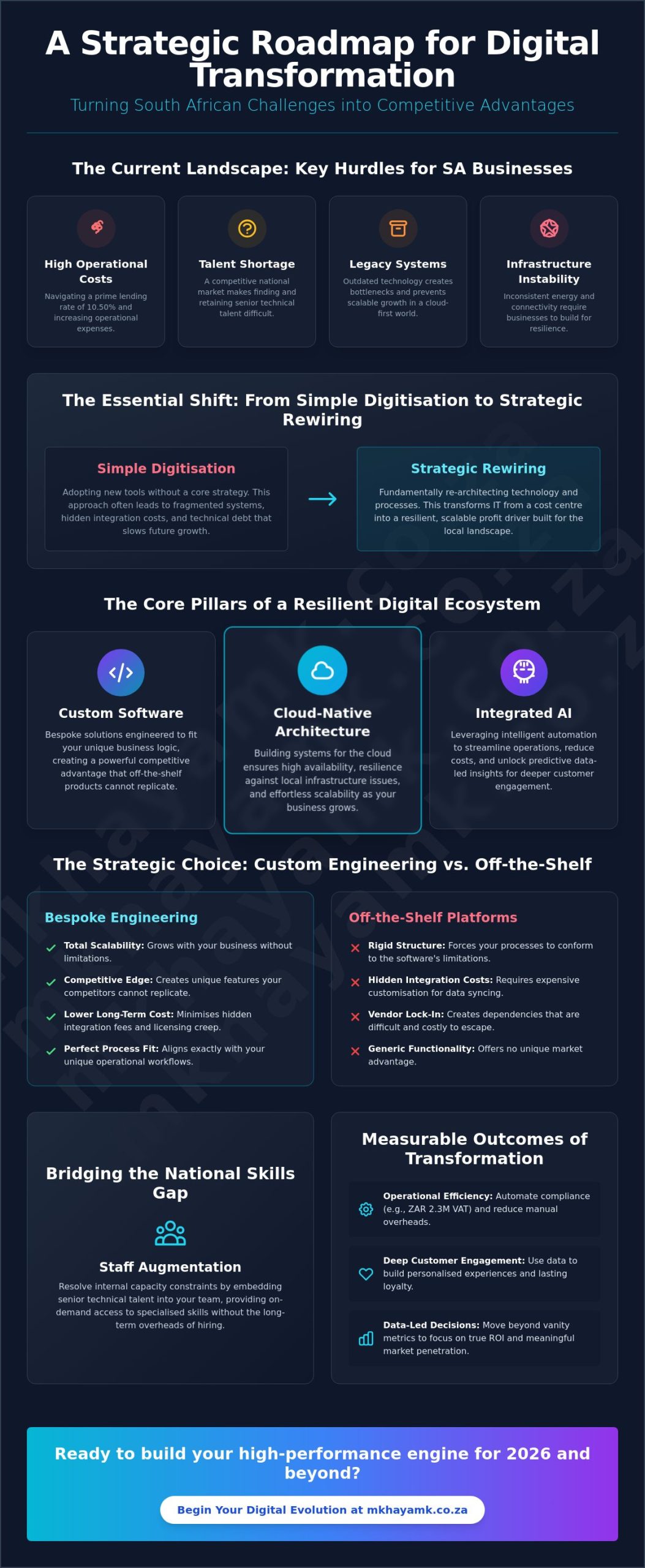
What if the very infrastructure challenges currently slowing your operations down could become the catalyst for your most significant competitive advantage? It’s a sentiment many South African leaders share. You’re likely dealing with high operational costs and a frustrating shortage of local technical talent, all whilst trying to scale using legacy systems that weren’t built for a cloud-first economy. Achieving sustainable business growth with digital transformation south africa requires more than just adopting new tools. It demands a resilient orchestration of technology that works around local hurdles and builds long-term stability.
We understand that navigating a prime lending rate of 10.50% and persistent infrastructure instability requires a partner who values methodical execution over flashy claims. This guide shows you exactly how to leverage bespoke software, integrated AI, and robust cloud solutions to drive measurable growth within our unique economic landscape. We’ll preview the strategic shifts needed to turn your technical debt into a scalable, high-performance engine. By the end of this article, you’ll have a clear roadmap for modernising your operations and securing a dominant position in the national market through 2026 and beyond.
Key Takeaways
Understand why strategic rewiring, rather than simple digitisation, is the primary driver of modern business evolution in South Africa.
Identify how to integrate custom software, cloud services, and AI to build a resilient ecosystem that thrives despite local infrastructure challenges.
Compare the long-term value of bespoke engineering against rigid off-the-shelf platforms to minimise hidden integration costs while scaling.
Resolve internal capacity constraints by leveraging staff augmentation to access senior technical talent in a competitive national market.
Discover how to achieve measurable business growth with digital transformation south africa through a collaborative, end-to-end partnership.
Navigating the Digital Frontier: Why Transformation is the Engine of South African Business Growth
In 2026, digital transformation isn’t merely about adopting new software; it’s a fundamental strategic rewiring of your entire organisation. For local firms, the shift from simply “going digital” to “optimising for growth” marks a significant turning point in how we approach the market. This evolution is the primary engine behind business growth with digital transformation south africa, allowing agile enterprises to bypass traditional development hurdles that once slowed down expansion. By integrating technology into the core of your business model, you create a foundation that’s both resilient and ready for rapid scaling.
To better understand how these shifts impact small and medium enterprises in our local context, watch this insightful discussion:
The South African Business Landscape in 2026
The national ecosystem has reached a level of maturity where fintech integration is seamless and expected. Local firms now use technology to mitigate infrastructure challenges, such as energy instability or inconsistent connectivity, by building more resilient, cloud-optimised systems. This is supported by the R50 billion commitment to data centres announced in the 2026 State of the Nation Address, which provides the backbone for modern services. However, success also depends on addressing the digital divide in South Africa. Inclusive strategies ensure your services reach a broader national audience, turning social responsibility into meaningful market penetration.
Defining Measurable Growth in a Digital Economy
Growth must be measurable to be meaningful. We’ve moved beyond vanity metrics like website hits to focus on actual ROI and substantial cost reduction. Digital agility allows your business to pivot whilst your competitors remain stagnant, tied down by rigid, outdated structures. This level of digital transformation creates a direct correlation between technical maturity and corporate accountability. With the VAT registration threshold now at ZAR 2.3 million as of April 2026, businesses need precise data automation to manage compliance and operational scaling effectively. Every technical investment should build long-term value and support your journey toward becoming a market leader.
The Core Pillars of a Resilient Digital Ecosystem: Custom Software, Cloud, and AI
Building a resilient digital ecosystem requires more than just purchasing tools; it involves orchestrating three core technologies: custom software, cloud-native architecture, and intelligent automation. These pillars shouldn’t exist in isolation. Instead, they must be integrated to form a cohesive foundation that supports business growth with digital transformation south africa. Recent analysis of the state of digital transformation in South Africa suggests that whilst many firms have begun their journey, those who achieve the highest ROI are the ones moving away from fragmented legacy systems toward unified, agile environments.
Bespoke Software Engineering for Competitive Advantage
Off-the-shelf platforms often fail to account for the specific regulatory and operational nuances of our local market. Our software engineering services focus on building tools that mirror your unique workflows rather than forcing you to adapt to rigid templates. This precision ensures that every feature serves a commercial purpose. Additionally, investing in high-end UI/UX design isn’t just about aesthetics; it’s a practical strategy to drive user adoption amongst your staff and customers, directly impacting internal efficiency and market penetration.
AI and Data Automation: Optimising the Human Element
AI integration has shifted from experimentation to execution. By implementing AI & data automation, businesses can free their teams from repetitive tasks, allowing them to focus on high-value strategy. In sectors like logistics and finance, AI is already being used to optimise routing and detect fraud in real-time. Predictive analytics takes this a step further, identifying emerging growth opportunities by analysing national market trends before they become obvious to competitors. This data-led approach is a critical component of business growth with digital transformation south africa, turning raw information into a roadmap for expansion.
Cloud Migration: Building for Stability and Scale
With cloud services projected to have a compound annual growth rate of 27%, the move toward hybrid and multi-cloud environments is essential for stability. Cloud-native architectures provide the resilience needed for 24/7 operations, especially whilst dealing with local infrastructure challenges. This transition allows for national scalability that on-premise systems simply can’t match. By adopting DevOps practices, you accelerate your software delivery cycles, ensuring your business remains agile. If you’re ready to modernise your infrastructure, exploring our cloud solutions is a logical first step toward long-term stability.
Strategic Choice: Custom Engineering vs Off-the-Shelf Solutions for Scaling
Deciding between bespoke engineering and off-the-shelf software is one of the most critical choices for achieving business growth with digital transformation south africa. Whilst a ready-made platform might seem like a faster route to market, the five-year total cost of ownership (TCO) often tells a different story. Rigid platforms frequently carry a hidden “integration tax,” where your team spends more time forcing the software to work with local processes than actually using it to scale. This friction eventually slows down your momentum and increases operational costs.
Custom software allows you to build proprietary business processes directly into your technical architecture. This creates a unique competitive advantage that rivals cannot simply buy or replicate. By focusing on long-term stability and methodical execution, you ensure that your technical debt remains low whilst your ability to innovate remains high. It’s about building a stable anchor for your business in a rapidly changing technological landscape.
When Off-the-Shelf Falls Short
Generic ERPs often struggle with the specific regulatory and economic nuances of South African sectors. For example, a standard financial platform might not handle the specificities of local credit risk or interest rate fluctuations with the precision required. This is why many firms opt for custom loan management systems that are built to handle our specific market dynamics from the ground up. Relying on generic tools also risks “vendor lock-in,” where escalating licensing fees eat into your margins as your user base grows, making it harder to maintain a lean operation.
The ROI of Custom Development
Owning the intellectual property (IP) of your core systems provides a level of corporate stability that subscription models cannot offer. Custom applications allow you to tailor your infrastructure to specific local compliance standards, such as the VAT registration threshold increase to ZAR 2.3 million that took effect in April 2026. Bespoke engineering ROI is defined by the ability to adapt your technical infrastructure at the same pace as your commercial ambitions without being restricted by a third-party roadmap. This level of control ensures that your technology remains an asset that supports your journey, rather than a rigid framework that limits your potential for expansion.
Bridging the Skills Gap: Staff Augmentation and Agile Implementation
South Africa’s technical talent pool is currently under immense pressure. As firms strive for business growth with digital transformation south africa, they often encounter a stark reality: a national shortage of senior developers and data scientists. This gap can stall even the most ambitious scaling plans, leaving businesses with technical debt and missed opportunities. Rather than waiting months to fill a permanent role whilst competitors move ahead, visionary leaders are turning to flexible models that prioritise momentum and precision. It’s about finding a stable anchor in a talent market that is rapidly changing.
Execution requires a structured rhythm to ensure long-term stability. Bringing in specialised talent on a project basis allows you to maintain a lean operation whilst still accessing high-end expertise. This is where agile methodologies become indispensable. By breaking complex transformation projects into manageable sprints, you ensure that every technical investment remains on track and aligned with your commercial goals. This methodical approach reinforces your image as a detail-oriented and reliable partner in your own company’s evolution.
How Staff Augmentation Accelerates Growth
Staff augmentation allows you to extend your internal capabilities without the heavy overhead of traditional recruitment. By integrating specialised professionals into your existing teams, you drastically reduce recruitment overhead and time-to-hire for critical roles. This is particularly effective in our hybrid work era, where access to both remote and on-site experts ensures your project remains adequately resourced. Our staff augmentation services provide the technical depth needed to execute complex builds without the long-term liability of expanding your permanent payroll. This approach is a practical way to maintain agility whilst managing the current 10.50% prime lending rate, ensuring every technical spend delivers immediate value.
A Roadmap for Successful Digital Implementation
Navigating a successful transformation requires a clear, step-by-step path forward. We suggest following this logical progression to manage risk and ensure measurable results:
Step 1: Audit legacy systems. Conduct a thorough review to identify growth bottlenecks and technical debt.
Step 2: Define a phased roadmap. Break the transformation into stages to ensure early wins and manageable scaling.
Step 3: Select the right partner. Choose a visionary guide capable of executing your technical vision with quiet confidence.
Step 4: Continuous iteration. Use real-time data and user feedback to refine your systems and support long-term growth.
If you’re ready to bridge your internal skills gap and accelerate your project timelines, connect with our team today to explore how our specialised talent can support your strategic vision.
Partnering for Success: How Mkhaya MK Drives Sustainable Digital Evolution
Achieving sustainable business growth with digital transformation south africa is not a solo endeavour. It requires a visionary guide who understands the intricate balance between technical precision and the unique commercial realities of our national market. At Mkhaya MK, we position ourselves as that stable anchor, offering a partnership rooted in transparency and methodical execution. Our end-to-end digital transformation services are designed to move your organisation from a state of reactive maintenance to one of proactive, scalable innovation. We value quiet confidence over flashy claims, ensuring that every project we undertake is grounded in practical results that you can measure and rely upon for years to come.
A Proven Portfolio of Enterprise Solutions
Our commitment to your success is reflected in a diverse portfolio of enterprise solutions that solve real-world problems. We’ve developed specialised tools such as our Facility Management System and Learner Management System to address the specific operational hurdles local organisations face daily. For enterprises looking to refine their supply chain and maximise their margins, our Optimate procurement platform provides the visibility and control needed to reduce waste and improve efficiency. This stability is further reinforced by our long-term commitment to managed cloud and DevOps support, ensuring your infrastructure remains resilient whilst you focus on high-level strategy. Every tool we build is a step toward a more refined and constructed business model.
Taking the Next Step Toward Scalable Growth
We believe that a collaborative partnership model leads to far better outcomes than a traditional, detached vendor-client relationship. By working as an extension of your own team, we ensure that the entire development process is marked by integrity and a deep investment in your long-term success. This approach allows us to build systems that aren’t just technically sound but are also deeply aligned with your personal journey as a business leader. It’s time to turn the strategic concepts and technologies discussed in this guide into a concrete path forward. Business growth with digital transformation south africa is within your reach when you have the right technical ally at your side to navigate the complexities of the 2026 landscape. Contact our team today to begin a strategic consultation and discover how we can help you build a more resilient future.
Securing Your Competitive Edge in the 2026 Landscape
The journey toward 2027 requires more than just technical adoption; it demands a fundamental shift in how you view your infrastructure. By prioritising bespoke engineering and resilient cloud architectures, you move beyond the limitations of rigid legacy systems. This strategic rewiring is the most reliable path to achieving sustainable business growth with digital transformation south africa. We’ve explored how bridging the skills gap through staff augmentation ensures your projects remain on track, even whilst navigating a complex national talent market.
Mkhaya MK brings end-to-end software engineering expertise and deep local market insight to every partnership. Whether you require specialised products for loan, facility, or learner management, our focus remains on precision and long-term stability. We act as a stable anchor for your ambitions, providing the technical depth needed to turn visionary concepts into measurable results. It’s time to build a foundation that supports your scaling goals for years to come.
What is the first step in digital transformation for a South African business?
The first step is a comprehensive audit of your current legacy systems to identify specific growth bottlenecks. This process allows you to understand exactly where technical debt is hindering your expansion. Once you’ve mapped these inefficiencies, you can define a phased roadmap that prioritises high-impact changes. This methodical beginning ensures that your technical investments align with your commercial objectives from day one.
How long does it typically take to see ROI from custom software development?
ROI from custom software is typically realised over a three-to-five-year period as you avoid the integration tax of off-the-shelf platforms. Whilst initial development costs require investment, you own the intellectual property and avoid escalating licensing fees as you scale. Measurable business growth with digital transformation south africa often starts with immediate operational efficiencies that compound over time. Owning your core architecture provides a level of stability that subscription models simply can’t match.
Can staff augmentation help if we already have an internal IT team?
Staff augmentation is an excellent way to extend the capabilities of an existing internal team without permanent overhead. It allows you to bring in specialised senior developers or data scientists for specific projects or phases. This model is particularly effective for bridging the national skills gap during intensive development cycles. Your internal team retains control whilst benefiting from the refined expertise of external professionals who integrate seamlessly into your workflow.
Is digital transformation only for large enterprises in South Africa?
No, digital transformation is a critical driver for businesses of all sizes, including SMMEs. Smaller firms often have the agility to leapfrog traditional development stages more quickly than large corporations. By adopting cloud-native architectures early, SMMEs can compete on a national level with minimal physical infrastructure. It’s about using technology to level the playing field and secure a dominant position in your specific niche.
How does Mkhaya MK ensure the security of cloud-based applications?
We secure cloud-based applications through a combination of cloud-native architectures and rigorous DevOps practices. This includes continuous monitoring and automated security protocols that protect your data against the rising average of 2,204 cyberattacks per week seen in early 2026. Our focus is on building a stable anchor for your operations. We ensure that your digital assets remain protected whilst you focus on scaling your core business.
What is the difference between a facility management system and a generic ERP?
How can AI-driven automation reduce operational costs for my business?
AI-driven automation reduces costs by handling repetitive operational tasks that currently consume your team’s time. By implementing AI & data automation, you free up human talent for high-value strategic work. In sectors like logistics, AI optimises routing to reduce fuel consumption, whilst in finance, it provides real-time fraud detection. These efficiencies lead to a leaner operation and more predictable business growth with digital transformation south africa.
Why is UI/UX design critical for the success of a digital transformation project?
UI/UX design is critical because the success of any digital tool depends entirely on user adoption. If your staff or customers find a system difficult to navigate, the investment fails to deliver its intended value. High-quality design ensures that your software is intuitive and efficient, which directly impacts internal productivity. Precision in the user interface turns complex technical capabilities into a seamless experience for all stakeholders.