

Inventory Management System South Africa: A Strategic Guide for 2026
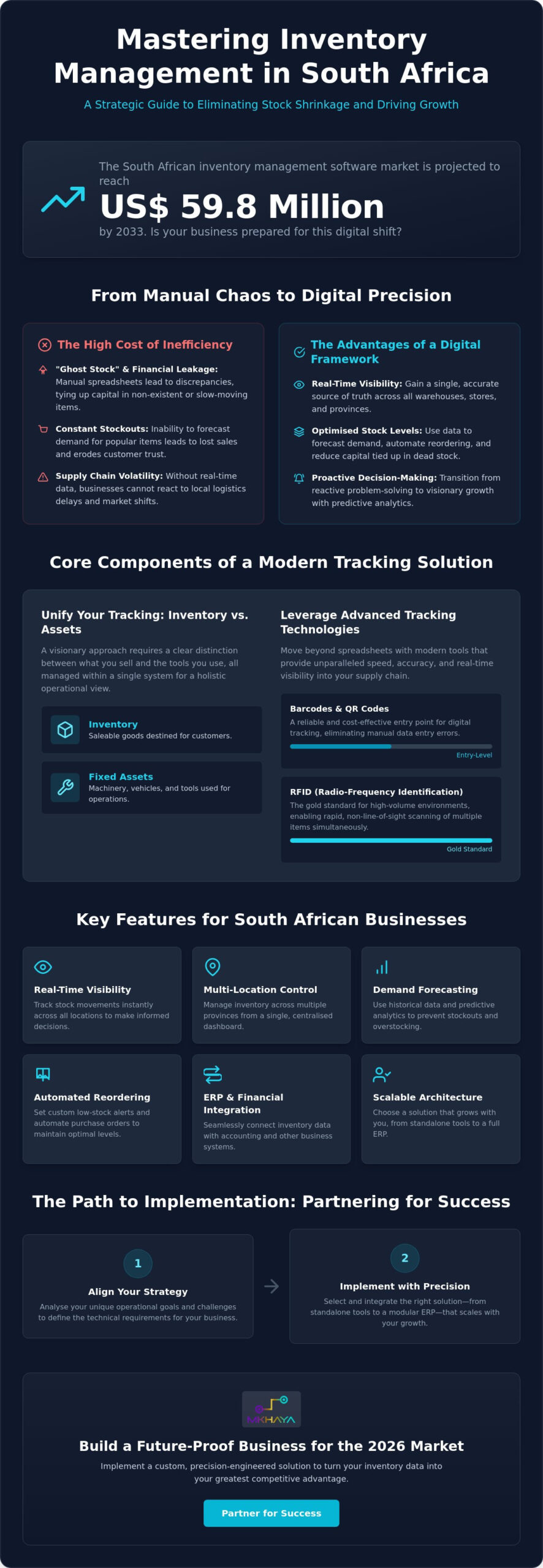
The South African inventory management software market is projected to reach US$ 59.8 million by 2033, yet many local enterprises still struggle to find the right inventory management system south africa to prevent stock shrinkage. You likely feel that traditional ways of counting boxes are failing to keep pace with a rapidly changing economy. It’s a common frustration when valuable capital is tied up in slow-moving stock while your most popular items face constant stockouts. We understand that building a reliable business requires more than just luck; it requires precision and a partner who values your long-term stability.
This guide will help you implement a robust strategy tailored to these unique local challenges. You’ll discover how to optimise your supply chain, reduce unexplained losses, and move towards a more precise, data-driven future. We’ll walk through the essential steps of achieving real-time visibility across multiple locations and automating your reordering processes. By the end of this article, you’ll have a clear roadmap for integrating these tools with your existing financial or ERP systems to ensure your business remains a stable, forward-looking anchor in the 2026 market.
Key Takeaways
- Eliminate “ghost stock” and financial leakage by moving beyond manual spreadsheets to a strategic digital framework.
- Gain real-time visibility by integrating advanced tracking technologies like RFID and QR codes for both saleable stock and fixed assets.
- Scale with confidence by choosing between standalone tools and modular ERP systems that grow alongside your business requirements.
- Optimise operations across multiple provinces using a modern inventory management system south africa designed for demand forecasting and multi-location control.
- Implement a precision-engineered solution through a methodical two-step process that aligns your technical stack with your unique operational goals.
Understanding Inventory Management Systems in the South African Context
Inventory management is far more than a simple tally of items on a shelf. It’s the strategic discipline of overseeing the entire flow of goods, from the initial manufacturer to the warehouse and finally to the point of sale. In our local market, establishing a robust inventory management system south africa ensures that your operational rhythm remains steady despite external pressures. By centralising data, your business can transition from reactive firefighting to proactive, visionary growth. Precision in this area is the foundation of a reliable supply chain.
To better understand how these systems function in a real-world warehouse environment, watch this helpful video showing a local success story:
For many local enterprises, manual spreadsheets remain the default tool for tracking. However, these static records are the primary cause of “ghost stock” (items that appear in the system but don’t exist in reality) and significant financial leakage. South African businesses face unique hurdles, including supply chain volatility and frequent logistics delays. Without modern inventory management software, these bottlenecks become insurmountable. Digital transformation provides the necessary transparency to secure your stock and protect your margins in a fluctuating economy.
The High Cost of Inefficient Stock Control
Inefficiency carries a heavy price tag. Dead stock drains your cash flow and occupies valuable warehouse space that should be reserved for high-velocity items. Efficiency breeds confidence. In our competitive national market, stockouts do more than lose a single sale; they erode the customer trust you’ve worked hard to build. Integrating a comprehensive ERP solution provides the oversight needed to mitigate these risks by linking inventory data directly to your broader financial operations.
Why 2026 is the Year for Digital Migration
Cloud-based systems are now essential for multi-location South African enterprises because they provide a single source of truth accessible across provincial borders. We’re seeing a decisive shift towards data-driven decision-making in the local retail and manufacturing sectors. Investing in custom software development allows businesses to build bespoke tools that turn inventory data into a distinct competitive advantage. A tailored inventory management system south africa provides the agility needed to respond to market shifts instantly, ensuring long-term stability and precision for your brand.
Core Components of a Modern Asset Tracking Solution
A common oversight in operational planning involves treating saleable stock and operational tools as a single category. A visionary approach requires a clear distinction between inventory, which represents goods destined for customers, and assets, which include the machinery, vehicles, and tools used to deliver them. By implementing a unified inventory management system south africa, you gain a holistic view of both stock levels and fixed assets. This clarity prevents the accidental depletion of sales stock whilst ensuring that your essential equipment remains accounted for and maintained.
The modern technology stack has evolved far beyond simple spreadsheets. Barcoding and QR codes offer a reliable entry point for digital tracking, but RFID (Radio Frequency Identification) has become the gold standard for high-volume environments. These tools provide the real-time visibility necessary to manage complex supply chains. For a deeper look at the fundamentals, this inventory management guide for South African businesses highlights how local enterprises are leveraging these technologies to stay competitive. Using a robust asset tracking solution south africa ensures that your high-value equipment is monitored across national logistics routes, reducing the risk of loss during transit.
Traceability is no longer optional in sectors such as food, beverage, and electronics. Regulatory compliance requires a precise record of an item’s journey from origin to destination. A sophisticated system captures this data automatically, allowing you to respond to audits or recalls with absolute confidence. Reliability in these moments protects your brand’s reputation and ensures long-term stability.
Real-Time Visibility with RFID and IoT
IoT sensors represent the next frontier in stock control. These devices monitor the condition of sensitive inventory, such as temperature or humidity levels, during long-haul transit across South Africa. RFID technology complements this by allowing warehouse staff to scan entire pallets in seconds without needing a direct line of sight. When you integrate AI and data automation, the system can process this tracking data to predict maintenance schedules or reorder needs before a crisis occurs.
The Role of Mobile Applications in the Warehouse
Empowering your team with mobile-first software transforms the warehouse floor. Staff can perform instant stock takes and update records on the move, which significantly reduces the human error associated with manual tallying. The success of these tools depends heavily on intuitive UI/UX design. If the interface is clear and purposeful, your team is more likely to embrace the system, leading to more accurate data and smoother daily operations. If you are ready to build a more resilient operation, our team can help you customise a solution that fits your specific workflow.
Inventory Management vs. ERP: Choosing the Right Strategy
Deciding between a standalone inventory management system south africa and a full-scale Enterprise Resource Planning (ERP) platform is a pivotal moment for any growing business. While standalone tools focus purely on stock levels, an ERP integrates these figures with your financial, sales, and human resources data. This creates a single source of truth that eliminates the friction of moving data between disconnected silos. Research into inventory management practices for South African SMMEs suggests that many local businesses suffer when their systems don’t communicate effectively. By choosing an integrated path, you ensure that every sale immediately reflects in your balance sheet and procurement schedule.
A common concern is that an ERP might be too complex or overwhelming for a medium-sized operation. We believe in a modular approach where you only implement the features you need today. You can start with core inventory and finance modules, then expand as your operational footprint grows. This strategy ensures you aren’t paying for unnecessary features while maintaining a clear path toward operational excellence through a unified digital ecosystem. It’s about building a stable anchor for your business that remains agile as your needs evolve.
When to Opt for Bespoke Software Development
Off-the-shelf software often forces your business to adapt to its rigid workflows, rather than the other way around. If you find your team working around the system or struggling with a lack of local tax compliance features, it’s time to consider a custom route. Through precise software engineering, we build bespoke modules that mirror your specific warehouse layout and unique handling requirements. Custom systems offer the long-term stability of owning your intellectual property without the burden of escalating per-user licensing fees as your staff count increases. This approach allows for a solution that fits your business like a glove.
Integrating Procurement and Supplier Management
Your inventory levels shouldn’t exist in a vacuum. A truly strategic inventory management system south africa talks directly to your suppliers to ensure seamless replenishment. When stock hits a pre-defined reorder point, the system can automatically generate and send purchase orders to your preferred vendors. Using a tool like the Optimate procurement platform streamlines these external relationships by centralising supplier communication. This allows for effortless electronic comparisons, ensuring you always secure the best value for your procurement spend whilst maintaining optimal stock levels. Automation in this area reduces manual errors and frees your team to focus on higher-level strategy.
Key Features to Look For in a South African Inventory System
We also recommend prioritising automated reorder alerts. By setting specific “par levels”, your inventory management system south africa can notify you the moment stock drops below a safe threshold. This prevents out-of-stock scenarios for your best-selling items and maintains a steady rhythm of trade. Seamless integration capabilities are the final piece of the puzzle. Your inventory data should flow effortlessly into your accounting software, such as Xero or Sage, and connect with your facility management systems to create a unified operational environment.
Reporting and Analytics for Informed Decisions
Meaningful data is the fuel for strategic growth. A modern system should offer detailed reports, such as stock turnover ratios and ABC analysis, which categorises items based on their value and frequency of sale. Accessing these insights from anywhere in the country is made possible through cloud application services. Data-driven insights lead to better cash flow management by identifying exactly where your money is tied up on the shelves.
Security and Access Control
Protecting your assets requires more than just physical locks. Role-based access control is essential to prevent internal theft and ensure that only authorised personnel can make data changes. Detailed audit trails provide a clear record of every transaction, helping you identify the source of any stock discrepancies with absolute precision. We often find that digital transformation consulting is the best way to align these software security features with your internal business policies. If you’re ready to secure your supply chain, reach out to us to discuss your specific requirements.
The Path to Implementation: Partnering for Success
Implementing an inventory management system south africa is a deliberate journey that requires a steady hand and a clear roadmap. The first step involves a comprehensive audit of your existing stock-taking processes to pinpoint exact pain points, such as where manual errors most frequently occur or where shrinkage is highest. Once these gaps are identified, you must decide between bespoke custom development or a specialised tool like a loan management system or a broader ERP. This choice defines your operational foundation and should align perfectly with your long-term business goals.
Data integrity remains the most critical factor during the transition phase. You must rigorously clean your records before migration to ensure the new system starts with precise, verified figures. Moving messy or outdated data into a new environment only replicates old problems and erodes staff confidence. Training your team is equally vital; a system is only as effective as the people using it. If your internal team is stretched thin, utilising staff augmentation can provide the temporary technical expertise needed to lead a seamless transition without disrupting your daily operations.
Finally, the implementation phase moves into a cycle of monitoring and iteration. Success isn’t a one-time event but a continuous process of refinement. As your business grows, your system should scale alongside it, effortlessly adapting to new warehouse locations, diverse product lines, or changing regulatory requirements. This iterative approach ensures that your technology remains a high-performance asset rather than a legacy burden. For financial service providers looking to apply similar automation principles to their credit operations, exploring an automated loan processing system south africa can deliver comparable gains in efficiency and compliance. Lenders navigating the complexities of NCR compliance and the COFI Bill will also find that selecting the right loan management system south africa is equally critical to building a scalable, regulation-ready operation.
Why Mkhaya MK is Your Strategic Guide
We position ourselves as a visionary yet practical guide in your digital journey. Our approach values transparency and methodical execution over flashy, unsubstantiated claims, ensuring that every solution we build is rooted in your actual business needs. We bring a “quiet confidence” to every project, born from a deep understanding of the South African technological landscape and the unique challenges local businesses face. You can learn more about our commitment to integrity and mutual success on our about us page.
Next Steps: From Vision to Execution
Moving from a broad vision to concrete execution requires a dedicated partner who is invested in your personal journey. We invite you to a strategic consultation to map out your specific inventory needs and identify the most reliable path forward for your enterprise. Our solutions are built for long-term stability and scalability, acting as a stable anchor in a rapidly changing market. Visit our contact us page to begin your personalised assessment and secure your operational future.
Securing Your Operational Future
Establishing a robust inventory management system south africa is the definitive step toward long-term stability in an increasingly complex market. We’ve explored how moving beyond manual spreadsheets to digital precision protects your margins and builds lasting customer trust. By choosing a modular approach to technology, you ensure that your business remains agile, scalable, and ready for the challenges of 2026. Precision in stock control isn’t just about efficiency; it’s about building a reliable foundation for your brand’s legacy.
Our team provides end-to-end digital transformation expertise and specialised proprietary products like Optimate and MkhayaMove to support your national reach. We focus on delivering operational stability through methodical execution and transparent partnership. Partner with Mkhaya MK to build your future-proof inventory ecosystem. Together, we can transform your supply chain into a visionary asset that drives mutual success for years to come.
Frequently Asked Questions
What is the best inventory management system for a South African SME?
The best inventory management system south africa for an SME is one that offers modular scalability to grow alongside your business requirements. While off-the-shelf options exist, a system that integrates with local tax requirements and your specific logistics chain provides the greatest long-term stability. It should focus on ease of use for your warehouse team whilst providing deep analytical insights for management to make informed decisions.
How does an asset tracking solution differ from basic inventory software?
Basic inventory software tracks items intended for sale, whereas an asset tracking solution monitors the fixed equipment and tools used to run your business. A unified system allows you to manage both saleable stock and operational assets like vehicles or machinery in one place. This distinction is vital for maintaining an accurate balance sheet and ensuring your operational tools are always maintained and ready for use.
Can I integrate my inventory system with my existing accounting software?
Integration with accounting software like Xero or Sage is a standard feature of a modern inventory management system south africa. This connection ensures that every stock movement is automatically reflected in your financial records, which eliminates the need for manual data entry. It reduces the risk of human error and provides a real-time view of your business’s financial health across all provincial locations.
How much does it cost to implement a custom inventory management system in South Africa?
Implementation costs depend entirely on the scope of your requirements, the number of modules chosen, and the level of customisation needed for your workflow. We focus on building solutions that provide a clear return on investment by reducing shrinkage and improving operational efficiency. Each project is priced based on the specific technical support and features your business requires to achieve its strategic goals.
What are the benefits of using RFID for stock control in local warehouses?
RFID technology allows for the rapid scanning of entire pallets or shelves without requiring a direct line of sight to each individual barcode. This significantly reduces the time required for monthly stock takes in large warehouses, leading to lower labour costs and higher data accuracy. It’s an ideal solution for high-volume environments where speed and precision are essential for maintaining a competitive edge in the local market.
How do I prevent stock shrinkage using digital tools?
Digital tools prevent shrinkage by providing real-time visibility and detailed audit trails for every item in your facility. Automated alerts notify you of unexpected stock movements, while role-based access control ensures that only authorised staff can adjust inventory levels. These features create a culture of transparency and accountability, making it much easier to identify and address the source of any discrepancies with absolute precision.
Is cloud-based inventory software secure for my business data?
Cloud-based software is highly secure because it utilises advanced encryption and redundant data centres that are often more resilient than local servers. Your data is protected against physical hardware failure and local security breaches, ensuring that your business information remains accessible only to authorised users. Regular automated backups provide additional peace of mind, allowing you to focus on growth rather than worrying about technical maintenance.
How long does it take to migrate from manual spreadsheets to an automated system?
Migration typically takes between four weeks and three months, depending on the volume of your data and the cleanliness of your current records. A successful transition relies on a methodical approach that includes data auditing, staff training, and rigorous testing. We work closely with your team to ensure the move from manual spreadsheets to an automated system is smooth and does not disrupt your daily operations.