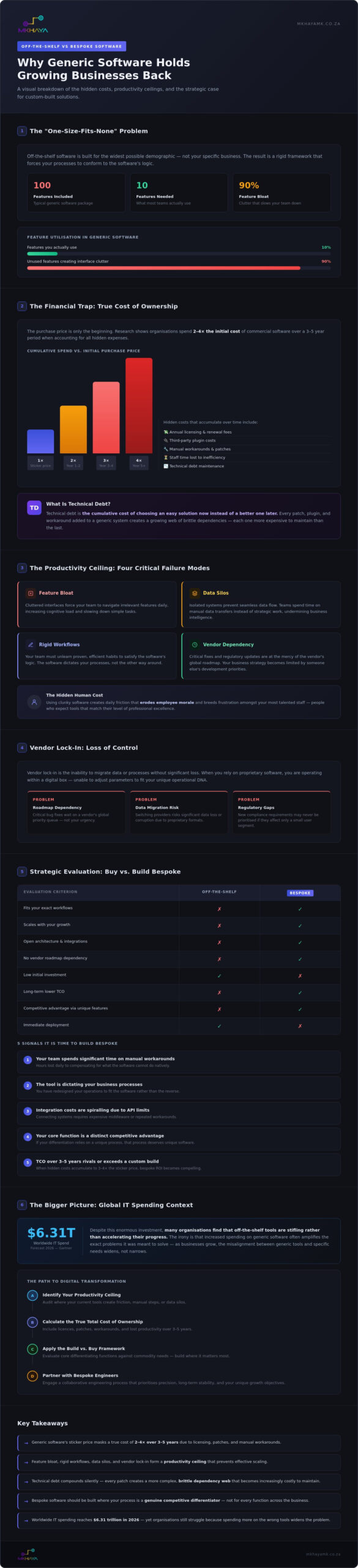
Why is it that the more your business grows, the more your digital tools seem to hold you back? You likely chose your current systems for their convenience, yet you are now spending your afternoons managing data silos and creating manual workarounds for missing features. It is a common frustration; whilst Gartner forecasts worldwide IT spending to reach $6.31 trillion in 2026, many organisations are finding that the problems with off-the-shelf software limitations are actually stifling their progress. When you spend up to four times the initial cost of a generic package just to keep it functional, the productivity ceiling becomes a very real obstacle to your success.
We believe that technology should be a catalyst for your ambition, not a constraint. In this article, you will learn how to identify the exact moment your generic tools become a liability and how bespoke engineering provides the scalability your business requires. We will provide a clear understanding of why your current software is failing, alongside a framework to justify the long-term return on investment for custom development. This is your path toward a seamless digital transformation that ensures your technology remains a stable anchor as you scale.
Recognise why the initial purchase price of generic software often masks a much higher Total Cost of Ownership (TCO) driven by technical debt and inefficient manual patches.
Identify how the problems with off-the-shelf software limitations, such as feature bloat and rigid frameworks, create a productivity ceiling that prevents your organisation from scaling effectively.
Explore how to dismantle data silos by moving beyond restrictive API limits toward an open architecture that supports seamless integration and reliable business intelligence.
Apply a practical evaluation framework to determine when to build bespoke solutions for core business functions that provide a distinct competitive advantage.
Visualise a path toward digital transformation through a collaborative engineering process that prioritises precision, long-term stability, and your unique growth objectives.
Commercial Off-the-Shelf (COTS) software is often presented as a rapid solution for immediate operational needs. It is a mass-market, rigid framework built to cater to the widest possible demographic rather than the specific nuances of your business. Whilst this accessibility is tempting, it frequently introduces systemic problems with off-the-shelf software limitations that surface just as your organisation gains momentum. By relying on proprietary software, you are effectively operating within a digital box where you cannot adjust the parameters to fit your unique operational DNA.
This lack of control stands in stark contrast to the precision required by modern enterprises. When your software dictates your processes rather than the other way around, you lose the agility needed to respond to market shifts. A generic tool might solve a surface-level problem today, but it often creates a deeper technical debt that hinders long-term stability. It’s about moving from a state of compromise to a state of construction where every tool serves a specific, high-value purpose and supports your future ambitions.
To better understand this concept, watch this helpful video:
The “One-Size-Fits-None” Reality
Investing in a software suite with 100 features when your team only requires 10 is more than just a financial waste; it is a strategic error. This “feature bloat” clutters the user interface, making simple tasks feel unnecessarily complex and unintuitive. When generic workflows force your team to unlearn efficient, proven habits just to satisfy a software’s logic, overall productivity suffers. There is also a psychological toll to consider. Using “clunky” software leads to daily friction that erodes employee morale and breeds frustration amongst your most talented staff, who expect tools that match their level of professional excellence.
Vendor Roadmap Dependency
Your business growth should be dictated by your own vision, not a third-party developer’s schedule. When a critical bug appears or a new regulatory requirement emerges, you are at the mercy of the vendor’s roadmap. If your specific needs aren’t a priority for their global user base, you are left waiting indefinitely for updates that may never come. This dependency means your business strategy is effectively limited by someone else’s development priorities. Vendor lock-in is the inability to migrate data or processes without significant loss. To break free from these constraints, many leaders are turning to custom software engineering to regain total control over their digital destiny.
Many businesses view the initial purchase price of a software package as the primary financial factor. This is a narrow perspective that often masks the true scale of the investment. The problems with off-the-shelf software limitations often manifest as hidden expenses that can dwarf the sticker price within just a few years. Research indicates that organisations may spend between two and four times the initial cost of commercial software when factoring in licensing, customisation, and the inevitable manual workarounds required to keep the system functional over a three-to-five-year period.
This financial strain is compounded by the accumulation of technical debt. Technical debt is the cumulative cost of choosing an easy solution now instead of a better one later. When you “patch” a generic system with third-party plugins or external scripts to fix a missing feature, you aren’t just solving a problem; you’re creating a complex web of dependencies. Over time, these patches become brittle and expensive to maintain. If you are concerned that your current stack is draining resources, exploring bespoke software engineering could reveal a more sustainable path forward where you invest in assets rather than temporary fixes.
Licensing Fees vs. True Ownership
The SaaS model is fundamentally a “renting” arrangement. Whilst it offers a lower entry point, the escalating per-user licensing fees can become a significant burden as your national team expands. For South African firms, this is often exacerbated by currency fluctuations, where a sudden dip in the Rand can lead to an unbudgeted spike in international subscription costs. In contrast, bespoke code is a capital asset. Whilst custom-built software requires a higher upfront investment, it typically becomes more cost-effective than off-the-shelf solutions after two to four years of use, as you no longer pay for features you don’t use or seats you haven’t filled.
The Cost of Workarounds and Manual Overrides
The most insidious cost of generic software is the direct revenue loss caused by a lack of automation. When systems refuse to communicate, your team is forced to build “Excel-based” bridges to move data between departments. Every hour spent on manual data entry is an hour lost to high-value strategic work. These manual overrides also introduce human error, which can lead to “expensive enough” mistakes in billing or inventory management. Even the highlights the significant risk management and compliance burdens placed on organisations that choose non-custom solutions for high-stakes environments. Choosing a “good enough” solution today often leads to a productivity ceiling that prevents you from reaching your full commercial potential tomorrow.
As your operations expand, the digital infrastructure supporting them must adapt. Generic solutions often rely on rigid API limits that restrict how data flows between your tools. This creates a bottleneck. Custom builds, by contrast, offer an open architecture designed for high-volume data exchange. This technical flexibility is crucial for supporting complex, proprietary business logic that off-the-shelf packages simply cannot accommodate. Whilst generic software might suffice for basic tasks, the problems with off-the-shelf software limitations become glaringly obvious when you attempt to integrate specialised workflows.
The performance lag that occurs when COTS databases are pushed beyond their limits is more than a nuisance; it is a risk to your operational stability. Mass-market databases are optimised for the average user, not for the high-concurrency demands of a growing enterprise. When your data volume increases, these systems often struggle to maintain speed, leading to time-outs and processing errors. Moving to a bespoke solution allows for a database structure tailored specifically to your data patterns, ensuring your system remains responsive regardless of your workload.
Data Silos and Failed System Communication
Working within “walled gardens” is a major source of frustration for modern leaders. If your CRM refuses to talk to your ERP or your inventory management system, you are left with fragmented data. This lack of a single “source of truth” leads to poor executive decision-making, as you are forced to rely on incomplete or outdated information. Through custom software engineering, we focus on creating a unified digital ecosystem. By building systems that are integrated by design, you eliminate the friction of data silos and ensure that every department has access to the insights they need to drive growth.
When Growth Outpaces Your Software
Rapid national expansion often reveals the fragility of closed-source platforms. These systems rarely support the addition of custom modules that reflect your unique competitive advantages. If you want to introduce a new service or a unique billing model, you might find that your software simply does not allow it. Bespoke engineering ensures that your technology is built for the future, providing the scalability required to support your long-term vision. The following table highlights the fundamental differences between these two approaches across key business metrics.
Metric
Off-the-Shelf (COTS)
Bespoke Engineering
Integration
Rigid API limits; frequent “walled garden” silos.
Open architecture; seamless cross-system communication.
Ownership
Subscription model; you rent the functionality.
Full intellectual property; the software is a company asset.
Scalability
Limited by vendor roadmap and generic database caps.
Unlimited; grows with your specific business requirements.
Deciding between a commercial package and a custom build requires a shift from reactive purchasing to strategic investment. Whilst generic tools are suitable for standard administrative tasks, they often fail when applied to the core activities that define your market position. To help you navigate this transition, we recommend a five-step framework for evaluating your current software limitations:
Identify Friction Points: Document every manual workaround or Excel bridge your team uses to bypass system constraints.
Audit Total Cost: Calculate the true expense of licensing plus the lost revenue from productivity bottlenecks.
Assess Differentiation: Determine if the process being automated is a standard utility or a unique service that sets you apart.
Evaluate Connectivity: Test whether the software can integrate seamlessly with your existing South African financial or compliance systems.
Forecast Growth: Model whether the system can handle a 20% or 50% increase in transaction volume without performance degradation.
Engaging in digital transformation consulting during this planning phase ensures that your technology roadmap aligns with your long-term commercial goals. This structured approach helps you move beyond the common problems with off-the-shelf software limitations by identifying which parts of your stack are assets and which are liabilities.
Assessing Your Competitive Advantage
A helpful way to categorise your needs is through “Core vs Context” activities. Context activities are necessary but non-differentiable utilities, such as email or basic word processing; for these, off-the-shelf software is perfectly adequate. However, your “Core” activities are what make you unique. If you use the same generic logistics or finance software as your competitors, you are effectively limited to their same operational ceiling. In the South African market, where local regulations like POPIA or specific VAT requirements demand precision, customisation allows you to out-innovate rivals by automating complex, high-volume tasks that generic tools simply cannot manage.
The Role of Staff Augmentation
The transition to bespoke engineering does not have to be a disruptive overhaul. Many organisations adopt a hybrid approach, using IT staff augmentation services to bridge the skills gap whilst building custom modules to extend existing systems. This model provides you with dedicated developers who integrate into your specific business culture and understand your unique operational nuances. By having expert oversight, you reduce the risks associated with custom projects and ensure that the final product is a stable, scalable anchor for your digital ecosystem. If you are ready to reclaim your productivity, contact our team today to begin your strategic evaluation.
Mkhaya MK serves as a visionary partner for those ready to transcend the productivity ceiling and reclaim their operational independence. We guide your organisation through an end-to-end digital transformation that begins with meticulous UI/UX design and culminates in robust cloud deployment. Rather than forcing your unique operations into a pre-defined, rigid box, we build around your specific commercial goals. For many clients, this journey starts with our flexible frameworks, such as our loan management systems, which provide a stable foundation that can be fully customised to your proprietary requirements. By choosing bespoke engineering, you eliminate the recurring problems with off-the-shelf software limitations and gain the long-term stability that only comes with owning your own source code.
Owning your intellectual property is a fundamental shift in how technology serves your business. In a landscape where global vendors frequently discontinue support for legacy features, such as the discontinuation of Salesforce to Salesforce support in mid-2026, total code ownership ensures you are never left stranded. Your software becomes a secure, private asset that you control entirely. This level of autonomy allows for a more resilient security posture, as you can implement precise protocols that meet your specific risk profile without waiting for a third-party patch.
Precision Engineering for National Scale
Designing for the South African market requires a deep understanding of local operational challenges, from navigating specific regulatory frameworks to managing unique user behaviours. Our approach is rooted in “quiet confidence” and methodical execution, ensuring that every line of code serves a practical purpose. We frequently integrate AI and data automation into these builds to maximise efficiency. This allows your team to focus on high-level strategy whilst the system handles repetitive logic with absolute precision. This synergy between custom engineering and intelligent automation creates a digital ecosystem that is both agile and resilient, capable of supporting rapid national expansion.
Taking the Next Step Toward Autonomy
Transitioning from commercial software to a custom solution is a significant investment in your company’s valuation. When you own the intellectual property, your software is a tangible asset on your balance sheet rather than a perpetual monthly expense. This provides immense peace of mind, backed by dedicated local support and maintenance that understands your specific timeline and business culture. You no longer have to wait for a global vendor to address the specific problems with off-the-shelf software limitations that hinder your progress. If you are ready to break the ceiling and secure your digital future, contact Mkhaya MK for a strategic consultation and let us build the future of your business together.
We’ve explored how the hidden costs of licensing and the persistent friction of data silos can stall your momentum. By shifting your focus toward bespoke engineering, you turn technology from a monthly expense into a high-value asset that grows alongside your organisation. Addressing the problems with off-the-shelf software limitations is the first step toward building a more resilient and scalable future where your tools finally match your ambition.
Mkhaya MK provides the end-to-end digital transformation expertise required to navigate this transition with precision. From our specialised loan and facility management systems to our national South African support network, we’re dedicated to your long-term stability and mutual success. It’s time to move beyond the constraints of generic frameworks and invest in a digital ecosystem that belongs entirely to you. We’re ready to act as your stable anchor in this rapidly changing landscape, ensuring your technology remains a catalyst for growth rather than a ceiling on your potential.
What are the main disadvantages of off-the-shelf software for a growing business?
The primary disadvantages include a lack of customisation, rigid workflows, and the inability to scale alongside unique business processes. These systems are built for the mass market, which often leads to feature bloat where you pay for tools you never use. Additionally, the problems with off-the-shelf software limitations often result in data silos, as generic packages may not integrate seamlessly with your existing South African financial or compliance systems.
Is custom software development more expensive than off-the-shelf in the long run?
Custom software is typically more cost-effective than off-the-shelf solutions after two to four years of use. Whilst the initial investment is higher, you eliminate escalating per-user licensing fees and the ongoing costs associated with manual workarounds. Research suggests businesses can spend two to four times the initial purchase price of generic software on maintenance and patches over five years, making bespoke engineering a more sustainable financial asset for your organisation.
How do I know if my business has outgrown its current software?
You’ve likely outgrown your software when your team relies on manual Excel bridges to move data between systems or when simple tasks require complex workarounds. If your current tools don’t support new service offerings or if performance lags during peak periods, you’ve reached a productivity ceiling. This transition often signals that your technology has become a constraint on your growth rather than a catalyst for your strategic ambition and forward-looking goals.
Can custom software be integrated with my existing off-the-shelf tools?
Yes, custom software is specifically designed with an open architecture to integrate seamlessly with your existing digital ecosystem. We build bespoke solutions that communicate effectively with standard tools like email or accounting packages, ensuring a unified source of truth for your business intelligence. This approach allows you to retain functional utility software whilst building custom modules for the core activities that provide your competitive advantage in the local market.
What is technical debt in the context of commercial software?
Technical debt refers to the cumulative cost and complexity created by choosing quick, generic fixes over robust, long-term solutions. In commercial software, this often manifests as a web of brittle third-party plugins and manual data overrides used to solve the problems with off-the-shelf software limitations. Over time, these patches become difficult to maintain and expensive to update, eventually requiring a complete system overhaul to restore operational efficiency and stability.
How long does it typically take to develop a bespoke software solution?
The development timeline varies based on the complexity of your requirements, but a typical bespoke project moves from initial UI/UX design to deployment over several months. We follow a highly structured, rhythmic progression to ensure each phase is fully articulated before moving to the next. This methodical approach prioritises transparency and reliability, allowing us to build a stable, high-end anchor for your business without the pressure of rushed or flashy execution.
Does Mkhaya MK provide support after the custom software is launched?
Mkhaya MK remains a deeply invested partner by providing dedicated local support and maintenance long after your solution has launched. Our relationship is built on mutual success, so we ensure your system remains agile and secure as your business evolves. This commitment includes regular updates and performance monitoring, providing the peace of mind that your digital infrastructure is managed by experts who understand your specific culture and traditional values of integrity.
Can I own the source code if I choose custom development?
You retain full ownership of the source code and all intellectual property when you choose custom development with us. This ownership transforms your software into a tangible company asset on your balance sheet, rather than a perpetual monthly subscription expense. Having control over your code ensures long-term stability and security, as you’re never at the mercy of a global vendor’s roadmap, sudden pricing changes, or discontinued feature support.
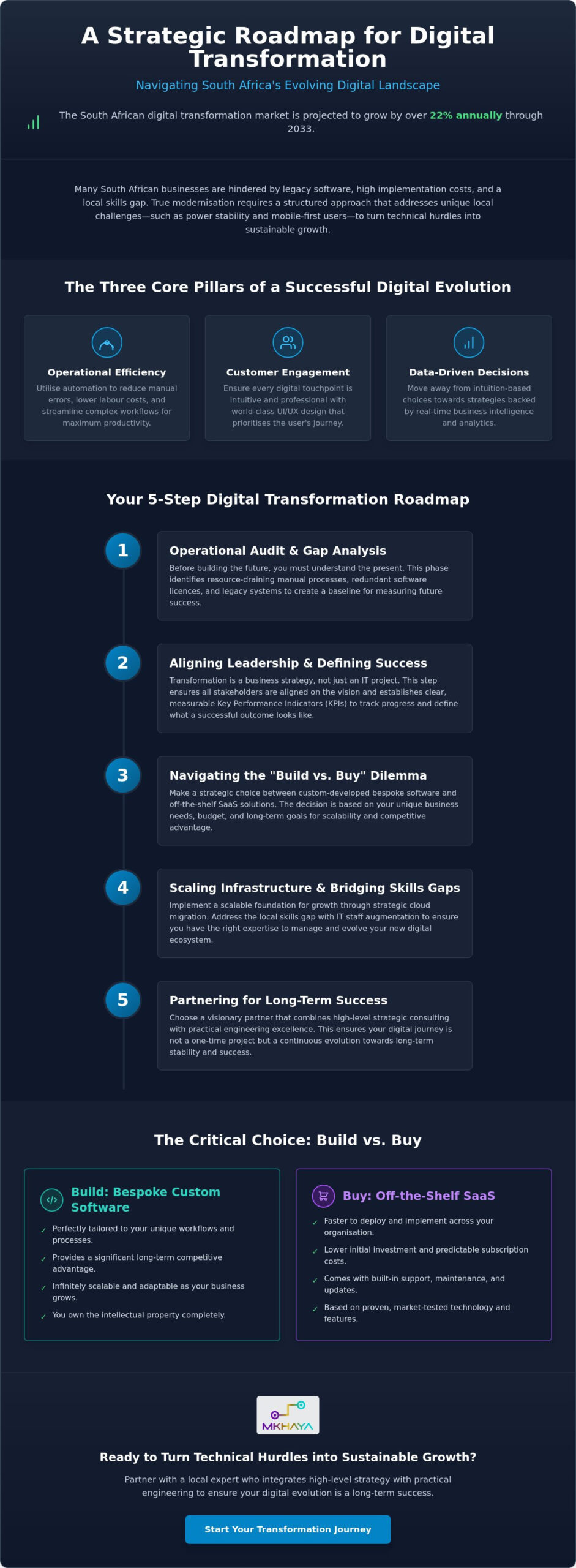
What if the very systems meant to support your business are actually the ones holding your growth hostage? With the South African digital transformation market projected to grow by over 22% annually through 2033, the pressure to evolve has never been more intense. Many local leaders find themselves trapped between legacy software that slows down operations and the high cost of failed IT implementations. If you’ve struggled to find reliable local talent or feel overwhelmed by the complexity of modernising, you aren’t alone. Partnering with the right digital transformation consulting south africa firm can turn these technical hurdles into a clear path for sustainable growth.
We understand that true modernisation isn’t about buying the newest gadget; it’s about building a stable foundation that supports your unique goals. This guide offers a practical, structured roadmap to help you navigate the transition with precision and confidence. You’ll learn how to audit your current processes, manage rising cloud costs, and implement scalable technology that actually improves efficiency. From understanding how the new R2.3 million VAT threshold affects your digital strategy to choosing the right bespoke software, we’ll walk through the essential steps to ensure your digital journey is a success.
Key Takeaways
Learn why successful digital transformation consulting south africa requires a unique balance between infrastructure resilience and mobile-first user experiences.
Discover how to conduct a thorough operational audit to identify legacy tech debt and define measurable KPIs for your modernisation journey.
Evaluate the “Build vs Buy” dilemma to decide between off-the-shelf SaaS or bespoke custom software development tailored to your specific business needs.
Explore how cloud migration and IT staff augmentation can bridge the local skills gap and provide a scalable foundation for sustainable growth.
Understand the value of a visionary partnership that integrates high-level strategic consulting with practical engineering excellence to ensure long-term stability.
What is Digital Transformation Consulting in South Africa?
At its heart, Digital transformation consulting is the strategic process of aligning modern technology with your core business objectives. It isn’t just about installing new software or moving files to a server. Instead, it involves a fundamental shift in how your organisation delivers value. In the South African context, this requires a specialised approach. Local businesses must contend with specific infrastructure challenges, such as power stability and varying connectivity speeds, whilst catering to a consumer base that is overwhelmingly mobile-first.
To better understand this concept, watch this helpful video:
The Core Pillars of a Successful Digital Evolution
Building a resilient digital foundation rests on three essential pillars. First, operational efficiency focuses on using automation to reduce manual errors and lower labour costs. Second, customer engagement ensures that every digital touchpoint feels intuitive and professional. This is achieved through world-class UI/UX design services that prioritise the user’s journey. Finally, data-driven decision making moves your leadership team away from gut-feel choices toward strategies backed by real-time business intelligence.
Why Local Expertise Matters for National Enterprises
Navigating the South African business environment requires more than just technical skill; it demands local insight. A local partner understands the intricacies of the regulatory landscape, ensuring your systems remain POPIA compliant from day one. They also help you navigate unique economic challenges, such as fluctuating exchange rates that impact software licensing costs. By choosing a partner who understands the domestic market, you ensure that your technology scales smoothly across diverse national operations without encountering regional friction or cultural misalignment.
How to Organise Your Digital Transformation Strategy: A 5-Step Roadmap
Embarking on a journey of digital transformation consulting south africa requires moving beyond vague ambitions toward a granular, actionable plan. Transformation without structure is simply expensive experimentation. By following a methodical, five-phase roadmap, you can ensure that every Rand invested produces a measurable return and supports your long-term vision. This structured approach provides the stability needed to navigate the complexities of modernising a national enterprise.
Step 1: The Operational Audit and Gap Analysis
Before you can build the future, you must understand the limitations of the present. This initial phase involves evaluating existing workflows to see exactly where manual processes are draining your resources. We often identify “shadow IT”—unauthorised software used by different departments—and redundant software licences that inflate costs without adding value. Determining which legacy systems can be modernised and which must be replaced is a critical decision. This audit creates a baseline, allowing you to measure the actual impact of your future technology investments against current inefficiencies.
Step 2: Aligning Leadership and Defining Success
Digital evolution isn’t just a technical task; it’s a cultural shift that requires total buy-in. It’s essential that the C-suite and middle management are aligned on the digital vision to prevent internal friction during implementation. We recommend creating a roadmap that delivers “quick wins” early on. These small, visible victories build organisational momentum and prove the project’s value to stakeholders. To keep your efforts focused, write a single sentence defining success for your specific business case. For instance: “Our goal is to reduce customer onboarding time by 50% through automated identity verification.”
Once the strategic foundation is set, the process moves into technical construction and continuous improvement. Phase 3 involves architecting a scalable technology stack, prioritising cloud-native solutions that offer the flexibility South African businesses need to grow. Phase 4 is the execution stage, where we use agile software engineering and iterative testing to bring the vision to life safely. Finally, Phase 5 ensures long-term stability by monitoring, measuring, and refining the digital ecosystem. This continuous feedback loop allows you to adapt to market changes whilst maintaining peak operational performance. If you’re ready to begin this journey, exploring our proven engagement methodology can help clarify the road ahead.
Navigating the Build vs Buy Dilemma in the South African Market
One of the most frequent questions we encounter in digital transformation consulting south africa is whether to invest in a ready-made platform or build a unique solution from scratch. This decision is rarely a simple “either-or” choice. Instead, it’s about finding the right balance for your specific operational needs. Many leaders worry that custom work is too expensive for a local business. However, when you consider the long-term cost of rigid licensing and the inability to adapt to local market shifts, bespoke development often proves more cost-effective over time. Hybrid models often provide the best return on investment; you might use a global accounting tool whilst building a custom layer that connects directly to your unique logistics chain.
When to Choose Off-the-Shelf ERP or Management Systems
Standard business processes that don’t provide a competitive advantage are often best served by established ERP solutions. If your requirements for payroll or basic inventory management align with industry standards, an off-the-shelf product allows for faster deployment. It’s vital to evaluate the long-term licensing costs of global platforms, which are often pegged to fluctuating foreign currencies. Always check for integration capabilities with existing South African financial tools. With the 2026 VAT registration threshold increasing to R2.3 million, ensuring your software can handle local tax compliance and SARS eFiling requirements is a non-negotiable priority for any growing enterprise.
The Strategic Advantage of Bespoke Software Engineering
Custom builds should focus on your “secret sauce”—the specific processes that make your business unique and competitive. When you invest in custom software development, you own the intellectual property rather than merely renting it. This ownership provides long-term stability and removes the risk of a third-party provider suddenly changing their terms or pricing. Bespoke applications are also designed specifically for local user behaviour. In South Africa, this means creating interfaces that function reliably despite connectivity constraints or high data costs. Whether you need a specialised loan management system or a unique procurement platform, a custom build ensures the technology fits your workflow perfectly, rather than forcing your team to adapt to a generic template.
Choosing the right path requires a partner who understands both the technical possibilities and the local economic reality. By aligning your technology choices with your long-term business goals, you create a scalable ecosystem that supports growth without unnecessary technical debt. This balanced approach ensures that your digital evolution remains agile, precise, and firmly rooted in your company’s specific needs.
Scaling Your Infrastructure: Cloud Migration and Staff Augmentation
Once you’ve defined your strategic roadmap and chosen your software path, the focus must shift to the engine room of your organisation. Scaling your infrastructure is a critical phase where theoretical plans become operational reality. In any successful digital transformation consulting south africa engagement, this step ensures that your technology can handle increased loads whilst remaining secure and cost-effective. Without a flexible, modern foundation, even the most sophisticated custom applications will struggle to deliver their full value. By modernising your back-end systems, you create a resilient environment that supports both current operations and future innovations like AI and data automation.
Foundational Cloud Migration and DevOps
Transitioning from on-premise servers to secure, scalable cloud environments is the cornerstone of modern business evolution. Utilising expert cloud migration services allows you to move away from the limitations of physical hardware toward a more agile setup. To maintain this environment, we implement DevOps services that ensure continuous integration and deployment. This approach reduces the time between a business requirement and a live technical solution. Ultimately, cloud infrastructure reduces long-term capital expenditure by shifting costs to a predictable operational model whilst increasing the agility needed to respond to sudden market changes. Once this stable foundation is in place, you can begin to layer in AI and data automation to further refine your efficiency.
Overcoming the Skills Gap with Staff Augmentation
South Africa’s technology landscape currently faces a significant shortage of specialised technical talent. This gap can often stall transformation projects just as they gain momentum. To solve this, we introduce staff augmentation as a strategic outcome of our consulting process. This model allows you to access highly skilled developers, analysts, and engineers without the heavy overhead and long lead times of permanent hiring. You can scale your internal tech team quickly to meet the intense demands of a migration or a new software launch. Crucially, this partnership ensures a steady knowledge transfer between augmented staff and your permanent employees, leaving your internal team stronger and more capable than they were before the project began.
Building a scalable infrastructure requires a blend of high-level cloud strategy and practical, hands-on engineering. If you’re ready to bridge the skills gap and modernise your technical foundation, we invite you to connect with our expert team to discuss a tailored scaling strategy for your business.
Partnering for Success: How Mkhaya MK Executes Digital Evolution
Our Comprehensive Transformation Ecosystem
Our approach encompasses every stage of the modernisation process. We move organised and seamlessly from initial digital transformation consulting to the final deployment of bespoke tools. This ecosystem includes specialised products such as our loan management platform and ERP solutions, each meticulously tailored for the national market. We don’t simply deliver a product and depart. Instead, we provide continuous support and AI-driven optimisation. This commitment ensures your technology remains agile and never falls behind in an increasingly competitive landscape.
Start Your Journey: Discovery and Engagement
Taking the first step toward modernisation shouldn’t feel overwhelming. We begin every partnership with a comprehensive discovery session designed to audit your current tech stack and identify immediate opportunities for improvement. This phase is the bedrock of our digital transformation consulting south africa service, where we listen to your pains and define what success looks like for your specific organisation. This transparent, methodical execution creates a stable anchor for the work ahead.
What can you expect during the first 90 days? Our focus remains on building organisational momentum through “quick wins” whilst architecting the foundation for larger shifts. We prioritise clear communication and knowledge transfer, ensuring your internal team feels supported throughout the transition. This structured rhythm leads you from a broad vision toward a concrete, high-performing digital reality. If you’re ready to move beyond legacy limitations, contact Mkhaya MK today to begin your digital transformation.
Building Your Resilient Digital Future
Modernising your business operations is a continuous journey that requires a blend of strategic vision and technical precision. By moving beyond simple digitisation and embracing a structured roadmap, you ensure that your technology serves your business goals rather than complicating them. Whether you’re navigating the decision between bespoke builds and off-the-shelf platforms or scaling your internal team to meet new demands, the focus must always remain on creating a stable, scalable foundation.
Expert digital transformation consulting south africa provides the clarity needed to overcome local infrastructure hurdles and the technical skills gap. Mkhaya MK offers a comprehensive ecosystem to support this evolution. Our end-to-end software engineering and cloud expertise, combined with specialised proprietary products like our Loan Management System and Facility Management System, provide a reliable path to success. We also offer agile staff augmentation to ensure your projects never lose momentum due to talent shortages. Partner with Mkhaya MK for your Digital Transformation and turn your technological vision into a concrete reality. We’re ready to walk this path with you.
Frequently Asked Questions
What is the typical timeline for a digital transformation project in South Africa?
A typical project timeline ranges from six to eighteen months depending on the complexity of your requirements. Smaller automation tasks might take a few weeks; however, a full scale digital transformation consulting south africa engagement requires a phased rollout to ensure long term stability. This allows your team to adapt to new workflows whilst technical teams refine the infrastructure in a controlled manner.
How much does digital transformation consulting cost for a mid-sized business?
The investment required is determined by the scope of your legacy debt and the complexity of the required solutions. Rather than a fixed fee, costs are usually structured around specific phases such as the initial audit or custom software development. This ensures that your budget is allocated toward high impact areas that provide the fastest return on investment for your specific business model.
Can digital transformation be done in stages, or must it be all at once?
Executing in stages is the most reliable method for local enterprises. This modular approach allows you to address high priority bottlenecks first, such as automating manual data entry, before moving to more complex cloud integrations. It minimises operational disruption and allows you to fund future phases using the savings generated by early efficiencies, creating a self sustaining cycle of growth.
Is my business too small to benefit from digital transformation consulting?
No business is too small to benefit from a strategic digital shift. Even smaller operations see significant growth by adopting AI and data automation or migrating to the cloud. Modernising early prevents the accumulation of technical debt. It makes it much easier to scale your operations and maintain a competitive edge as your customer base expands within the national market.
How do we ensure our data remains secure during a cloud migration?
Security is maintained through a combination of end to end encryption, multi factor authentication, and strict access controls. During a cloud migration, we prioritise compliance with the Protection of Personal Information Act (POPIA). This ensures that your sensitive business data and customer information remain protected against external threats throughout the entire transition, providing peace of mind for your stakeholders.
What is the difference between IT consulting and digital transformation consulting?
How do we measure the ROI of our digital transformation efforts?
ROI is measured by tracking specific Key Performance Indicators (KPIs) defined during the initial audit phase. These often include metrics such as a percentage reduction in manual processing time, lower customer acquisition costs, or increased system uptime. By comparing these figures against your pre transformation baseline, you can see the tangible impact on your bottom line and overall operational efficiency.
What happens to our legacy systems during the transformation process?
Your legacy systems are evaluated during the initial audit to determine their future viability. Some systems are retired and replaced with more efficient cloud native tools, whilst others are modernised by adding a custom software layer. This ensures that you don’t lose valuable historical data whilst moving toward a more agile, modern technical environment that supports your future ambitions.
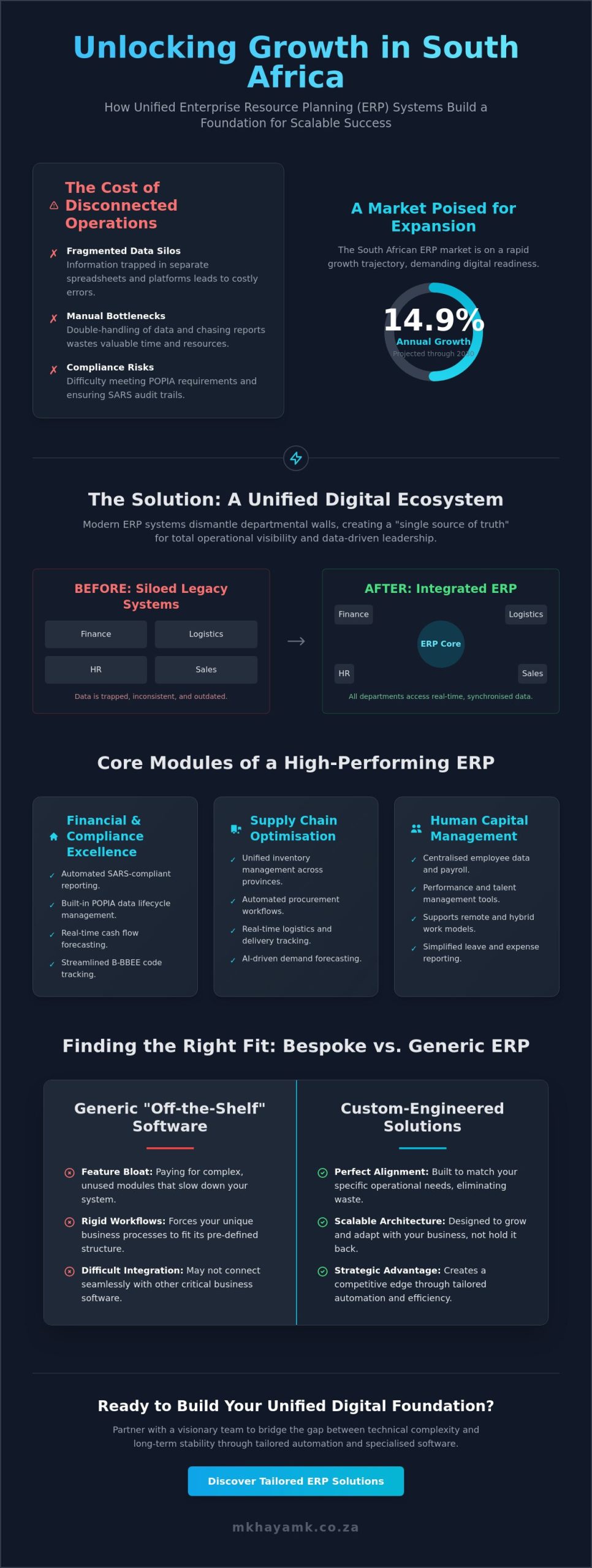
What if the primary barrier to your company’s growth isn’t market demand, but the invisible friction of fragmented data and manual bottlenecks? In an economy where the South African ERP market is projected to expand by 14.9% annually through 2030, staying competitive requires more than just hard work. It demands a unified digital foundation. Selecting the right ERP solutions South Africa offers is about more than software; it’s about building a reliable architecture that integrates every department into a single, cohesive engine.
You likely recognise the frustration of chasing real-time reports across disparate platforms or the anxiety of ensuring your data deletion logs meet the latest POPIA requirements. We understand that these operational hurdles can stifle even the most ambitious enterprises. This guide explores how modern ERP systems transform these challenges into strategic advantages by automating workflows and securing local compliance. We will examine the shift toward cloud-first adoption, the impact of AI-driven insights, and the practical steps to achieving long-term stability in an evolving technological landscape.
Key Takeaways
Understand how transitioning from siloed legacy systems to a unified digital ecosystem creates a robust foundation for scalable business growth.
Identify the core modules, such as automated financial management and supply chain optimisation, that define high-performing ERP solutions South Africa requires.
Learn to distinguish between feature-heavy generic software and custom-engineered solutions that eliminate “feature bloat” to align with your specific operational needs.
Discover a structured implementation strategy that ensures safe data migration and seamless workflow mapping while maintaining business continuity.
Explore how a visionary partnership can bridge the gap between technical complexity and long-term stability through tailored automation and specialised software products.
What are ERP Solutions and Why Do South African Enterprises Need Them?
At its core, an Enterprise Resource Planning (ERP) system acts as the central nervous system of an organisation. Understanding What are ERP Solutions involves seeing beyond simple software; it’s about a unified ecosystem where every department, from finance to logistics, shares a common data language. For years, businesses operated within silos where information stayed trapped in separate spreadsheets or disconnected accounting packages. This fragmentation often led to double-handling of data and costly miscommunications. Modern ERP solutions south africa provide a bridge, consolidating these disparate threads into a single, integrated digital platform that empowers leaders with total visibility.
To better understand how these systems function within a local context, watch this helpful case study:
Beyond efficiency, these platforms serve as a critical anchor for compliance. As of June 2026, the Information Regulator has placed a sharp focus on automated logs of data deletion to ensure adherence to POPIA. A robust ERP system doesn’t just store data; it manages the entire lifecycle of information. This includes role-based access and audit trails that are essential for navigating the complex South African regulatory landscape. By centralising these processes, companies reduce the risk of manual oversight and build a foundation of trust with their clients.
The Evolution of Business Management Software
The journey of business management has shifted dramatically. What began as basic ledger software has matured into comprehensive suites that support the dynamic needs of today’s workforce. With the rise of remote and hybrid work models across the country, the reliance on on-premise servers has faded. Managed cloud infrastructure now ensures that a team in Cape Town and a warehouse in Johannesburg remain perfectly synchronised. This evolution allows for a level of agility that was previously impossible, turning software from a back-office tool into a driver of digital transformation.
Why National Scalability Requires Integrated Data
The Essential Modules of a High-Performing ERP System
A high-performing ERP system functions as a modular framework designed to scale alongside your ambitions. Whilst weighing the advantages and disadvantages of ERP, it becomes clear that the value lies in how these modules communicate. Choosing the right ERP solutions South Africa provides means selecting a suite that addresses both global standards and local nuances. By integrating financial management, supply chain logistics, and human capital into a single interface, you eliminate the friction that slows down decision-making and business growth.
Financial and Compliance Excellence
South African businesses face a specific regulatory environment, including the standard 27% corporate income tax rate and evolving B-BBEE codes. An effective ERP automates SARS-compliant reporting and financial auditing, ensuring that your team spends less time on manual entries and more on strategy. Automated cash flow forecasting provides the stability needed to navigate market shifts, whilst direct integration with local banking gateways ensures that transactions remain seamless and secure. This level of precision is vital for maintaining long-term stability in a fluctuating economy.
Operational and Supply Chain Optimisation
For resource-heavy industries, real-time asset tracking is a necessity rather than a luxury. Implementing a specialised facility management system within your ERP framework allows for precise resource allocation and maintenance scheduling. Similarly, the Optimate Procurement Platform streamlines supplier relationships by optimising inventory levels and reducing waste. These tools ensure that your national distribution remains efficient, even when faced with local logistical challenges. Integrated logistics modules provide the visibility required to manage complex supply chains with quiet confidence.
Data-Driven Decision Making
The true power of modern ERP solutions South Africa relies on lies in their ability to turn raw data into actionable intelligence. By leveraging AI & Data Automation, executive dashboards provide a 360-degree view of the organisation. Predictive analytics allow you to forecast demand and future-proof your growth by identifying trends before they impact the bottom line. This shift from reactive reporting to proactive insight is what defines a visionary enterprise. If you’re unsure which modules match your current growth phase, exploring our ERP solutions can help clarify your path forward.
Bespoke vs Generic: Finding the Best ERP Software for Local Requirements
Choosing between a global template and a custom-engineered system is a pivotal moment for any enterprise. Whilst large global brands offer a sense of familiarity, they often introduce “feature bloat”—a collection of complex tools and workflows that your team might never use, yet you still pay to maintain. When you explore the variety of ERP solutions south africa offers, it’s essential to ask whether the software will adapt to your business, or if you’ll be forced to adapt your business to the software. Bespoke custom software development ensures that your unique business logic is baked into the code rather than bolted on as an afterthought, providing a foundation that feels natural to your operations.
The Limitations of One-Size-Fits-All Systems
Forcing local processes into rigid global templates often creates significant operational friction. These generic systems are typically built for international markets, meaning they may lack the inherent flexibility required for South African business nuances. This misalignment often leads to manual workarounds, defeating the purpose of an integrated system. The hidden costs of trying to customise a rigid generic system can quickly spiral, as you’re essentially paying to rewrite the foundation of the product. Beyond the backend, user adoption often suffers when the interface feels clunky or irrelevant. Investing in high-quality UI/UX design services ensures that the system feels intuitive, encouraging your staff to engage with the platform rather than work around it. For businesses extending their digital ecosystem to mobile users, partnering with a specialised mobile app design company south africa can further bridge the gap between complex business requirements and the real-world needs of your users.
The Power of Specialised Proprietary Products
Sometimes, the best path forward isn’t a generic ERP or a completely blank slate, but a specialised proprietary product designed for your industry. For financial providers, a dedicated loan management system offers deep functionality that a generic ERP simply can’t match without extensive, expensive modifications. Similarly, a robust facility management system provides the granular asset tracking and maintenance scheduling required for resource-heavy sectors. These specialised tools can integrate seamlessly with your wider digital ecosystem, including a learner management system to track corporate skills development. This modular approach provides the stability of a proven product with the precision of a bespoke build, ensuring that every niche department is supported by tools that actually understand their daily challenges.
Executing a Seamless ERP Implementation Strategy
Implementing ERP solutions south africa requires a disciplined, methodical approach to ensure the transition enhances rather than disrupts your daily operations. A successful rollout isn’t a single event; it’s a journey that follows a logical, five-phase progression. This structured path allows for transparency and methodical execution, building trust amongst stakeholders whilst securing the long-term stability of the new system. By moving from a broad vision toward concrete execution, we ensure that every department is aligned and ready for the shift.
Phase 1: Discovery and Assessment. We begin by mapping your current workflows and identifying operational gaps. This ensures the solution addresses real-world friction points rather than theoretical ones.
Phase 2: Data Migration and Integration. Safely moving legacy data to the new system is a delicate process. We prioritise data integrity to ensure your historical insights remain intact and accessible.
Phase 3: Customisation and Configuration. Here, we align the software with your specific business rules. This phase turns a standard platform into a precision tool for your enterprise.
Phase 4: User Acceptance Testing (UAT). We verify that the system meets every operational need. Your team tests the logic in a controlled environment before the full rollout.
Phase 5: Training and Go-Live. Empowering your staff is the final step. We transition to the new platform with a clear support structure in place to handle the initial switch.
Overcoming Implementation Hurdles
Change management is often the most overlooked aspect of a rollout. Reducing staff resistance requires transparent communication and a clear explanation of the practical benefits. People need to feel supported as they learn new behaviours. From a technical standpoint, Cloud Application Services & DevOps play a vital role in maintaining high system availability. This infrastructure ensures that your migration doesn’t compromise data security or residency; it’s a critical factor for maintaining POPIA compliance during the move.
Ensuring Long-Term System Health
A successful go-live is just the beginning of the journey. Maintaining system health requires ongoing managed cloud services and proactive support. As your cloud footprint grows, implementing a deliberate approach to cloud cost optimisation south africa businesses rely on can prevent idle resources from silently eroding your technology budget. If your internal team lacks specific technical expertise, staff augmentation can fill those gaps during the critical early months. Regular software engineering updates are also essential to keep your system secure and performing at its peak. This continuous refinement ensures that your digital foundation remains a stable anchor as your business grows. Ready to start your transition? Explore our methodical implementation process to see how we guide your business toward operational excellence.
Partnering for Growth: Mkhaya MK’s Comprehensive ERP and Automation Portfolio
Mkhaya MK positions itself as a visionary partner invested in your personal journey toward operational excellence. We don’t just provide software; we build the digital architecture that supports your long-term stability. By merging custom software development with specialised ERP solutions south africa, we create a synergy that generic vendors cannot replicate. This approach ensures that every line of code serves a specific business outcome, turning technology from a cost centre into a strategic asset. We value transparency and methodical execution, acting as a stable anchor as you navigate the complexities of digital growth.
Our methodology integrates AI & data automation directly into the core ERP framework. This integration allows for predictive insights and automated workflows that free your team from repetitive manual tasks. When technical gaps arise during a complex rollout, our staff augmentation services extend your internal capabilities, providing the expert hands needed for project success. It’s a holistic ecosystem designed for mutual success and steady, forward-looking ambition, ensuring that your business remains agile in a shifting market.
Our Specialised Product Ecosystem
To achieve national scalability, businesses require tools that understand the specific demands of their sector. Our Optimate Procurement Platform streamlines supplier management, whilst MkhayaMove provides the precision needed for complex logistics. For financial providers, our loan management system offers a robust platform for managing credit lifecycles with quiet confidence. Meanwhile, our facility management system ensures that physical assets are utilised to their full potential. These proprietary products aren’t isolated tools; they are essential components of a broader digital transformation strategy that scales alongside your enterprise.
Your Journey to Digital Maturity
Our collaborative process begins with strategic consulting and moves through to methodical execution. This journey isn’t about high-pressure urgency; it’s about a deliberate pace that ensures each milestone is fully articulated and achieved. We believe in building a relationship where your success is the primary metric of our own. This commitment to integrity and precision allows us to guide you from a broad vision toward a concrete, high-end digital reality. We invite you to explore our resources to learn more about modernising your tech stack. If you’re ready to refine your operations and embrace a proactive, data-driven future, contact us today to begin our partnership.
Building a Future-Ready Enterprise
Transitioning to a unified digital ecosystem is a strategic necessity for national scalability, whilst selecting the right ERP solutions south africa provides allows you to replace operational friction with data-driven precision. We’ve explored how a modular approach helps your business grow without the burden of feature bloat, ensuring that local compliance remains a core pillar of your architecture. This journey requires a partner that understands both global standards and the specific nuances of our local market.
Mkhaya MK is a privately held South African technology firm and an end-to-end digital transformation expert. Our specialised proprietary systems, including the Optimate Procurement Platform and MkhayaMove, provide the precision needed to solve unique logistical and procurement challenges. We’re dedicated to your long-term stability and mutual success, acting as a visionary guide through every phase of your growth. Discover our ERP solutions and start your digital transformation journey today. Let’s build a more efficient, resilient future together.
Frequently Asked Questions
What is the average timeline for an ERP implementation in South Africa?
Implementation timelines typically range from six to twelve months, depending on the complexity of your business logic and data migration needs. Smaller projects or modular rollouts can sometimes be completed in three to six months. We prioritise a methodical progression through discovery and testing to ensure the system is stable before go-live, avoiding the risks associated with rushed deployments that could disrupt your operations.
Can a custom ERP solution integrate with my existing accounting software?
Yes, custom ERP systems are designed to bridge the gap between your new digital ecosystem and legacy accounting tools. We use robust integration protocols to ensure that financial data flows seamlessly between platforms without manual entry. This connectivity preserves your historical financial records whilst providing the enhanced operational visibility that modern ERP solutions South Africa requires to remain competitive and agile in a changing market.
How does an ERP system help with POPIA compliance?
Modern systems automate the lifecycle of personal information by implementing role-based access controls and detailed audit trails. As of 2026, the Information Regulator focuses on automated logs of data deletion, which our systems handle natively. By centralising data, you eliminate the risk of unsecured personal information sitting in disconnected spreadsheets, ensuring your business meets every legal requirement under the Act with quiet confidence.
Is a cloud-based ERP better than an on-premise system for local businesses?
Cloud-based systems are generally superior for South African enterprises due to their resilience against local infrastructure challenges like load shedding. Whilst on-premise servers require expensive backup power and physical security, cloud infrastructure offers high availability and remote accessibility. This ensures your team can continue working from any location with an internet connection, providing a stable anchor for business continuity during power outages or connectivity issues.
What are the main differences between bespoke ERP and SAP or Sage?
The main difference lies in the balance between flexibility and “feature bloat”. Global brands like SAP or Sage offer massive, rigid templates that often include complex tools your team will never use. A bespoke solution is custom-engineered to match your exact business logic. This eliminates unnecessary complexity and ensures the user interface is intuitive, leading to higher adoption rates and a more refined operational flow for your staff.
How do I know if my business is ready for an ERP upgrade?
What is the role of AI in modern ERP solutions?
AI serves as a catalyst for predictive analytics and task automation within the core framework. In the current market, AI-driven ERP solutions South Africa employs use machine learning to forecast demand and automate repetitive financial entries. This shift allows executives to move from reactive decision-making to a proactive stance, where future trends are identified before they impact the bottom line, ensuring long-term stability and precision.
How does Mkhaya MK support businesses after the ERP system goes live?
We remain deeply invested in your journey through ongoing managed cloud services and regular software engineering updates. Our support doesn’t end at go-live; we provide staff augmentation to fill technical gaps and ensure your team feels confident using the new system. This collaborative relationship ensures long-term stability and allows us to refine the platform as your business evolves and scales nationally, creating an atmosphere of mutual success.
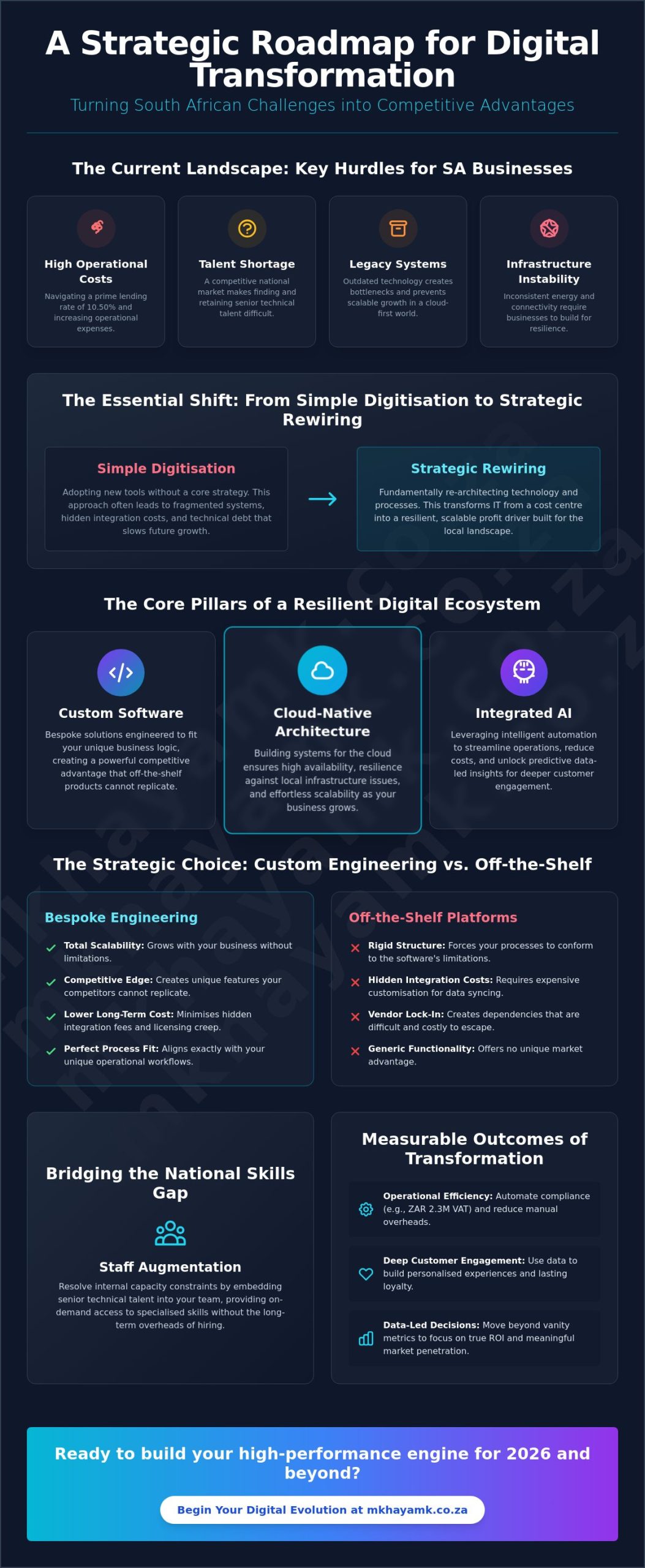
What if the very infrastructure challenges currently slowing your operations down could become the catalyst for your most significant competitive advantage? It’s a sentiment many South African leaders share. You’re likely dealing with high operational costs and a frustrating shortage of local technical talent, all whilst trying to scale using legacy systems that weren’t built for a cloud-first economy. Achieving sustainable business growth with digital transformation south africa requires more than just adopting new tools. It demands a resilient orchestration of technology that works around local hurdles and builds long-term stability.
We understand that navigating a prime lending rate of 10.50% and persistent infrastructure instability requires a partner who values methodical execution over flashy claims. This guide shows you exactly how to leverage bespoke software, integrated AI, and robust cloud solutions to drive measurable growth within our unique economic landscape. We’ll preview the strategic shifts needed to turn your technical debt into a scalable, high-performance engine. By the end of this article, you’ll have a clear roadmap for modernising your operations and securing a dominant position in the national market through 2026 and beyond.
Key Takeaways
Understand why strategic rewiring, rather than simple digitisation, is the primary driver of modern business evolution in South Africa.
Identify how to integrate custom software, cloud services, and AI to build a resilient ecosystem that thrives despite local infrastructure challenges.
Compare the long-term value of bespoke engineering against rigid off-the-shelf platforms to minimise hidden integration costs while scaling.
Resolve internal capacity constraints by leveraging staff augmentation to access senior technical talent in a competitive national market.
Discover how to achieve measurable business growth with digital transformation south africa through a collaborative, end-to-end partnership.
Navigating the Digital Frontier: Why Transformation is the Engine of South African Business Growth
In 2026, digital transformation isn’t merely about adopting new software; it’s a fundamental strategic rewiring of your entire organisation. For local firms, the shift from simply “going digital” to “optimising for growth” marks a significant turning point in how we approach the market. This evolution is the primary engine behind business growth with digital transformation south africa, allowing agile enterprises to bypass traditional development hurdles that once slowed down expansion. By integrating technology into the core of your business model, you create a foundation that’s both resilient and ready for rapid scaling.
To better understand how these shifts impact small and medium enterprises in our local context, watch this insightful discussion:
The South African Business Landscape in 2026
The national ecosystem has reached a level of maturity where fintech integration is seamless and expected. Local firms now use technology to mitigate infrastructure challenges, such as energy instability or inconsistent connectivity, by building more resilient, cloud-optimised systems. This is supported by the R50 billion commitment to data centres announced in the 2026 State of the Nation Address, which provides the backbone for modern services. However, success also depends on addressing the digital divide in South Africa. Inclusive strategies ensure your services reach a broader national audience, turning social responsibility into meaningful market penetration.
Defining Measurable Growth in a Digital Economy
Growth must be measurable to be meaningful. We’ve moved beyond vanity metrics like website hits to focus on actual ROI and substantial cost reduction. Digital agility allows your business to pivot whilst your competitors remain stagnant, tied down by rigid, outdated structures. This level of digital transformation creates a direct correlation between technical maturity and corporate accountability. With the VAT registration threshold now at ZAR 2.3 million as of April 2026, businesses need precise data automation to manage compliance and operational scaling effectively. Every technical investment should build long-term value and support your journey toward becoming a market leader.
The Core Pillars of a Resilient Digital Ecosystem: Custom Software, Cloud, and AI
Building a resilient digital ecosystem requires more than just purchasing tools; it involves orchestrating three core technologies: custom software, cloud-native architecture, and intelligent automation. These pillars shouldn’t exist in isolation. Instead, they must be integrated to form a cohesive foundation that supports business growth with digital transformation south africa. Recent analysis of the state of digital transformation in South Africa suggests that whilst many firms have begun their journey, those who achieve the highest ROI are the ones moving away from fragmented legacy systems toward unified, agile environments.
Bespoke Software Engineering for Competitive Advantage
Off-the-shelf platforms often fail to account for the specific regulatory and operational nuances of our local market. Our software engineering services focus on building tools that mirror your unique workflows rather than forcing you to adapt to rigid templates. This precision ensures that every feature serves a commercial purpose. Additionally, investing in high-end UI/UX design isn’t just about aesthetics; it’s a practical strategy to drive user adoption amongst your staff and customers, directly impacting internal efficiency and market penetration.
AI and Data Automation: Optimising the Human Element
AI integration has shifted from experimentation to execution. By implementing AI & data automation, businesses can free their teams from repetitive tasks, allowing them to focus on high-value strategy. In sectors like logistics and finance, AI is already being used to optimise routing and detect fraud in real-time. Predictive analytics takes this a step further, identifying emerging growth opportunities by analysing national market trends before they become obvious to competitors. This data-led approach is a critical component of business growth with digital transformation south africa, turning raw information into a roadmap for expansion.
Cloud Migration: Building for Stability and Scale
With cloud services projected to have a compound annual growth rate of 27%, the move toward hybrid and multi-cloud environments is essential for stability. Cloud-native architectures provide the resilience needed for 24/7 operations, especially whilst dealing with local infrastructure challenges. This transition allows for national scalability that on-premise systems simply can’t match. By adopting DevOps practices, you accelerate your software delivery cycles, ensuring your business remains agile. If you’re ready to modernise your infrastructure, exploring our cloud solutions is a logical first step toward long-term stability.
Strategic Choice: Custom Engineering vs Off-the-Shelf Solutions for Scaling
Deciding between bespoke engineering and off-the-shelf software is one of the most critical choices for achieving business growth with digital transformation south africa. Whilst a ready-made platform might seem like a faster route to market, the five-year total cost of ownership (TCO) often tells a different story. Rigid platforms frequently carry a hidden “integration tax,” where your team spends more time forcing the software to work with local processes than actually using it to scale. This friction eventually slows down your momentum and increases operational costs.
Custom software allows you to build proprietary business processes directly into your technical architecture. This creates a unique competitive advantage that rivals cannot simply buy or replicate. By focusing on long-term stability and methodical execution, you ensure that your technical debt remains low whilst your ability to innovate remains high. It’s about building a stable anchor for your business in a rapidly changing technological landscape.
When Off-the-Shelf Falls Short
Generic ERPs often struggle with the specific regulatory and economic nuances of South African sectors. For example, a standard financial platform might not handle the specificities of local credit risk or interest rate fluctuations with the precision required. This is why many firms opt for custom loan management systems that are built to handle our specific market dynamics from the ground up. Relying on generic tools also risks “vendor lock-in,” where escalating licensing fees eat into your margins as your user base grows, making it harder to maintain a lean operation.
The ROI of Custom Development
Owning the intellectual property (IP) of your core systems provides a level of corporate stability that subscription models cannot offer. Custom applications allow you to tailor your infrastructure to specific local compliance standards, such as the VAT registration threshold increase to ZAR 2.3 million that took effect in April 2026. Bespoke engineering ROI is defined by the ability to adapt your technical infrastructure at the same pace as your commercial ambitions without being restricted by a third-party roadmap. This level of control ensures that your technology remains an asset that supports your journey, rather than a rigid framework that limits your potential for expansion.
Bridging the Skills Gap: Staff Augmentation and Agile Implementation
South Africa’s technical talent pool is currently under immense pressure. As firms strive for business growth with digital transformation south africa, they often encounter a stark reality: a national shortage of senior developers and data scientists. This gap can stall even the most ambitious scaling plans, leaving businesses with technical debt and missed opportunities. Rather than waiting months to fill a permanent role whilst competitors move ahead, visionary leaders are turning to flexible models that prioritise momentum and precision. It’s about finding a stable anchor in a talent market that is rapidly changing.
Execution requires a structured rhythm to ensure long-term stability. Bringing in specialised talent on a project basis allows you to maintain a lean operation whilst still accessing high-end expertise. This is where agile methodologies become indispensable. By breaking complex transformation projects into manageable sprints, you ensure that every technical investment remains on track and aligned with your commercial goals. This methodical approach reinforces your image as a detail-oriented and reliable partner in your own company’s evolution.
How Staff Augmentation Accelerates Growth
Staff augmentation allows you to extend your internal capabilities without the heavy overhead of traditional recruitment. By integrating specialised professionals into your existing teams, you drastically reduce recruitment overhead and time-to-hire for critical roles. This is particularly effective in our hybrid work era, where access to both remote and on-site experts ensures your project remains adequately resourced. Our staff augmentation services provide the technical depth needed to execute complex builds without the long-term liability of expanding your permanent payroll. This approach is a practical way to maintain agility whilst managing the current 10.50% prime lending rate, ensuring every technical spend delivers immediate value.
A Roadmap for Successful Digital Implementation
Navigating a successful transformation requires a clear, step-by-step path forward. We suggest following this logical progression to manage risk and ensure measurable results:
Step 1: Audit legacy systems. Conduct a thorough review to identify growth bottlenecks and technical debt.
Step 2: Define a phased roadmap. Break the transformation into stages to ensure early wins and manageable scaling.
Step 3: Select the right partner. Choose a visionary guide capable of executing your technical vision with quiet confidence.
Step 4: Continuous iteration. Use real-time data and user feedback to refine your systems and support long-term growth.
If you’re ready to bridge your internal skills gap and accelerate your project timelines, connect with our team today to explore how our specialised talent can support your strategic vision.
Partnering for Success: How Mkhaya MK Drives Sustainable Digital Evolution
Achieving sustainable business growth with digital transformation south africa is not a solo endeavour. It requires a visionary guide who understands the intricate balance between technical precision and the unique commercial realities of our national market. At Mkhaya MK, we position ourselves as that stable anchor, offering a partnership rooted in transparency and methodical execution. Our end-to-end digital transformation services are designed to move your organisation from a state of reactive maintenance to one of proactive, scalable innovation. We value quiet confidence over flashy claims, ensuring that every project we undertake is grounded in practical results that you can measure and rely upon for years to come.
A Proven Portfolio of Enterprise Solutions
Our commitment to your success is reflected in a diverse portfolio of enterprise solutions that solve real-world problems. We’ve developed specialised tools such as our Facility Management System and Learner Management System to address the specific operational hurdles local organisations face daily. For enterprises looking to refine their supply chain and maximise their margins, our Optimate procurement platform provides the visibility and control needed to reduce waste and improve efficiency. This stability is further reinforced by our long-term commitment to managed cloud and DevOps support, ensuring your infrastructure remains resilient whilst you focus on high-level strategy. Every tool we build is a step toward a more refined and constructed business model.
Taking the Next Step Toward Scalable Growth
We believe that a collaborative partnership model leads to far better outcomes than a traditional, detached vendor-client relationship. By working as an extension of your own team, we ensure that the entire development process is marked by integrity and a deep investment in your long-term success. This approach allows us to build systems that aren’t just technically sound but are also deeply aligned with your personal journey as a business leader. It’s time to turn the strategic concepts and technologies discussed in this guide into a concrete path forward. Business growth with digital transformation south africa is within your reach when you have the right technical ally at your side to navigate the complexities of the 2026 landscape. Contact our team today to begin a strategic consultation and discover how we can help you build a more resilient future.
Securing Your Competitive Edge in the 2026 Landscape
The journey toward 2027 requires more than just technical adoption; it demands a fundamental shift in how you view your infrastructure. By prioritising bespoke engineering and resilient cloud architectures, you move beyond the limitations of rigid legacy systems. This strategic rewiring is the most reliable path to achieving sustainable business growth with digital transformation south africa. We’ve explored how bridging the skills gap through staff augmentation ensures your projects remain on track, even whilst navigating a complex national talent market.
Mkhaya MK brings end-to-end software engineering expertise and deep local market insight to every partnership. Whether you require specialised products for loan, facility, or learner management, our focus remains on precision and long-term stability. We act as a stable anchor for your ambitions, providing the technical depth needed to turn visionary concepts into measurable results. It’s time to build a foundation that supports your scaling goals for years to come.
What is the first step in digital transformation for a South African business?
The first step is a comprehensive audit of your current legacy systems to identify specific growth bottlenecks. This process allows you to understand exactly where technical debt is hindering your expansion. Once you’ve mapped these inefficiencies, you can define a phased roadmap that prioritises high-impact changes. This methodical beginning ensures that your technical investments align with your commercial objectives from day one.
How long does it typically take to see ROI from custom software development?
ROI from custom software is typically realised over a three-to-five-year period as you avoid the integration tax of off-the-shelf platforms. Whilst initial development costs require investment, you own the intellectual property and avoid escalating licensing fees as you scale. Measurable business growth with digital transformation south africa often starts with immediate operational efficiencies that compound over time. Owning your core architecture provides a level of stability that subscription models simply can’t match.
Can staff augmentation help if we already have an internal IT team?
Staff augmentation is an excellent way to extend the capabilities of an existing internal team without permanent overhead. It allows you to bring in specialised senior developers or data scientists for specific projects or phases. This model is particularly effective for bridging the national skills gap during intensive development cycles. Your internal team retains control whilst benefiting from the refined expertise of external professionals who integrate seamlessly into your workflow.
Is digital transformation only for large enterprises in South Africa?
No, digital transformation is a critical driver for businesses of all sizes, including SMMEs. Smaller firms often have the agility to leapfrog traditional development stages more quickly than large corporations. By adopting cloud-native architectures early, SMMEs can compete on a national level with minimal physical infrastructure. It’s about using technology to level the playing field and secure a dominant position in your specific niche.
How does Mkhaya MK ensure the security of cloud-based applications?
We secure cloud-based applications through a combination of cloud-native architectures and rigorous DevOps practices. This includes continuous monitoring and automated security protocols that protect your data against the rising average of 2,204 cyberattacks per week seen in early 2026. Our focus is on building a stable anchor for your operations. We ensure that your digital assets remain protected whilst you focus on scaling your core business.
What is the difference between a facility management system and a generic ERP?
How can AI-driven automation reduce operational costs for my business?
AI-driven automation reduces costs by handling repetitive operational tasks that currently consume your team’s time. By implementing AI & data automation, you free up human talent for high-value strategic work. In sectors like logistics, AI optimises routing to reduce fuel consumption, whilst in finance, it provides real-time fraud detection. These efficiencies lead to a leaner operation and more predictable business growth with digital transformation south africa.
Why is UI/UX design critical for the success of a digital transformation project?
UI/UX design is critical because the success of any digital tool depends entirely on user adoption. If your staff or customers find a system difficult to navigate, the investment fails to deliver its intended value. High-quality design ensures that your software is intuitive and efficient, which directly impacts internal productivity. Precision in the user interface turns complex technical capabilities into a seamless experience for all stakeholders.