What if the greatest risk to your organisation’s integrity isn’t a sophisticated external threat, but the routine habit of circulating sensitive board packs via email? It’s a common practice that often leaves leadership teams exposed to unnecessary security vulnerabilities and administrative friction. Transitioning to a bespoke Board Management system allows you to move beyond these outdated methods, establishing a secure, paperless environment where precision and confidentiality are the default.
We understand that maintaining a “single source of truth” for governance documents is often easier said than done, especially when tracking action items amongst multiple committees. This guide will show you how a tailored digital solution can automate King IV compliance tracking and streamline the preparation of minutes. By the end of this executive briefing, you’ll discover how to transform your boardroom into a strategic hub that fosters seamless collaboration and forward-looking ambition for 2026 and beyond.
Key Takeaways
Move beyond insecure email and physical packs by adopting a secure digital platform designed specifically for high-level executive communication.
Enhance your security posture through granular permission controls and multi-factor authentication within a dedicated Board Management system.
Reduce administrative overhead whilst ensuring alignment with King IV requirements for digital record keeping and automated action tracking.
Prioritise intuitive user interfaces and national data residency to ensure your directors can collaborate effectively and securely across South Africa.
Understand why a custom-engineered portal often outperforms generic SaaS by reflecting the unique workflows of your company secretarial team.
A Board Management system is a secure digital platform designed to centralise board-level communication and document management. Unlike traditional methods that rely on physical paper packs or insecure email chains, this technology provides a unified environment for sensitive decision-making. It has evolved from a simple document repository into a comprehensive ecosystem that underpins modern Governance, risk, and compliance (GRC) frameworks. Whilst many organisations once viewed these tools as optional, they’re now a core requirement for executive security and operational precision.
To better understand how these digital platforms function, watch this helpful overview:
For the Company Secretary, these systems are transformative. They replace the manual burden of compiling board packs with automated workflows, ensuring that every director receives the correct information at the right time. This transition eliminates the “email trail” of sensitive financial and strategic reports; it’s a critical step in reducing cyber risk. The result is a more agile leadership team that can focus on long-term stability rather than administrative hurdles.
The Evolution of Governance Technology
The journey from physical minute books to digital audit trails reflects a broader shift towards real-time collaboration amongst non-executive directors. In South Africa, 2026 marks a pivotal moment for the “paperless boardroom”. As organisations seek to align with King IV requirements for digital record keeping, the move towards integrated systems has become a strategic necessity. This evolution ensures that governance is proactive, providing a steady anchor in a fast-paced corporate environment.
Core Components of a Board Portal
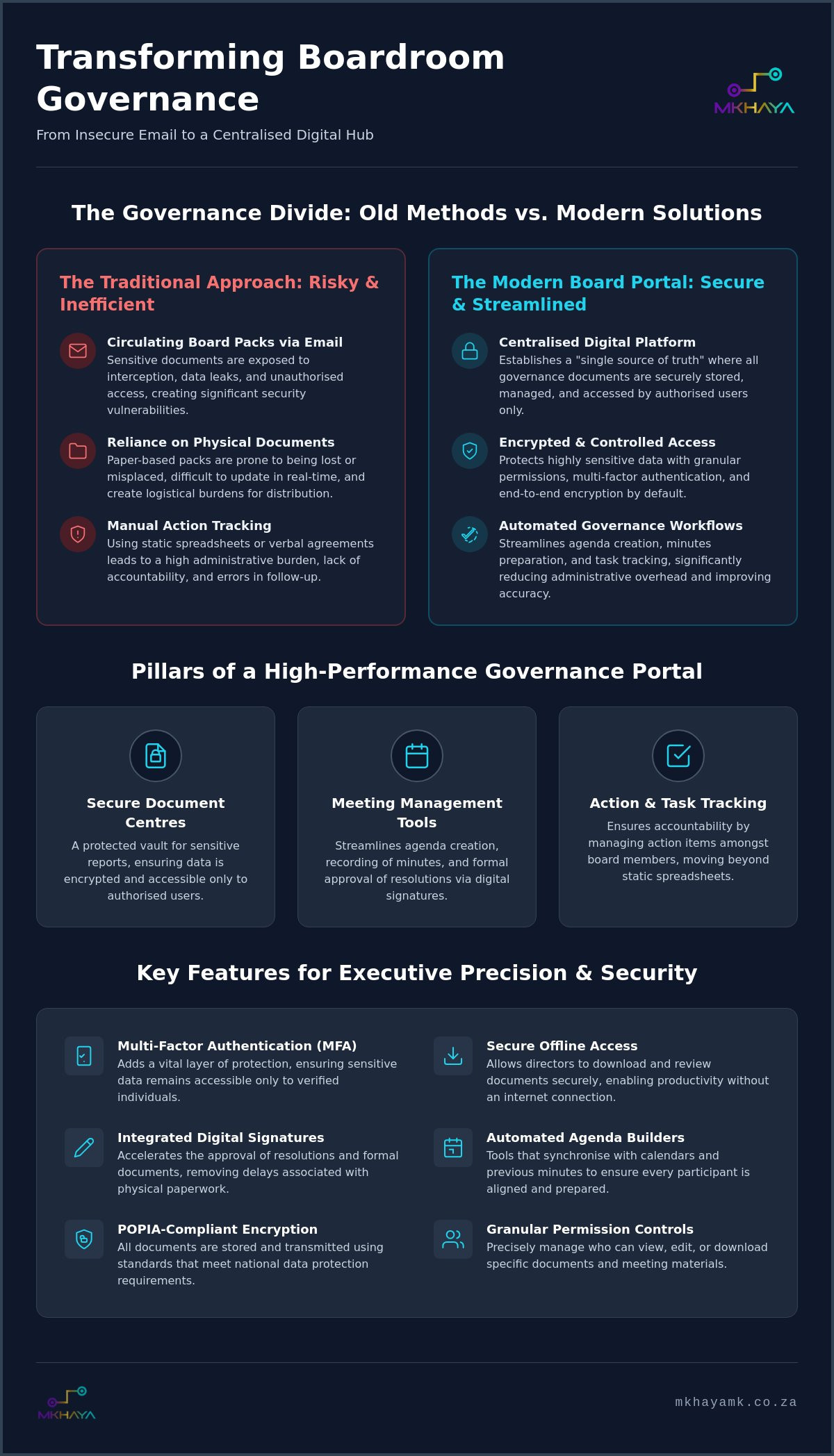
A high-performance portal is built on several foundational pillars that ensure reliability and mutual success for the entire board:
Secure document centres: These act as a protected vault for sensitive financial and strategic reports, ensuring data remains encrypted and accessible only to authorised users.
Meeting management tools: These streamline the creation of agendas, the recording of minutes, and the formal approval of resolutions through digital signatures.
Task tracking: This component ensures accountability by managing action items amongst board members, moving beyond the limitations of static spreadsheets and verbal promises.
Key Features of a High-Performance Governance Portal
To move beyond basic document storage, a modern Board Management system must offer a suite of integrated capabilities that prioritise security without sacrificing usability. It’s about creating a seamless experience for the non-executive director who might be reviewing a board pack whilst travelling between Johannesburg and Cape Town. A truly strategic portal doesn’t just hold information; it refines the way leadership teams interact with it. By integrating these high-performance features, your organisation constructs a resilient framework for long-term stability and executive precision.
Multi-factor authentication (MFA): This adds a vital layer of protection, ensuring that sensitive data remains accessible only to verified individuals.
Offline access: Directors can download and review documents securely, allowing for productive work even without a stable internet connection.
Integrated digital signatures: This capability accelerates the approval of resolutions, removing the delays associated with physical paperwork.
Automated agenda builders: These tools synchronise with existing calendar systems, ensuring that every participant is aligned and prepared.
POPIA-compliant encryption: Every document is stored and transmitted using standards that meet national data protection requirements, safeguarding your reputation.
As you look to modernise your governance workflows, investing in a bespoke Board Management system provides the quiet confidence that your data is secure and your processes are efficient. If you are ready to explore how these tools fit into your broader strategy, our team can help you navigate the path of digital transformation with a solution tailored to your specific needs.
Security and Compliance Frameworks
Precision in security is non-negotiable at the board level. Role-based access control (RBAC) ensures that directors only see committee data relevant to their specific duties, preventing accidental information leaks. For added peace of mind, remote wipe capabilities allow administrators to clear sensitive data from lost or stolen executive devices instantly. Every action is recorded in full audit logs, providing a transparent history of document views and modifications that supports your compliance efforts.
Collaboration and Decision-Making Tools
Effective governance relies on the ability of board members to collaborate effectively across distances. In-app annotation tools allow for the detailed review of board packs on the go, with notes that stay synced across devices. Formal board resolutions are handled through dedicated voting and polling modules, ensuring that every voice is heard and recorded accurately. By moving board communication to private, secure messaging channels, you keep strategic discussions away from personal apps and insecure platforms.
The Strategic Benefits of Digitising Board Operations
Digitising board operations is a deliberate move towards long-term stability and refined precision. When an organisation implements a dedicated Board Management system, the most immediate impact is the dramatic reduction in administrative friction. The company secretarial team, often burdened by the manual assembly of complex documents, can pivot towards higher-value governance support. This shift isn’t just about saving time; it’s about enhancing the strategic agility of the entire leadership team. By centralising documents, you eliminate the fragmented “email trail” that often leads to security vulnerabilities and version control errors.
In the South African context, this transition is essential for aligning with King IV principles of transparency and accountability. A digital platform provides a clear, unalterable audit trail that satisfies regulatory scrutiny whilst protecting sensitive executive discussions. It ensures that every decision is backed by a “single source of truth”, which is a cornerstone of modern digital transformation. This structured approach to data also simplifies compliance with POPIA, as sensitive personal and corporate information remains within a controlled, encrypted environment rather than scattered across various personal devices.
Efficiency and Cost Reduction
Preparing a 300-page board pack manually is a monumental task that often takes days of coordination. By automating this process, secretarial teams can reduce preparation time significantly, allowing for more thorough review cycles. There are also tangible physical savings to consider. The recurring costs of high-volume printing, secure couriering, and the eventually necessary shredding of sensitive documents are eliminated in a paperless boardroom. Additionally, the onboarding process for new board members becomes a seamless experience, as they gain instant access to historical archives and orientation materials without the need for physical handovers.
Risk Mitigation and Governance
Risk management is strengthened when version control issues in financial reporting are eliminated. A centralised Board Management system ensures that every director is reviewing the latest iteration of a document, preventing the strategic errors that occur when decisions are based on outdated data. This level of control is vital for meeting the requirements of the Companies Act. Beyond routine reporting, these systems provide a secure, confidential environment for sensitive committee discussions or whistleblowing reports. This ensures that delicate matters are handled with the highest level of integrity and commitment, reinforcing the board’s role as a stable anchor for the business.
How to Choose and Implement a Board Management Solution
Selecting a Board Management system is a strategic decision that requires a balance between high-end security and effortless usability. It’s not just about the features; it’s about how the system fits into the lived experience of your directors. When evaluating potential solutions, look for a partner that understands the specific nuances of South African corporate governance. This includes verifying the vendor’s support for national data residency requirements, which is essential for maintaining POPIA compliance and ensuring long-term stability for your records.
Implementation success relies on a clear, step-by-step roadmap rather than a rushed deployment. Verify the implementation timeline and the level of training support provided; a reliable partner stays invested in your team’s journey long after the initial setup. Flexibility is also vital. Your chosen system must adapt to unique committee structures and specific secretarial workflows rather than forcing your board to change its proven methods. If you’re ready to define your requirements, connect with our advisory team to discuss a tailored implementation roadmap.
Assessing User Experience (UX)
Simplicity drives adoption. If the interface feels cluttered or overly academic, even the most robust security features won’t prevent directors from reverting to insecure habits. High-performance governance relies on an intuitive design that feels modern and precise. This is why we prioritise user experience design south africa, ensuring that non-technical directors can navigate board packs and cast votes with confidence. Cross-device compatibility is equally important; the experience must remain consistent and reliable whether a director is using a tablet in a boardroom or a mobile device whilst travelling.
Integration with Existing Enterprise Systems
A Board Management system shouldn’t operate in a vacuum. To create a truly integrated governance ecosystem, the portal should ideally synchronise with your existing ERP solutions south africa. This connection allows for the seamless flow of financial data and strategic reports into the boardroom environment, reducing manual data entry and the risk of version control errors. Planning for a phased rollout is often the most practical path forward. This methodical execution allows the company secretarial team to master the meeting management tools before expanding the system to include broader committee collaboration and identity management integrations.
Bespoke Governance Solutions with Mkhaya MK
Whilst off-the-shelf SaaS platforms offer a quick start, they often lack the precision required for complex South African organisations. A generic Board Management system frequently forces a board to adapt its proven secretarial workflows to the limitations of the software. At Mkhaya MK, we believe that technology should be a silent, supportive partner that reflects your existing excellence. Our approach to custom software development in South Africa focuses on building bespoke portals that align perfectly with your governance culture. This ensures your executive team operates within a digital environment that feels familiar, secure, and high-end.
The advantage of a custom-engineered solution lies in its local relevance and tailored security protocols. Instead of dealing with detached international support desks, you gain access to a visionary guide that understands national data residency and the specific nuances of our regulatory landscape. By integrating digital transformation directly into the boardroom, we help you transition from legacy processes to a secure, automated ecosystem. This creates a stable anchor for your organisation, allowing leadership to focus on strategic movement rather than technical friction.
Tailored to Your Governance Framework
Precision in governance requires a system that mirrors your specific board and committee hierarchies. We design custom reporting modules that track the unique KPIs relevant to your sector, ensuring that every piece of data serves a strategic purpose. This bespoke construction means your system isn’t a static tool; it’s a dynamic asset that evolves alongside your organisational growth. Whether you’re managing a single board or a complex group structure, the architecture remains flexible and responsive to your needs.
A Partner in Long-Term Success
Our commitment to your success is rooted in traditional values of integrity and methodical execution. We don’t just deliver a product and disappear; we remain deeply invested in the personal journey of our clients. This includes providing ongoing support and maintenance to ensure 100% uptime for your critical meetings. We project a persona of quiet confidence, valuing transparency and reliability over flashy claims. This partnership ensures that your digital boardroom remains a high-performance environment for years to come. To take the next step in your governance journey, contact our expert team to discuss your specific requirements.
Securing the Future of Your Corporate Governance
The transition to a sophisticated Board Management system is more than a technical upgrade; it’s a commitment to the long-term stability and strategic agility of your leadership team. By moving away from fragmented email chains and embracing a secure, paperless boardroom, you establish a resilient framework that meets the highest standards of King IV and POPIA. This evolution ensures that every director remains aligned and every decision is backed by a verified audit trail.
Mkhaya MK stands as your visionary partner in this journey, offering national South African service coverage and specialised expertise in secure enterprise software engineering. We don’t just provide tools; we deliver end-to-end digital transformation that reflects your unique secretarial workflows. If you’re ready to build a governance ecosystem that inspires trust and drives mutual success, it’s time to take the next step.
What is the difference between a board portal and a standard document sharing app?
A board portal is a purpose-built governance environment, whilst standard sharing apps are generic storage repositories. Portals include specific tools for meeting agendas, minute-taking, and secure voting that generic apps lack. They offer a more refined level of security, ensuring that sensitive documents aren’t just stored, but are managed within a structured framework of executive accountability.
Is a board management system secure enough for highly sensitive financial data?
Yes, a bespoke Board Management system provides industrial-grade security for sensitive financial data through end-to-end encryption and multi-factor authentication. Unlike generic SaaS, a custom-engineered solution allows for specific security protocols tailored to your organisation’s risk profile. This methodical execution ensures that only authorised individuals can access high-level strategic reports, protecting your organisation from external threats and internal leaks.
How does a board management system help with King IV compliance in South Africa?
These systems facilitate King IV compliance by creating a transparent, unalterable audit trail of all board activities and decisions. They automate the tracking of action items and resolutions, ensuring that the board remains accountable and focused on long-term stability. By centralising governance documents, the system provides a “single source of truth” that directly supports the ethical leadership and effective control mandated by South African regulations.
Can directors use the system offline during travel?
Directors can securely access and annotate documents offline, ensuring productivity during national or international travel. The system automatically synchronises any changes or notes once a secure connection is re-established. This capability allows for continuous collaboration amongst board members, even when a stable internet connection isn’t available, without compromising the security of the underlying data.
How long does it typically take to implement a custom board management system?
The implementation timeline for a custom solution depends on the complexity of your governance framework and specific integration requirements. A phased rollout typically begins with a thorough discovery and design phase to ensure the system mirrors your secretarial workflows. This methodical approach ensures that the final solution is a stable anchor for your board, with the entire process managed through a transparent partnership to ensure mutual success.
What training is required for board members to use the new system effectively?
Training is typically minimal because high-performance systems are designed with an intuitive user interface for non-technical directors. We provide targeted sessions for both board members and administrative staff to ensure everyone feels confident using the tools. The focus remains on practical application, allowing directors to move from high-level concepts to active participation in the digital boardroom with very little friction.
Does the system support digital signatures for formal resolutions?
Digital signatures are fully supported for formal resolutions, allowing for the quick and legally binding approval of board decisions. This feature aligns with South African legislation to ensure that electronic approvals carry the same weight as physical signatures. It streamlines the resolution process, removing the need for physical paperwork and accelerating the board’s decision-making momentum.
Can we host our board management system on-premise or in a private cloud?
Custom solutions offer the flexibility to be hosted on-premise, in a private cloud, or within a dedicated national data centre. This choice allows you to maintain full control over data residency and sovereignty, ensuring your governance data remains within South African borders. It’s a practical way to meet internal IT policies whilst benefiting from a modern, agile platform designed for executive precision.
What if your most sensitive strategic discussions are currently sitting in an unsecured inbox, just one accidental ‘forward’ away from a reputational crisis? Many boards still rely on fragmented email chains and manual processes, yet the risk of a security leak via traditional board packs is higher than ever. To lead with confidence, you need a robust Board Management system that doesn’t just store documents but actually strengthens the integrity of your governance framework.
We understand that managing multiple committees whilst maintaining strict version control often feels like a constant uphill battle. You’ve likely felt the pressure of manual minute-taking or the urgency of meeting the SEC’s strict four-day cybersecurity disclosure rules enforced this year. This guide will show you how to modernise your corporate governance, enhance security, and streamline board operations through custom-engineered solutions. We’ll explore the transition to paperless meetings, automated compliance tracking, and the creation of a centralised repository for your most vital strategic assets.
Key Takeaways
Understand how a centralised digital hub replaces vulnerable physical packs to create a secure, real-time collaboration environment for executives.
Learn how to select a Board Management system that prioritises role-based access control and high-level security protocols for diverse committees.
Discover why bespoke architectures often outperform standard subscription portals by eliminating per-user fees and offering deeper integration.
Gain a strategic roadmap for a phased digital transition, beginning with focused pilot programmes to ensure board-wide adoption.
Explore how integrating AI and data automation can refine your governance workflows and provide more precise oversight of strategic assets.
The Evolution of Digital Governance: Why a Board Management System is Essential
A modern Board Management system serves as a secure, centralised digital hub where directors and executives converge to steer their organisations. It represents a fundamental shift from the era of cumbersome physical board packs to a world of real-time, encrypted digital collaboration. This transition isn’t just about convenience; it’s a strategic necessity to meet the rigorous transparency and accountability standards expected in 2026. This shift eliminates the lag time associated with printing and distribution, allowing for a more agile response to market shifts.
Digital transformation at the board level directly accelerates decision-making speed. When information is accessible instantly, leadership can pivot with precision rather than waiting for the next courier delivery. To better understand how these platforms function in practice, watch this helpful overview:
Moving Beyond Risky Email and Paper Processes
Relying on standard email to circulate sensitive PDF packs creates significant security vulnerabilities. Emails are easily intercepted or accidentally forwarded, putting proprietary data at risk. Manual processes often suffer from version control issues, where directors might review outdated financial figures, leading to potential governance failures. When multiple versions of a resolution exist across different devices, the risk of approving the wrong document becomes a tangible threat to corporate integrity. We define Digital Governance as the integration of technology to uphold transparency and fiduciary duty.
By adopting a dedicated system, boards align themselves with modern corporate governance principles, ensuring that every document is protected by enterprise-grade encryption rather than sitting in an unsecured inbox. This proactive approach to security is a hallmark of a reliable partnership between technology and leadership.
The Strategic Value of Centralised Governance
A centralised system creates a “single source of truth” for minutes, resolutions, and strategic plans. This clarity is invaluable for non-executive directors who need to provide effective oversight between formal meetings. Instead of searching through archived threads, they can access a curated repository of historical data at any time, which promotes a culture of steady, forward-looking ambition.
This structured approach supports the principles of the King IV Report on Corporate Governance by fostering an ethical culture and effective leadership. Using a Board Management system helps ensure your organisation remains a stable anchor amidst rapid technological change. For businesses looking to enhance their technical infrastructure, exploring digital transformation strategies is often the first step toward long-term stability and mutual success.
Core Capabilities of a Modern Board Management System
Selecting a Board Management system requires a focus on features that empower executive decision-making rather than merely digitising paperwork. At the executive level, certain capabilities are non-negotiable for maintaining the pace of modern business. These systems act as a modern solution for smarter governance, providing a framework where complex data becomes actionable insight. Key features include:
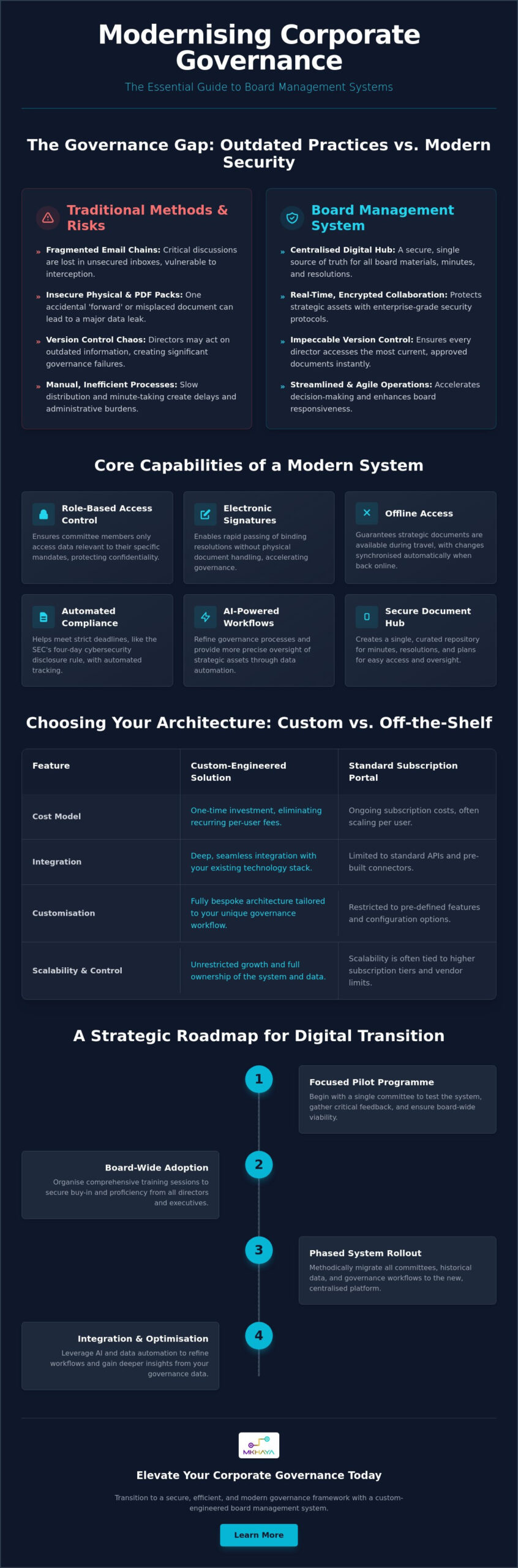
Electronic Signatures: Enables rapid passing of binding resolutions without physical document handling.
Role-Based Access Control: Ensures committee members only access data relevant to their specific mandates.
Offline Access: Guarantees that strategic documents are available for review during travel, synchronising once back online.
This level of agility is particularly vital when responding to the SEC’s 2026 requirement to disclose material cybersecurity incidents within four business days. Precision in access is equally critical. Role-based access prevents information overlap and maintains the confidentiality required for high-stakes discussions. For directors frequently travelling across the country, the ability to work without a constant connection ensures that preparation for the next session is never interrupted.
Advanced Security and Data Sovereignty
Security is the foundation of any governance platform. A reliable system must employ AES-256 encryption and multi-factor authentication (MFA) to guard against unauthorised entry. For South African firms, data sovereignty is a primary concern under POPIA regulations. Keeping sensitive board data within local borders or ensuring it resides in jurisdictions with equivalent protection is a legal necessity. Implementing detailed audit trails adds another layer of accountability, providing a chronological record of who accessed which document and at what time. This transparency builds trust and ensures that the board remains a stable anchor for the organisation.
Automation and AI in the Boardroom
The integration of AI is transforming how boards function. Modern platforms now utilise AI for automated minute-taking and even sentiment analysis to gauge the tone of board discussions. This technology identifies key risks and emerging trends directly from the dialogue. Automating task tracking ensures that every resolution passed is assigned to management with clear deadlines. AI-driven summarisation reduces director cognitive load without sacrificing detail, allowing for more focused strategic debate. If you’re looking to refine these processes, our expertise in AI & data automation can help you build a more responsive governance framework.
Custom vs. Off-the-Shelf: Choosing the Right Architecture
Deciding on the right architecture for your Board Management system is a pivotal choice that shapes your organisation’s long-term agility. Whilst many firms gravitate toward subscription-based portals for their perceived speed of implementation, these often lack the depth required for complex governance structures. Custom systems, by contrast, offer unparalleled scalability. They allow you to build an environment that mirrors your specific organisational hierarchy rather than forcing your board to adapt to a vendor’s pre-set logic. This tailored approach ensures that the technology serves the board, not the other way around.
Recurring operational expenses can quietly erode budgets over time. Subscription models frequently rely on per-user fees, which effectively penalise larger committees or organisations that need to provide access to a wide range of stakeholders. By treating your governance platform as a long-term asset through custom development, you move away from the cycle of endless monthly payments. You invest in a foundation that you own entirely, ensuring that your strategic tools grow alongside your business without unexpected financial hurdles. This creates an atmosphere of steady, forward-looking ambition where you control your own digital destiny.
When Off-the-Shelf Portals Fall Short
Rigid workflows in standard portals often fail to align with a specific board charter, creating friction in high-stakes environments. There’s also the matter of security. Sharing a multi-tenant cloud environment with other firms can introduce risks that bespoke solutions naturally avoid. These generic tools also struggle with integration. Attempting to link a standard portal with your existing ERP solutions can be notoriously difficult, often resulting in fragmented data silos that hinder effective oversight. These limitations can turn a supposed solution into a technical burden that slows down executive action.
The Benefits of Bespoke Board Portals
Choosing a bespoke path gives you absolute ownership of the source code. This means you have complete control over the security roadmap, allowing for precision adjustments as new threats emerge. UI/UX design can be tailored to match the digital literacy of your specific board members, ensuring that the technology feels like a supportive partner rather than a barrier. These portals also allow for seamless integration with other custom software engineering projects, creating a unified digital ecosystem. A custom Board Management system becomes a stable anchor in a rapidly changing technological landscape, providing the reliability your leadership team deserves.
Implementing Your Board System: A Strategic Roadmap
Transitioning to a modern Board Management system is a strategic journey that requires methodical execution rather than a hurried rollout. A successful transition typically unfolds in distinct phases, beginning with the digitisation of core workflows and culminating in a fully integrated governance environment. We’ve found that a “white-glove” onboarding process is essential for executive teams. This high-touch approach ensures that directors feel supported as they adapt to new tools, reducing the friction often associated with technical change. It’s about building a partnership that values reliability and mutual success from day one.
Before a full-scale deployment, we recommend launching a pilot programme with a single subcommittee, such as the Audit or Risk committee. This allows your organisation to refine security protocols and user permissions in a controlled setting before the main board adopts the platform. Managing the migration of historical board records is equally vital. Ensuring that years of resolutions and minutes are correctly indexed provides the continuity required for effective long-term oversight, turning your archive into a searchable strategic asset.
Assessing Governance Workflows
The first step involves mapping your existing meeting cycle, from initial agenda preparation through to final minute approval. This process often reveals hidden bottlenecks in your current digital transformation journey. By consulting closely with the Board Secretary, you can identify specific automation triggers that will save time, such as automated reminders for action items or instant distribution of updated board packs. This level of precision ensures the system mirrors your actual behaviour rather than imposing an external logic that doesn’t fit your culture.
Ensuring High Adoption Rates
High adoption rates depend on an intuitive interface that respects the limited time of busy executives. If the system is too complex, directors will naturally revert to familiar, less secure methods. Providing dedicated support is a non-negotiable requirement, ensuring assistance is available regardless of a director’s location or time zone. Finally, setting clear policies for the decommissioning of paper-based packs creates a necessary momentum for change. This shift positions your business as a stable anchor in a rapidly changing technological landscape.
Mkhaya MK stands as a dedicated partner for organisations navigating the complexities of high-stakes digital environments. We specialise in building secure, high-end enterprise applications that protect your strategic integrity at every level. By integrating AI & data automation with established governance best practices, we create tools that do far more than merely store documents. A custom Board Management system engineered by our team acts as a sophisticated engine for oversight, ensuring that every resolution and record is handled with absolute precision. Our collaborative process is deeply client-centric, ensuring the final architecture reflects your board’s unique culture and constitutional requirements whilst fostering an environment of professional confidence.
Partnering with a national firm provides the stability and local insight necessary to navigate complex South African regulations like POPIA and the King IV Report with ease. We don’t believe in one-size-fits-all solutions; instead, we focus on a supportive partnership that prioritises your specific journey. This long-term commitment allows us to act as a stable anchor for your leadership team, offering the reliability required to manage sensitive corporate data amidst a shifting technological landscape. We work alongside you to ensure that each technical capability is immediately linked to a practical benefit, driving mutual success through methodical execution.
Bespoke Engineering for Executive Needs
We build secure portals designed to integrate seamlessly with your existing cloud solutions, ensuring a cohesive digital strategy across your entire organisation. This creates a unified ecosystem where data flows securely between departments without compromising executive confidentiality or creating technical silos. Our engineering focus remains rooted in precision, stability, and long-term partnership, ensuring your system remains robust as your organisation scales. Mkhaya MK serves as a visionary yet practical guide in the South African tech landscape, helping you navigate the complexities of modern digital governance.
Ready to Modernise Your Boardroom?
The transition from operational friction to strategic governance excellence begins with a deliberate move toward modernisation. By moving away from fragmented, risky processes, you empower your directors to focus on high-level strategy rather than administrative hurdles. We encourage you to reach out for a consultation to discuss your specific board requirements and explore how a tailored Board Management system can benefit your leadership team. Visit our contact page today for a bespoke evaluation of your governance needs and take the first step toward a more secure digital future.
Securing Your Strategic Future
Modernising your governance is a journey from operational vulnerability toward precise, data-driven leadership. Transitioning from fragmented email chains to a centralised hub eliminates security risks whilst significantly enhancing executive decision-making speed. Choosing a bespoke Board Management system ensures your technology aligns perfectly with your organisational charter, providing a stable anchor in a rapidly changing corporate landscape.
At Mkhaya MK, we bring end-to-end digital transformation expertise and specialised experience in complex ERP and Loan Management systems to every project. Our national South African presence ensures we understand the nuances of local compliance, making your platform a reliable asset for years to come. We value the collaborative relationship that drives mutual success through methodical execution and professional confidence.
What is a board management system and why is it more secure than email?
A Board Management system is a secure, centralised digital hub designed specifically for executive collaboration. Unlike standard email, which is vulnerable to interception and accidental forwarding, these systems use AES-256 encryption and multi-factor authentication to protect sensitive data. This structure ensures that your strategic discussions remain confidential and accessible only to authorised individuals, providing a level of security that traditional inboxes simply cannot match.
How does a board portal help with POPIA compliance in South Africa?
A board portal assists with POPIA compliance by ensuring that sensitive personal information is handled within a secure, audited environment. By maintaining data sovereignty and providing detailed audit trails, you can track exactly who accessed specific documents and when. This transparency is vital for meeting South African regulatory requirements and demonstrates a proactive commitment to protecting director and stakeholder data whilst maintaining organisational integrity.
Can we integrate our existing ERP or financial systems with a custom board portal?
Yes, bespoke systems are specifically designed to integrate with your existing ERP or financial systems. This connectivity allows for the real-time flow of data into board reports, creating a single source of truth for your leadership team. By linking these systems, you eliminate manual data entry and ensure that directors are always reviewing the most current financial figures during their strategic deliberations.
What features should we prioritise for directors who are not tech-savvy?
You should prioritise an intuitive UI/UX design that focuses on clarity and ease of use. Features like one-click access to board packs, simple annotation tools, and a clear, searchable document library are essential for directors who may not be tech-savvy. A clean interface reduces cognitive load and ensures that the technology feels like a supportive partner rather than a barrier to effective governance.
How long does it typically take to develop and deploy a custom board management system?
The development and deployment of a custom Board Management system typically takes several months, depending on the complexity of your specific requirements. We recommend a phased approach, starting with a discovery period to map your unique workflows, followed by a pilot programme for a single subcommittee. This methodical progression ensures a stable rollout and allows for refinement before the system is introduced to the full board.
Is it possible to use the board management system on mobile devices and tablets?
Modern board systems are fully responsive and designed for use on both mobile devices and tablets. This flexibility allows directors to review board packs and sign resolutions whilst travelling or working remotely. High-end systems also include offline access, ensuring that documents can be downloaded securely and reviewed even without a constant internet connection, with changes synchronising automatically once back online.
How do we handle voting and resolutions within a digital board system?
Voting and resolutions are managed through integrated digital modules that support secure, binding electronic signatures. Directors can cast their votes on specific items directly within the platform, with the results automatically recorded in the minutes. This process streamlines the approval of resolutions between formal meetings, ensuring that executive actions are documented accurately and remain legally compliant with your board charter.
What happens to our historical board documents during the migration process?
Your historical board documents are carefully indexed and migrated into the new centralised repository during the implementation phase. This process ensures that past minutes, resolutions, and strategic plans remain accessible for future reference and oversight. By organising your archive within the new system, you transform decades of physical or fragmented digital records into a searchable, secure strategic asset for the organisation.