Outsource Software Development in South Africa: The 2026 Strategic Guide
64% of IT leaders globally now choose to outsource software development, yet many still find themselves stalled by a lack of senior engineering talent for AI and Cloud initiatives. You’ve likely felt the weight of rising in-house costs and the pressure of project delays that threaten your competitive edge. When you choose to outsource software development South Africa offers, you’re making a strategic move to bridge this gap with world-class expertise and precision engineering.
We believe that a successful partnership is built on reliability and mutual success rather than just technical delivery. This 2026 guide provides the roadmap you need to navigate the South African landscape, ensuring you secure high-tier talent whilst maintaining predictable development costs. We’ll examine the latest regulatory standards, current hourly rates, and the specific steps required to accelerate your time-to-market through a collaborative, result-focused partnership that transforms your digital vision into a stable reality.
Key Takeaways
- Understand the shift from tactical cost-cutting to a strategic “skills-as-a-service” model to bridge your AI and Cloud expertise gaps.
- Identify the most effective engagement model for your goals, whether you need to outsource software development South Africa for a defined project or scale your team via staff augmentation.
- Discover how timezone synchronicity and cultural alignment facilitate seamless real-time collaboration and ensure technical precision is maintained.
- Master a practical evaluation framework to look beyond sales presentations and accurately assess a partner’s true engineering capabilities.
- Learn how a visionary partnership can protect your intellectual property whilst accelerating your journey toward digital transformation.
Why South African Enterprises are Prioritising Software Development Outsourcing in 2026
The 2026 business environment has moved past the era where outsourcing was merely a tactic to trim budgets. Today, South African enterprises view it as a strategic “skills-as-a-service” model. This evolution aligns with the broader growth of Business Process Outsourcing, where the focus has shifted toward high-value ICT support and multi-disciplinary expertise. It’s about building a visionary partnership that prioritises long-term stability over short-term savings. By choosing this path, you transform technical debt into a refined asset that supports your broader commercial objectives.
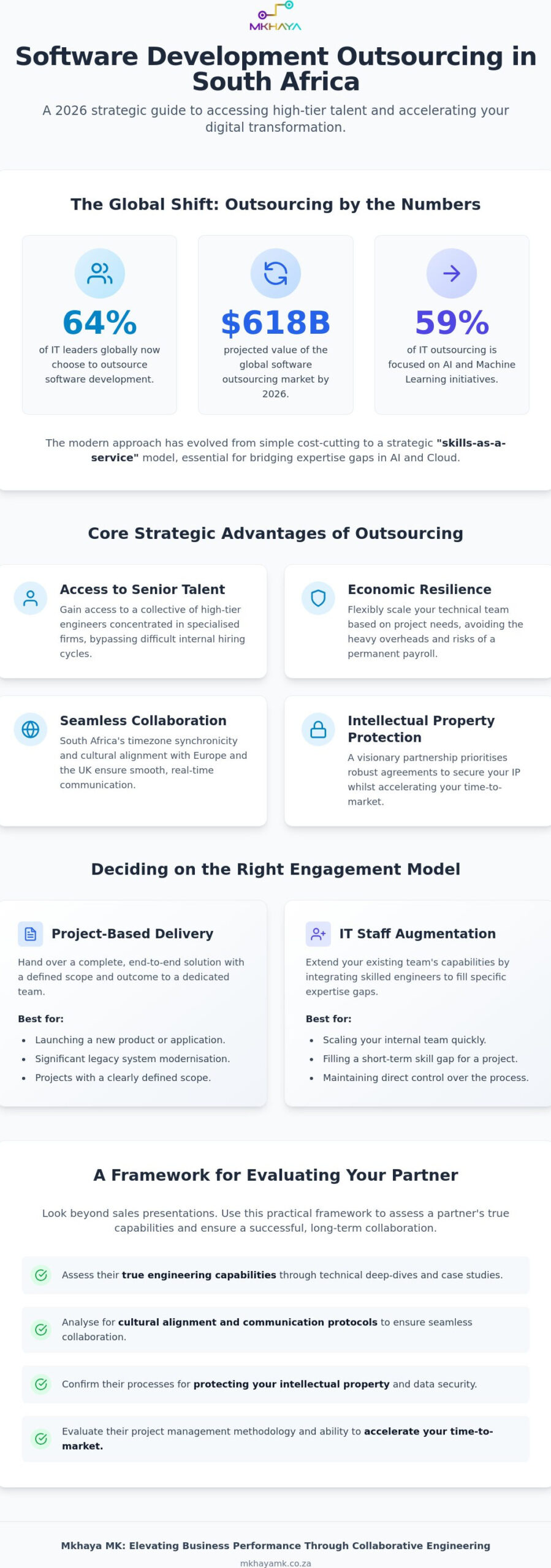
Finding senior engineers has become increasingly difficult within internal hiring cycles. Many of the most skilled developers are now choosing to work within specialised firms where they can apply their expertise across diverse, high-impact projects. This concentration of talent means that when you choose to outsource software development South Africa offers, you aren’t just hiring a vendor; you’re gaining access to a collective of engineers who understand the nuances of the local market. Currently, 64% of IT leaders globally rely on this model to maintain momentum. By 2026, the global software development outsourcing market is estimated to reach $618 billion, reflecting a widespread reliance on external partners to drive innovation.
To better understand the talent landscape and the investment required for these skills, watch this helpful video:
The 2026 Tech Landscape: AI and Cloud Integration
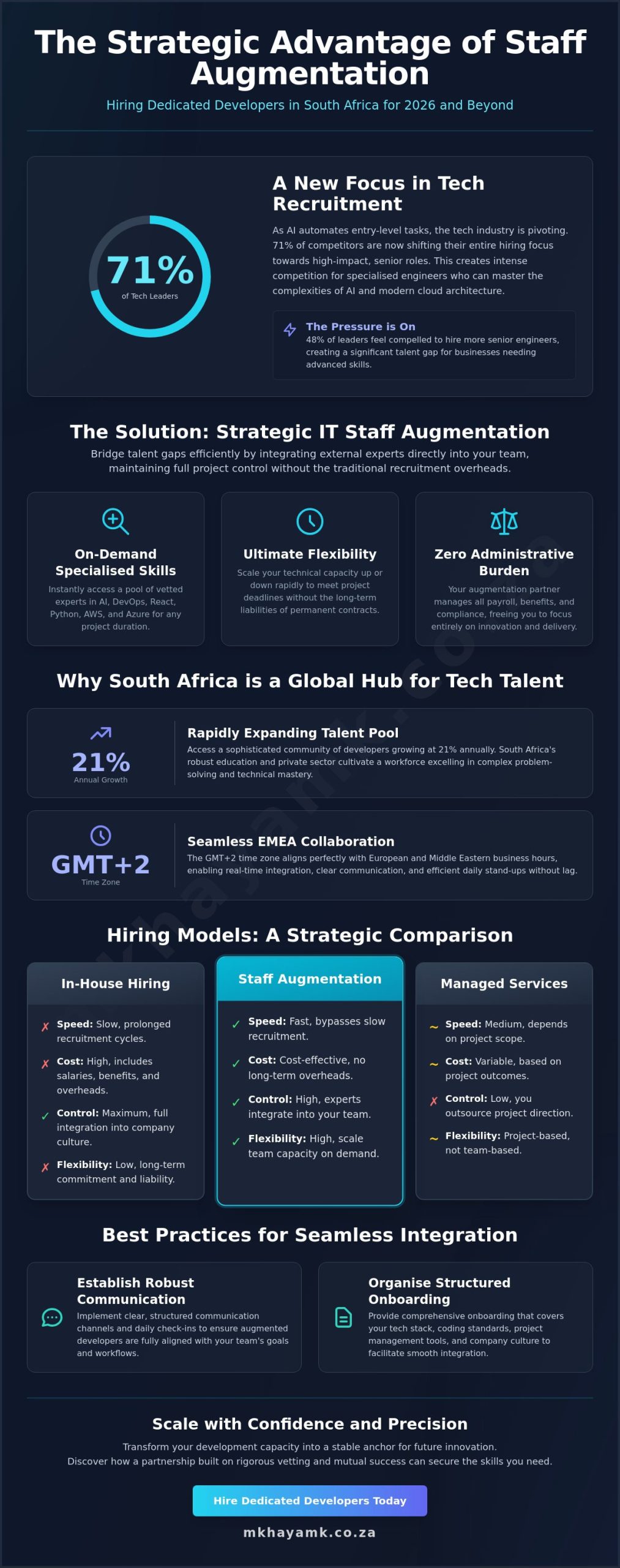
Modern applications are no longer just collections of code. They require sophisticated AI & data automation and robust DevOps frameworks to remain functional. With 59% of IT outsourcing now focused on AI and machine learning, the cost of falling behind is immense. Outsourcing allows your business to transition from clunky legacy systems to modern, scalable cloud architectures without the friction of a complete internal restructure. This acceleration is vital for maintaining a competitive edge whilst user expectations for speed and precision are at an all-time high.
Economic Resilience Through Flexible Scaling
Building a permanent technical department involves significant long-term payroll overheads and substantial hiring risks. If a senior developer leaves, the resulting vacuum can stall progress for months. Outsourcing provides the agility to scale your team up or down based on specific project phases or market fluctuations. This flexibility ensures your internal resources remain focused on core business strategy and high-level decision-making. Whether you are implementing bespoke ERP solutions or refining a customer-facing app, a partner-led approach provides the stability and precision needed to grow without the burden of fixed technical debt.
Deciding Between Project-Based Delivery and IT Staff Augmentation
Choosing the right engagement model is a pivotal step in your digital journey. It’s a decision that balances your internal capacity with your long-term strategic goals. When you decide to outsource software development South Africa provides two primary paths: handing over a specific outcome or extending your existing team’s capabilities. Each model serves a distinct purpose in 2026, particularly as enterprises seek to integrate complex AI and Cloud architectures into their core operations. Your choice should reflect your organisational maturity and the level of direct control you wish to maintain over the daily engineering process.
When to Choose Project-Based Software Engineering
This model is designed for businesses that require a complete, end-to-end solution with a defined scope. It’s the most effective route for launching a new product or undergoing a significant legacy modernisation. By opting for project-based custom software development, you leverage a partner’s entire ecosystem, including UI/UX designers, QA testers, and DevOps specialists. This approach removes the burden of managing individual tasks, allowing you to focus on the business impact whilst your partner ensures the technical precision of the final delivery. It’s especially valuable when building cloud-native applications that require a cohesive, multidisciplinary team to succeed.
The Benefits of IT Staff Augmentation
If you already have an established internal technical department but lack specific expertise, staff augmentation is the superior choice. This model allows you to rapidly scale your capacity with remote or on-site professionals who integrate directly into your workflows. You maintain full control over the development lifecycle and daily priorities. In the current market, where 59% of outsourcing is focused on AI and machine learning, augmentation provides immediate access to niche roles like Cloud Architects or Data Engineers. You avoid the friction and cost of a traditional recruitment cycle, gaining the specific skills needed to accelerate your existing roadmap without long-term payroll commitments.
Determining which path fits your current needs is often the first step toward a successful transformation. Whether you require a visionary guide to build a system from scratch or a reliable partner to bolster your internal ranks, the right model ensures your engineering efforts remain stable and scalable. If you’re unsure which direction aligns with your 2026 objectives, discussing your roadmap with a strategic partner can provide the clarity needed to move forward with confidence.
The Strategic Advantages of Partnering with a Local South African Engineering Firm
Whilst much of the global conversation regarding technical partnerships focuses on international trade, the most profound advantages often emerge from local-to-local collaborations. Engaging a partner within your own borders removes the friction of vast time differences and misaligned business cultures. This proximity facilitates real-time collaboration and daily stand-ups where technical nuance is preserved rather than lost in translation. When you choose to outsource software development South Africa based engineering firms provide a level of synchronicity that offshore hubs simply cannot replicate. It’s a relationship built on shared market understanding and a mutual commitment to the national digital economy.
The logic is clear; a local partner is an invested stakeholder in your success. South Africa’s tech ecosystems in Johannesburg and Cape Town are mature and globally competitive, producing engineers who are trained to solve complex problems with limited resources. By keeping your engineering efforts within the country, you contribute to a sector that has already created 174,000 jobs and generated billions in revenue. This collaborative approach ensures that your digital transformation remains grounded in local realities whilst meeting world-class standards of execution.
POPIA Compliance and Data Sovereignty
Data sovereignty is a pillar of modern business stability. Local partners are inherently aligned with the Protection of Personal Information Act (POPIA), ensuring that your sensitive data never leaves the national legal jurisdiction without proper oversight. This is particularly critical for financial institutions; under Joint Standard 1 of 2024, insurers must ensure all outsourcing agreements are fully compliant by 30 November 2026. Furthermore, insurers are required to notify the Prudential Authority at least 30 days before entering into any material arrangement. A local partner understands these regulatory hurdles and provides the legal certainty needed to protect your intellectual property and code ownership.
Quality Standards and Technical Excellence
South Africa has earned a reputation for high-end engineering that rivals traditional Western hubs. Our engineering graduates from institutions like UCT and Stellenbosch are sought after globally for their precision and ability to build scalable, cloud-native applications. Choosing a local firm allows you to access this “Nearshore” quality without the communication risks associated with low-cost offshore providers. For a deeper look at how these standards are applied in practice, read our detailed analysis on Custom Software Development in South Africa: A Strategic Guide for 2026. This focus on excellence ensures that your software is not just functional, but built for long-term stability and growth.
A Framework for Evaluating Your Next Software Outsourcing Partner
Selecting a partner is a high-stakes decision that requires a methodical approach. It moves beyond surface-level sales pitches and focuses on long-term stability. When you decide to outsource software development South Africa offers, you must first define your primary objective with absolute clarity. Are you looking to build a ground-breaking new product from scratch, or do you simply need to scale an existing engineering team? This distinction is vital because the maturity required for end-to-end delivery differs significantly from the support needed for staff augmentation.
Technical depth is the next pillar of your evaluation. In 2026, buzzwords like “AI-ready” are common, but actual engineering capability is rarer. You should evaluate a partner’s ability to handle complex cloud architectures and data-driven automation. Security and IP policies must be non-negotiable. Ensure your partner provides full code ownership and adheres to the POPIA standards mentioned in previous sections. Starting with a small, phased engagement or a “pilot” project is often the wisest way to build a foundation of trust before committing to a multi-year roadmap. This approach allows you to test their communication rhythm and technical precision without immediate, large-scale risk.
Technical Vetting and Discovery
Before any code is written, a visionary partner will conduct a thorough digital transformation audit. This discovery phase identifies technical debt and aligns the proposed tech stack with your long-term goals. It’s also the stage where UI/UX design takes centre stage. A well-designed user journey is essential for project-based development success. It ensures that the final engineering effort translates into actual business value for your end-users whilst maintaining technical excellence.
Operational Alignment and Transparency
Successful partnerships thrive on clear communication protocols. You need to know exactly how the partner will integrate with your internal workflows. This involves establishing clear KPIs and structured reporting cycles that provide real-time visibility. Transparency in pricing is equally vital. Avoid partners who obscure their cost structures with hidden fees throughout the development lifecycle. A collaborative mindset ensures that both parties are working toward mutual success, treating the outsourcing arrangement as a stable extension of your own business.
Discuss your technical roadmap with our engineering leads to see how a structured framework can secure your digital future and drive measurable results.
Mkhaya MK: Elevating Business Performance through Collaborative Engineering
Mkhaya MK positions itself as a visionary guide rather than a mere vendor. We understand that your digital journey is unique. Our philosophy is rooted in the belief that technical precision must be paired with a supportive partnership to achieve long-term stability. When you choose to outsource software development South Africa based enterprises often seek, you require a partner who values transparency and methodical execution as much as you do. We provide high-end engineering nationally, ensuring that your business logic is preserved and refined through every stage of the development lifecycle.
Our commitment to mutual success drives our delivery of comprehensive services. We build everything from bespoke ERP solutions to complex cloud-native applications that serve as a stable anchor in a rapidly changing technological landscape. By focusing on the collaborative relationship, we ensure that our engineering efforts translate directly into measurable business outcomes. This approach allows us to project a persona of quiet confidence, where our results speak louder than flashy claims.
Our End-to-End Digital Transformation Offering
Modernising your operations requires more than just updated code; it necessitates a complete shift toward integrated cloud solutions and AI automation. We specialise in constructing platforms that fit your specific requirements, including robust loan management and learner management systems. Our approach prioritises customisation and precision, ensuring that the software we build respects your unique business rules whilst providing the scalability needed for 2026 and beyond. This end-to-end focus allows us to handle the technical complexities so you can focus on high-level strategy.
Getting Started with Mkhaya MK
We follow a highly structured process that begins with a deep discovery phase. This ensures that every engagement, whether it is a full project handover or a staff augmentation model, is rooted in a clear understanding of your goals. We facilitate a seamless transition by integrating our senior engineers into your existing workflows, maintaining the communication rhythm established in our framework. This methodical implementation ensures reliability and mitigates the risks typically associated with scaling technical teams. It’s a deliberate pace that reinforces our image as a detail-oriented and reliable partner.
The journey toward digital excellence is a personal one. We invite you to contact Mkhaya MK today to discuss your 2026 software strategy and discover how a collaborative engineering partnership can elevate your business performance.
Securing Your Digital Future through Strategic Engineering
The decision to outsource software development South Africa offers is a commitment to long-term stability and precision engineering. By shifting from tactical cost-cutting to a strategic “skills-as-a-service” model, your enterprise can bridge the AI and Cloud expertise gap with confidence. We’ve explored how a local partnership ensures POPIA compliance whilst maintaining the cultural synchronicity required for complex digital transformation. Your ambition deserves a stable, visionary partner.
Mkhaya MK stands ready to support your journey. With a national South African footprint and specialised AI and Cloud expertise, we ensure your engineering processes are both compliant and high-performing. Our methodical approach to custom software development and staff augmentation is designed to inspire trust and deliver business-focused results. We value transparency and commitment above all else.
Partner with Mkhaya MK for your next software project to accelerate your roadmap with a reliable, detail-oriented team. Let’s build a digital landscape that reflects your ambition and secures your competitive edge for years to come.
Frequently Asked Questions
Is it cheaper to outsource software development in South Africa than to hire in-house?
Outsourcing is generally more cost-effective because it eliminates the long-term overheads associated with permanent payroll, such as office space, equipment, and benefits. Whilst the hourly rates for senior talent are competitive, the true saving comes from reduced recruitment friction and the ability to scale your team down when a project phase concludes. It allows you to convert fixed costs into variable expenses that align with your actual development needs.
What is the difference between IT staff augmentation and project-based outsourcing?
Staff augmentation involves adding specific technical professionals to your existing internal team to fill skill gaps whilst you retain direct management. Project-based outsourcing is a model where you hand over a defined scope of work to a partner who manages the end-to-end delivery of the final product. Your choice depends on whether you need to bolster your current capacity or require a partner to take full responsibility for a specific technical outcome.
How do I ensure my intellectual property is protected when outsourcing?
Intellectual property is protected through robust, locally governed contracts that explicitly state your full ownership of the source code and design assets upon payment. When you choose to outsource software development South Africa based firms provide the advantage of operating within a familiar legal framework. Ensure your agreement includes comprehensive non-disclosure clauses and clear terms regarding data sovereignty to safeguard your competitive advantages from day one.
Can South African software companies handle complex AI and data automation projects?
South African engineering firms are highly capable of delivering sophisticated AI and data automation solutions due to a mature tech ecosystem and world-class university graduates. Local teams are already building complex, cloud-native applications that integrate machine learning to drive business efficiency. With 59% of global outsourcing now focused on AI, South African partners have refined their precision engineering to meet these modern technical demands whilst maintaining high standards of execution.
How long does it typically take to scale a team through staff augmentation?
Scaling a team through staff augmentation typically takes a few weeks, which is significantly faster than the months required for traditional permanent hiring. This agility allows you to respond to market fluctuations or technical challenges without delaying your roadmap. A visionary partner maintains a pipeline of vetted senior developers, ensuring that you gain access to the specific expertise you need with minimal lead time.
What are the common risks of outsourcing and how can they be mitigated?
The most common risks include communication silos, misaligned expectations, and scope creep. You can mitigate these by establishing clear KPIs, insisting on transparent reporting structures, and maintaining a regular cadence of daily stand-ups. Choosing a partner who prioritises a collaborative relationship ensures that technical nuance is never lost. Methodical discovery phases at the start of an engagement also help to align the technical roadmap with your commercial objectives.
Do I need to have a technical background to manage an outsourced development partner?
You do not need a technical background if you partner with a firm that prioritises business-focused results and clear communication. A reliable partner acts as a bridge between complex engineering and your strategic goals, providing transparent updates in a language that non-technical stakeholders understand. Your role is to define the vision and business logic, whilst the engineering team handles the precision execution and technical stability of the system.
How does POPIA compliance affect software development outsourcing in South Africa?
POPIA compliance requires that all personal data is handled with strict security and stored within compliant jurisdictions. When you outsource software development South Africa based partners are already aligned with these national privacy laws, which simplifies your regulatory burden. This is particularly vital as we approach the November 2026 deadline for financial institutions to ensure all their outsourcing arrangements meet the latest Joint Standards for data protection and sovereignty.