

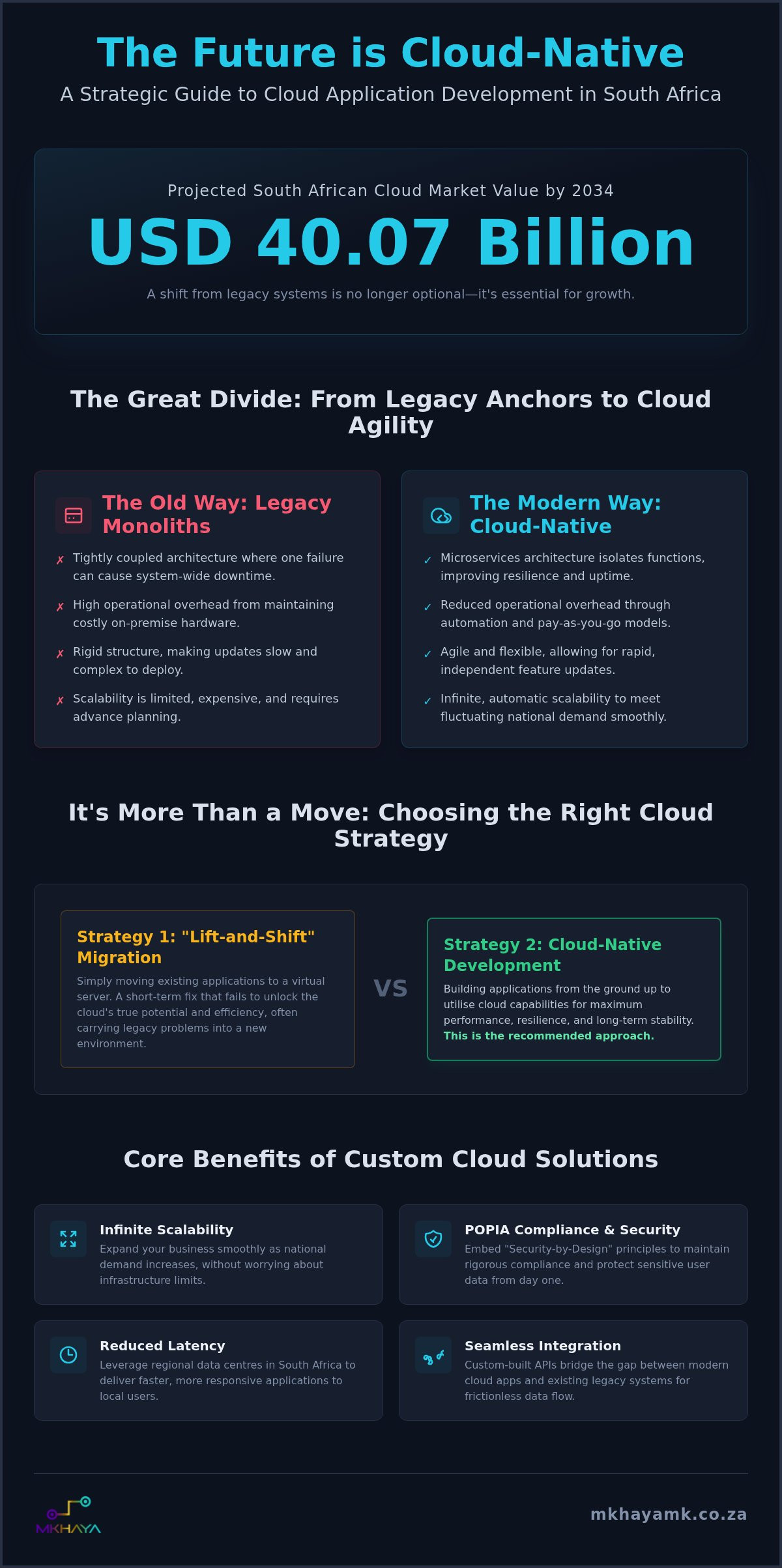
By 2034, South Africa’s cloud market is projected to reach a staggering USD 40.07 billion, yet many organisations still feel anchored by the weight of legacy systems. You’ve likely felt the mounting pressure of maintaining costly hardware whilst trying to keep pace with rapid digital shifts. Mastering cloud application development south africa requires more than just technical migration; it demands a strategy that balances modern innovation with the strict requirements of POPIA compliance and data sovereignty.
We recognise the difficulty of finding local engineering talent who can bridge the gap between global performance standards and national demand. This guide provides a clear roadmap for your cloud-native journey, showing you how to reduce operational overhead through purposeful automation. You’ll discover how to build applications that are secure, high-performing, and inherently scalable for the local landscape. From strategic engineering to long-term stability, let’s explore how to turn your cloud vision into a resilient business reality.
Key Takeaways
- Distinguish between modern cloud-native engineering and traditional migrations to ensure your infrastructure is built for long-term agility.
- Identify how custom-built applications offer infinite scalability, allowing your business to expand smoothly as national demand increases.
- Navigate the local provider landscape to optimise cloud application development south africa by leveraging regional data centres for reduced latency.
- Embed “Security-by-Design” principles into your development lifecycle to maintain rigorous POPIA compliance and protect sensitive user data.
- Accelerate your digital transformation through a methodical partnership that combines custom engineering with flexible staff augmentation.
The Evolution of Cloud Application Development in South Africa
Cloud application development south africa has transitioned from a niche technical choice to a fundamental business requirement. Unlike traditional software development, which often focuses on local server environments, cloud application development is the specific process of building and deploying software designed to run within cloud-native architectures. This approach allows businesses to move beyond the constraints of physical hardware, embracing a model where performance and scale are limited only by strategic vision. It’s about building for the cloud, not just moving to it.
To better understand how these technical shifts are being supported by major global infrastructure providers in the region, watch this helpful video:
For many years, the standard approach was “lift-and-shift”, simply moving existing applications to a virtual server. Whilst this solved immediate hardware concerns, it failed to unlock the true efficiency of the cloud. Modern engineering prioritises cloud-native development, where applications are constructed from the ground up to utilise the unique capabilities of cloud platforms. This shift is particularly vital given the current state of South Africa’s digital landscape, which now supports the high-speed connectivity required for sophisticated, decentralised operations.
From Legacy Monoliths to Cloud-Native Architecture
Legacy systems often function as monoliths, where every feature is tightly coupled. If one part fails, the entire system risks downtime. Modern cloud application development south africa replaces these rigid structures with microservices. By organising business logic into small, independent services, developers can update or scale specific features without impacting the whole application. Containers, such as Docker, play a crucial role here, providing a stable environment that ensures the software runs consistently regardless of where it’s deployed.
Why Cloud-First is the Standard for South African Enterprises
The arrival of local data centres from global hyperscalers has changed the game. South African enterprises no longer need to rely on overseas servers that introduce latency. A cloud-first strategy supports the agility needed for hybrid work models, allowing teams across the country to access high-performance tools securely. This methodology is a core component of custom software development in South Africa, providing the foundation for long-term stability and growth. By building on modern infrastructure, businesses can ensure their digital tools remain resilient and adaptable to changing market demands.
Strategic Benefits: Why Custom Cloud Solutions Outperform Generic Software
Generic off-the-shelf software often forces your business into a predetermined mould. It might solve immediate problems, but it rarely accounts for the specific nuances of your internal workflows or the unique demands of the local market. Custom cloud application development south africa offers a different path. By engineering solutions tailored to your precise requirements, you gain what we call “quiet confidence.” This is the steady assurance that your digital foundation won’t buckle under pressure or limit your growth as your operations expand.
Bespoke solutions allow for seamless integration with your existing infrastructure. Whether you are using a legacy ERP system or modern data tools, custom-built APIs act as the perfect bridge, ensuring data flows without friction. This level of refinement isn’t possible with generic platforms that often rely on “one-size-fits-all” connectors. By building specifically for your ecosystem, you eliminate technical debt and create a stable anchor for long-term stability.
Operational Agility and Infinite Scalability
Traditional infrastructure requires you to predict your peak traffic months in advance. If you guess wrong, you either overpay for idle servers or suffer through site crashes during high-demand periods. Cloud-native applications solve this by scaling horizontally in real-time. When national user traffic spikes, your application automatically allocates more resources to handle the load, ensuring performance remains consistent for every user.
This agility is built on a foundation of robust Cloud Solutions. Through modern DevOps pipelines, your engineering team can deploy updates and new features without any downtime. This means your business remains agile, responding to competitor moves or regulatory changes in days rather than months. It transforms software from a static tool into a living part of your business strategy.
Cost Management through Modern Engineering
One of the most significant shifts in 2026 is the transition from Capital Expenditure (CapEx) to Operational Expenditure (OpEx). Instead of investing heavily in physical hardware that depreciates over time, you pay for exactly what you use. Custom engineering takes this a step further through serverless architecture. In a serverless model, code only executes when triggered by a specific event, which eliminates the cost of keeping servers running 24/7 when they aren’t being used.
It’s a methodical approach to efficiency that directly impacts your bottom line. For a deeper look at managing these expenses, see our guide on Cloud Cost Optimisation in South Africa: A Strategic Guide for 2026. If you are ready to move beyond the limitations of generic software, exploring a partnership with Mkhaya MK can provide the stable, forward-looking foundation your business needs.
Navigating the Local Cloud Landscape: Providers and Models
Selecting the right infrastructure is a pivotal step in the journey of cloud application development south africa. It isn’t just about where your data resides; it’s about which ecosystem best supports your specific business logic and performance requirements. With major hyperscalers now firmly rooted in the country, the choice between AWS, Azure, and Google Cloud comes down to a methodical assessment of your long-term goals and existing technical stack.
The presence of local regions, particularly the established hubs in Cape Town and Johannesburg, has fundamentally changed the user experience. By hosting your application locally, you significantly reduce latency. In the context of local data centres, latency is the time delay between a user’s action and the application’s response. For real-time applications like financial platforms or logistics trackers, every millisecond counts towards maintaining user trust and operational efficiency.
Choosing the Right Provider for Your Development Goals
Each provider offers a unique set of tools that can influence your engineering velocity. Whilst AWS is often seen as the leader in innovation and tool variety, Azure is frequently the preferred choice for organisations already embedded in the Microsoft ecosystem. Google Cloud continues to gain ground by offering specialised capabilities in AI and data analytics, making it a strong contender for data-heavy projects.
| Provider | Core Strengths | Strategic Fit |
|---|---|---|
| AWS | Mature toolsets; extensive Cape Town region support. | High-scale consumer apps and rapid innovation. |
| Microsoft Azure | Deep integration with Office 365 and Windows Server. | Enterprise-grade migrations and corporate environments. |
| Google Cloud | Leading AI, machine learning, and data processing. | Data-heavy research and modern analytics platforms. |
The Hybrid Cloud: Maintaining Data Sovereignty
Beyond the public cloud, the hybrid model offers a balanced path for businesses with strict data requirements. Some organisations must keep specific datasets on-premise due to internal policy or historical infrastructure. A hybrid approach allows you to manage data flow between your local servers and the public cloud, ensuring you benefit from cloud-native agility without compromising your existing security protocols. This setup allows for a gradual, secure transition to more modern architectures.
This methodical integration is a key pillar of Digital Transformation, providing a stable bridge between your current capabilities and future ambitions. Managed services also play a vital role in accelerating the development lifecycle. By utilising pre-configured services for databases, authentication, or messaging, your engineering team can focus on building unique business value rather than managing the underlying hardware. This shift from manual maintenance to automated management reinforces a culture of reliability and allows your team to scale with quiet confidence.
Compliance and Security: Developing for the POPIA Era
In the current regulatory environment, compliance is no longer a checkbox exercise. It is the bedrock of digital trust. For businesses engaged in cloud application development south africa, the Protection of Personal Information Act (POPIA) dictates exactly how data must be collected, stored, and processed. A common concern amongst leadership is whether data is truly safer in the cloud than on a private local server. The reality is that global hyperscalers invest billions in security infrastructure, providing a level of protection that far exceeds what most individual organisations can maintain on-premise.
According to recent industry data, 88% of organisations have increased their cloud security efforts in 2026, reflecting a national shift towards proactive protection. Security in the cloud is a shared responsibility. Whilst the provider secures the underlying hardware and data centres, the developer is responsible for securing the application layer. This involves implementing rigorous encryption for data both at rest and in transit, alongside granular access controls that ensure only authorised personnel can interact with sensitive business information.
Ensuring Data Privacy and Regulatory Compliance
Custom-engineered applications provide a distinct advantage for maintaining POPIA compliance. We can build automated workflows that handle data deletion requests or subject access reports without manual intervention, reducing the risk of human error. By leveraging local data centres in Cape Town and Johannesburg, we ensure that sensitive South African data remains on national soil, satisfying strict residency requirements. Integrating AI & Data Automation allows for intelligent, real-time monitoring of data patterns, flagging potential anomalies before they become security breaches.
Security-by-Design in Cloud Engineering
Security-by-Design is a core engineering principle where security measures are integrated into the application from the very first line of code rather than added as an afterthought. This methodical approach often involves a Zero Trust architecture, where no user or system is trusted by default, regardless of whether they are inside or outside the network perimeter. Automated testing within the DevOps cycle identifies vulnerabilities during the development phase, ensuring that every update meets the highest safety standards before it ever reaches a user.
Building a resilient digital presence requires a partner who understands the intersection of innovation and regulation. If you are ready to secure your business’s future, contact Mkhaya MK today to discuss a compliant and high-performance roadmap for your next project.
Partnering with Mkhaya MK for Scalable Cloud Innovation
Choosing a partner for cloud application development south africa is about more than just finding technical expertise; it’s about forming a relationship built on transparency and long-term stability. At Mkhaya MK, we project a persona of quiet confidence, focusing on the methodical execution of your digital vision. We act as a visionary yet practical guide, ensuring your transition to the cloud is both ambitious and rooted in technical integrity. Our role is to be a stable anchor in a rapidly changing technological landscape, helping you move from high-level strategic concepts to a concrete path forward.
Success in the cloud requires a deep understanding of the synergy between custom software engineering and managed services. We provide the end-to-end expertise needed to align your business goals with modern infrastructure, creating a resilient digital presence that scales with national demand. By focusing on your specific workflows, we refine your operations to reduce overhead and improve performance, ensuring you remain competitive in the 2026 market.
Our Methodical Engineering Process
Stability begins with a thorough discovery phase where we plan for future growth. We don’t just build software; we architect for long-term reliability. Our team prioritises strategic architecture planning to ensure your platform remains high-performing as your user base expands. Through agile development and a robust continuous integration and deployment (CI/CD) pipeline, we deliver updates with precision. This rhythmic sense of momentum ensures that every phase of the Mkhaya MK Process is fully articulated before moving to the next.
Bridging the Skills Gap with Staff Augmentation
One of the primary pains for South African businesses is the difficulty in finding local expert engineering talent to support cloud application development south africa. We solve this through flexible staff augmentation, allowing you to extend your internal tech team with specialised cloud engineers quickly. This approach isn’t just about filling gaps; it’s about adding a layer of high-end expertise to your project precisely when it’s needed most.
Our remote professionals are deeply invested in your personal journey, providing the commitment and integrity your project deserves. For a comprehensive look at how to scale your team with precision, explore our guide on Hire Dedicated Developers in South Africa: A Strategic Guide to IT Staff Augmentation (2026). By combining project-based development with skilled team extension, we provide the stability and agility required to thrive in a modern, cloud-first environment.
Securing Your Digital Future through Methodical Innovation
Refining your digital infrastructure isn’t just about adopting new tools; it’s about building a stable foundation for long-term growth. Successful cloud application development south africa hinges on a compliance-first philosophy that balances innovation with national regulations. By moving beyond generic software and embracing custom, POPIA-compliant solutions, you ensure your organisation remains agile whilst maintaining the highest security standards.
A methodical approach to engineering allows you to reduce operational overhead through automation and serverless architecture. Mkhaya MK brings end-to-end software engineering expertise to every project, acting as specialists in POPIA-compliant cloud solutions. If you need to bridge the local skills gap, our flexible staff augmentation services allow you to scale your internal team with quiet confidence.
We’re ready to act as your visionary yet practical guide in this journey. Partner with Mkhaya MK to build your next-generation cloud application and transform your technological vision into a resilient business reality. Your path to sustainable digital transformation starts here.
Frequently Asked Questions
What is the difference between cloud hosting and cloud application development?
Cloud hosting provides the virtual infrastructure and server space where your data lives, whereas cloud application development is the engineering process of building software specifically to run in those environments. Hosting is essentially the utility and maintenance of storage. Development focuses on creating custom business logic, user interfaces, and integrations. It’s the difference between renting a plot of land and architecting a bespoke building designed for your specific needs.
Is cloud application development POPIA compliant in South Africa?
Yes, cloud application development can be fully POPIA compliant when engineered with a “Security-by-Design” approach from the start. By utilising local data centres in Cape Town and Johannesburg, we ensure that sensitive personal information remains within national borders. This satisfies residency requirements whilst providing the high-speed performance required for modern business. We integrate encryption and granular access controls to protect data according to the strict standards set by South African law.
How much does it cost to develop a custom cloud application?
The cost of developing a custom cloud application depends on the complexity of your business logic, the number of required integrations, and the intended scale of the user base. A methodical discovery phase helps define these variables before any engineering begins. Whilst the initial investment might be higher than generic off-the-shelf options, the long-term reduction in operational overhead and technical debt often provides a superior return on investment for growing organisations.
How long does the cloud application development lifecycle typically take?
The development lifecycle varies based on project scope, but most enterprise-grade solutions move from discovery to deployment within three to nine months. We use an agile methodology to deliver functional modules in shorter cycles, allowing your business to see value early in the process. This iterative approach ensures that the final product remains aligned with your evolving strategic goals whilst maintaining a steady and predictable momentum throughout the project.
Can we migrate our existing legacy software to a cloud-native architecture?
Yes, you can migrate legacy software to a cloud-native architecture through a process called refactoring or re-platforming. Instead of a simple “lift-and-shift” migration, we break down monolithic systems into microservices that thrive in the cloud. This transformation allows your older systems to benefit from modern features like horizontal scaling and automated recovery, breathing new life into your existing business investments whilst improving overall system resilience and performance.
What are the best cloud providers for South African businesses in 2026?
Amazon Web Services (AWS), Microsoft Azure, and Google Cloud are the leading choices for cloud application development south africa due to their significant local infrastructure investments. AWS and Azure have established regions in the country, providing low latency for local users. Google Cloud’s Johannesburg region offers specialised AI and data tools. The best choice depends on your existing technical stack; for example, Azure is often preferred by organisations already using Microsoft enterprise tools.
Why should we choose custom development over off-the-shelf cloud software?
Custom development provides a platform built specifically for your unique workflows, whereas off-the-shelf software often requires you to change your internal processes to fit the tool. Bespoke applications offer infinite scalability and eliminate the recurring licensing fees associated with generic platforms. By owning the code, you gain long-term stability and the freedom to innovate without being restricted by the roadmap or technical limitations of a third-party software vendor.
How does Mkhaya MK ensure the security of cloud applications?
We ensure security by embedding protective measures into every layer of the engineering process through a Zero Trust architecture. This means every system interaction is verified, regardless of its origin. We utilise automated security testing within our DevOps pipelines to identify vulnerabilities before they reach production. This methodical execution, combined with rigorous encryption and compliance monitoring, provides the quiet confidence you need to manage sensitive business data securely and reliably.