

Why is it that the more your business grows, the more your digital tools seem to hold you back? You likely chose your current systems for their convenience, yet you are now spending your afternoons managing data silos and creating manual workarounds for missing features. It is a common frustration; whilst Gartner forecasts worldwide IT spending to reach $6.31 trillion in 2026, many organisations are finding that the problems with off-the-shelf software limitations are actually stifling their progress. When you spend up to four times the initial cost of a generic package just to keep it functional, the productivity ceiling becomes a very real obstacle to your success.
We believe that technology should be a catalyst for your ambition, not a constraint. In this article, you will learn how to identify the exact moment your generic tools become a liability and how bespoke engineering provides the scalability your business requires. We will provide a clear understanding of why your current software is failing, alongside a framework to justify the long-term return on investment for custom development. This is your path toward a seamless digital transformation that ensures your technology remains a stable anchor as you scale.
Key Takeaways
- Recognise why the initial purchase price of generic software often masks a much higher Total Cost of Ownership (TCO) driven by technical debt and inefficient manual patches.
- Identify how the problems with off-the-shelf software limitations, such as feature bloat and rigid frameworks, create a productivity ceiling that prevents your organisation from scaling effectively.
- Explore how to dismantle data silos by moving beyond restrictive API limits toward an open architecture that supports seamless integration and reliable business intelligence.
- Apply a practical evaluation framework to determine when to build bespoke solutions for core business functions that provide a distinct competitive advantage.
- Visualise a path toward digital transformation through a collaborative engineering process that prioritises precision, long-term stability, and your unique growth objectives.
Understanding the Inherent Limitations of Off-the-Shelf Software
Commercial Off-the-Shelf (COTS) software is often presented as a rapid solution for immediate operational needs. It is a mass-market, rigid framework built to cater to the widest possible demographic rather than the specific nuances of your business. Whilst this accessibility is tempting, it frequently introduces systemic problems with off-the-shelf software limitations that surface just as your organisation gains momentum. By relying on proprietary software, you are effectively operating within a digital box where you cannot adjust the parameters to fit your unique operational DNA.
This lack of control stands in stark contrast to the precision required by modern enterprises. When your software dictates your processes rather than the other way around, you lose the agility needed to respond to market shifts. A generic tool might solve a surface-level problem today, but it often creates a deeper technical debt that hinders long-term stability. It’s about moving from a state of compromise to a state of construction where every tool serves a specific, high-value purpose and supports your future ambitions.
To better understand this concept, watch this helpful video:
The “One-Size-Fits-None” Reality
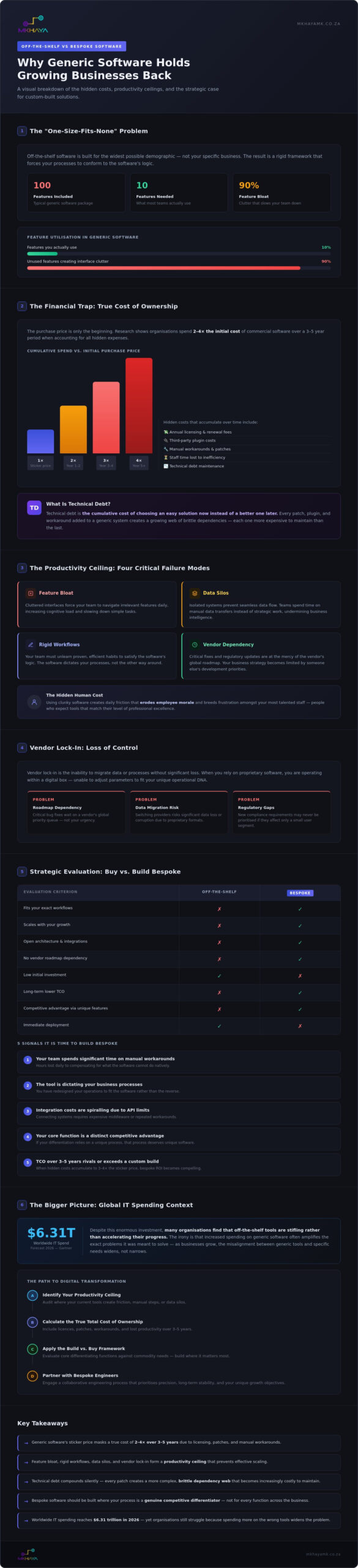
Investing in a software suite with 100 features when your team only requires 10 is more than just a financial waste; it is a strategic error. This “feature bloat” clutters the user interface, making simple tasks feel unnecessarily complex and unintuitive. When generic workflows force your team to unlearn efficient, proven habits just to satisfy a software’s logic, overall productivity suffers. There is also a psychological toll to consider. Using “clunky” software leads to daily friction that erodes employee morale and breeds frustration amongst your most talented staff, who expect tools that match their level of professional excellence.
Vendor Roadmap Dependency
Your business growth should be dictated by your own vision, not a third-party developer’s schedule. When a critical bug appears or a new regulatory requirement emerges, you are at the mercy of the vendor’s roadmap. If your specific needs aren’t a priority for their global user base, you are left waiting indefinitely for updates that may never come. This dependency means your business strategy is effectively limited by someone else’s development priorities. Vendor lock-in is the inability to migrate data or processes without significant loss. To break free from these constraints, many leaders are turning to custom software engineering to regain total control over their digital destiny.
The Financial Trap: Hidden Costs and Long-Term Technical Debt
Many businesses view the initial purchase price of a software package as the primary financial factor. This is a narrow perspective that often masks the true scale of the investment. The problems with off-the-shelf software limitations often manifest as hidden expenses that can dwarf the sticker price within just a few years. Research indicates that organisations may spend between two and four times the initial cost of commercial software when factoring in licensing, customisation, and the inevitable manual workarounds required to keep the system functional over a three-to-five-year period.
This financial strain is compounded by the accumulation of technical debt. Technical debt is the cumulative cost of choosing an easy solution now instead of a better one later. When you “patch” a generic system with third-party plugins or external scripts to fix a missing feature, you aren’t just solving a problem; you’re creating a complex web of dependencies. Over time, these patches become brittle and expensive to maintain. If you are concerned that your current stack is draining resources, exploring bespoke software engineering could reveal a more sustainable path forward where you invest in assets rather than temporary fixes.
Licensing Fees vs. True Ownership
The SaaS model is fundamentally a “renting” arrangement. Whilst it offers a lower entry point, the escalating per-user licensing fees can become a significant burden as your national team expands. For South African firms, this is often exacerbated by currency fluctuations, where a sudden dip in the Rand can lead to an unbudgeted spike in international subscription costs. In contrast, bespoke code is a capital asset. Whilst custom-built software requires a higher upfront investment, it typically becomes more cost-effective than off-the-shelf solutions after two to four years of use, as you no longer pay for features you don’t use or seats you haven’t filled.
The Cost of Workarounds and Manual Overrides
The most insidious cost of generic software is the direct revenue loss caused by a lack of automation. When systems refuse to communicate, your team is forced to build “Excel-based” bridges to move data between departments. Every hour spent on manual data entry is an hour lost to high-value strategic work. These manual overrides also introduce human error, which can lead to “expensive enough” mistakes in billing or inventory management. Even the highlights the significant risk management and compliance burdens placed on organisations that choose non-custom solutions for high-stakes environments. Choosing a “good enough” solution today often leads to a productivity ceiling that prevents you from reaching your full commercial potential tomorrow.
Breaking the Productivity Ceiling: Integration and Scalability Issues
As your operations expand, the digital infrastructure supporting them must adapt. Generic solutions often rely on rigid API limits that restrict how data flows between your tools. This creates a bottleneck. Custom builds, by contrast, offer an open architecture designed for high-volume data exchange. This technical flexibility is crucial for supporting complex, proprietary business logic that off-the-shelf packages simply cannot accommodate. Whilst generic software might suffice for basic tasks, the problems with off-the-shelf software limitations become glaringly obvious when you attempt to integrate specialised workflows.
The performance lag that occurs when COTS databases are pushed beyond their limits is more than a nuisance; it is a risk to your operational stability. Mass-market databases are optimised for the average user, not for the high-concurrency demands of a growing enterprise. When your data volume increases, these systems often struggle to maintain speed, leading to time-outs and processing errors. Moving to a bespoke solution allows for a database structure tailored specifically to your data patterns, ensuring your system remains responsive regardless of your workload.
Data Silos and Failed System Communication
Working within “walled gardens” is a major source of frustration for modern leaders. If your CRM refuses to talk to your ERP or your inventory management system, you are left with fragmented data. This lack of a single “source of truth” leads to poor executive decision-making, as you are forced to rely on incomplete or outdated information. Through custom software engineering, we focus on creating a unified digital ecosystem. By building systems that are integrated by design, you eliminate the friction of data silos and ensure that every department has access to the insights they need to drive growth.
When Growth Outpaces Your Software
Rapid national expansion often reveals the fragility of closed-source platforms. These systems rarely support the addition of custom modules that reflect your unique competitive advantages. If you want to introduce a new service or a unique billing model, you might find that your software simply does not allow it. Bespoke engineering ensures that your technology is built for the future, providing the scalability required to support your long-term vision. The following table highlights the fundamental differences between these two approaches across key business metrics.
| Metric | Off-the-Shelf (COTS) | Bespoke Engineering |
|---|---|---|
| Integration | Rigid API limits; frequent “walled garden” silos. | Open architecture; seamless cross-system communication. |
| Ownership | Subscription model; you rent the functionality. | Full intellectual property; the software is a company asset. |
| Scalability | Limited by vendor roadmap and generic database caps. | Unlimited; grows with your specific business requirements. |
Strategic Evaluation: When to Buy and When to Build Bespoke
Deciding between a commercial package and a custom build requires a shift from reactive purchasing to strategic investment. Whilst generic tools are suitable for standard administrative tasks, they often fail when applied to the core activities that define your market position. To help you navigate this transition, we recommend a five-step framework for evaluating your current software limitations:
- Identify Friction Points: Document every manual workaround or Excel bridge your team uses to bypass system constraints.
- Audit Total Cost: Calculate the true expense of licensing plus the lost revenue from productivity bottlenecks.
- Assess Differentiation: Determine if the process being automated is a standard utility or a unique service that sets you apart.
- Evaluate Connectivity: Test whether the software can integrate seamlessly with your existing South African financial or compliance systems.
- Forecast Growth: Model whether the system can handle a 20% or 50% increase in transaction volume without performance degradation.
Engaging in digital transformation consulting during this planning phase ensures that your technology roadmap aligns with your long-term commercial goals. This structured approach helps you move beyond the common problems with off-the-shelf software limitations by identifying which parts of your stack are assets and which are liabilities.
Assessing Your Competitive Advantage
A helpful way to categorise your needs is through “Core vs Context” activities. Context activities are necessary but non-differentiable utilities, such as email or basic word processing; for these, off-the-shelf software is perfectly adequate. However, your “Core” activities are what make you unique. If you use the same generic logistics or finance software as your competitors, you are effectively limited to their same operational ceiling. In the South African market, where local regulations like POPIA or specific VAT requirements demand precision, customisation allows you to out-innovate rivals by automating complex, high-volume tasks that generic tools simply cannot manage.
The Role of Staff Augmentation
The transition to bespoke engineering does not have to be a disruptive overhaul. Many organisations adopt a hybrid approach, using IT staff augmentation services to bridge the skills gap whilst building custom modules to extend existing systems. This model provides you with dedicated developers who integrate into your specific business culture and understand your unique operational nuances. By having expert oversight, you reduce the risks associated with custom projects and ensure that the final product is a stable, scalable anchor for your digital ecosystem. If you are ready to reclaim your productivity, contact our team today to begin your strategic evaluation.
Future-Proofing Your Business with Mkhaya MK’s Bespoke Solutions
Mkhaya MK serves as a visionary partner for those ready to transcend the productivity ceiling and reclaim their operational independence. We guide your organisation through an end-to-end digital transformation that begins with meticulous UI/UX design and culminates in robust cloud deployment. Rather than forcing your unique operations into a pre-defined, rigid box, we build around your specific commercial goals. For many clients, this journey starts with our flexible frameworks, such as our loan management systems, which provide a stable foundation that can be fully customised to your proprietary requirements. By choosing bespoke engineering, you eliminate the recurring problems with off-the-shelf software limitations and gain the long-term stability that only comes with owning your own source code.
Owning your intellectual property is a fundamental shift in how technology serves your business. In a landscape where global vendors frequently discontinue support for legacy features, such as the discontinuation of Salesforce to Salesforce support in mid-2026, total code ownership ensures you are never left stranded. Your software becomes a secure, private asset that you control entirely. This level of autonomy allows for a more resilient security posture, as you can implement precise protocols that meet your specific risk profile without waiting for a third-party patch.
Precision Engineering for National Scale
Designing for the South African market requires a deep understanding of local operational challenges, from navigating specific regulatory frameworks to managing unique user behaviours. Our approach is rooted in “quiet confidence” and methodical execution, ensuring that every line of code serves a practical purpose. We frequently integrate AI and data automation into these builds to maximise efficiency. This allows your team to focus on high-level strategy whilst the system handles repetitive logic with absolute precision. This synergy between custom engineering and intelligent automation creates a digital ecosystem that is both agile and resilient, capable of supporting rapid national expansion.
Taking the Next Step Toward Autonomy
Transitioning from commercial software to a custom solution is a significant investment in your company’s valuation. When you own the intellectual property, your software is a tangible asset on your balance sheet rather than a perpetual monthly expense. This provides immense peace of mind, backed by dedicated local support and maintenance that understands your specific timeline and business culture. You no longer have to wait for a global vendor to address the specific problems with off-the-shelf software limitations that hinder your progress. If you are ready to break the ceiling and secure your digital future, contact Mkhaya MK for a strategic consultation and let us build the future of your business together.
Reclaiming Your Digital Autonomy
We’ve explored how the hidden costs of licensing and the persistent friction of data silos can stall your momentum. By shifting your focus toward bespoke engineering, you turn technology from a monthly expense into a high-value asset that grows alongside your organisation. Addressing the problems with off-the-shelf software limitations is the first step toward building a more resilient and scalable future where your tools finally match your ambition.
Mkhaya MK provides the end-to-end digital transformation expertise required to navigate this transition with precision. From our specialised loan and facility management systems to our national South African support network, we’re dedicated to your long-term stability and mutual success. It’s time to move beyond the constraints of generic frameworks and invest in a digital ecosystem that belongs entirely to you. We’re ready to act as your stable anchor in this rapidly changing landscape, ensuring your technology remains a catalyst for growth rather than a ceiling on your potential.
Partner with Mkhaya MK for Custom Software that Scales
Frequently Asked Questions
What are the main disadvantages of off-the-shelf software for a growing business?
The primary disadvantages include a lack of customisation, rigid workflows, and the inability to scale alongside unique business processes. These systems are built for the mass market, which often leads to feature bloat where you pay for tools you never use. Additionally, the problems with off-the-shelf software limitations often result in data silos, as generic packages may not integrate seamlessly with your existing South African financial or compliance systems.
Is custom software development more expensive than off-the-shelf in the long run?
Custom software is typically more cost-effective than off-the-shelf solutions after two to four years of use. Whilst the initial investment is higher, you eliminate escalating per-user licensing fees and the ongoing costs associated with manual workarounds. Research suggests businesses can spend two to four times the initial purchase price of generic software on maintenance and patches over five years, making bespoke engineering a more sustainable financial asset for your organisation.
How do I know if my business has outgrown its current software?
You’ve likely outgrown your software when your team relies on manual Excel bridges to move data between systems or when simple tasks require complex workarounds. If your current tools don’t support new service offerings or if performance lags during peak periods, you’ve reached a productivity ceiling. This transition often signals that your technology has become a constraint on your growth rather than a catalyst for your strategic ambition and forward-looking goals.
Can custom software be integrated with my existing off-the-shelf tools?
Yes, custom software is specifically designed with an open architecture to integrate seamlessly with your existing digital ecosystem. We build bespoke solutions that communicate effectively with standard tools like email or accounting packages, ensuring a unified source of truth for your business intelligence. This approach allows you to retain functional utility software whilst building custom modules for the core activities that provide your competitive advantage in the local market.
What is technical debt in the context of commercial software?
Technical debt refers to the cumulative cost and complexity created by choosing quick, generic fixes over robust, long-term solutions. In commercial software, this often manifests as a web of brittle third-party plugins and manual data overrides used to solve the problems with off-the-shelf software limitations. Over time, these patches become difficult to maintain and expensive to update, eventually requiring a complete system overhaul to restore operational efficiency and stability.
How long does it typically take to develop a bespoke software solution?
The development timeline varies based on the complexity of your requirements, but a typical bespoke project moves from initial UI/UX design to deployment over several months. We follow a highly structured, rhythmic progression to ensure each phase is fully articulated before moving to the next. This methodical approach prioritises transparency and reliability, allowing us to build a stable, high-end anchor for your business without the pressure of rushed or flashy execution.
Does Mkhaya MK provide support after the custom software is launched?
Mkhaya MK remains a deeply invested partner by providing dedicated local support and maintenance long after your solution has launched. Our relationship is built on mutual success, so we ensure your system remains agile and secure as your business evolves. This commitment includes regular updates and performance monitoring, providing the peace of mind that your digital infrastructure is managed by experts who understand your specific culture and traditional values of integrity.
Can I own the source code if I choose custom development?
You retain full ownership of the source code and all intellectual property when you choose custom development with us. This ownership transforms your software into a tangible company asset on your balance sheet, rather than a perpetual monthly subscription expense. Having control over your code ensures long-term stability and security, as you’re never at the mercy of a global vendor’s roadmap, sudden pricing changes, or discontinued feature support.