

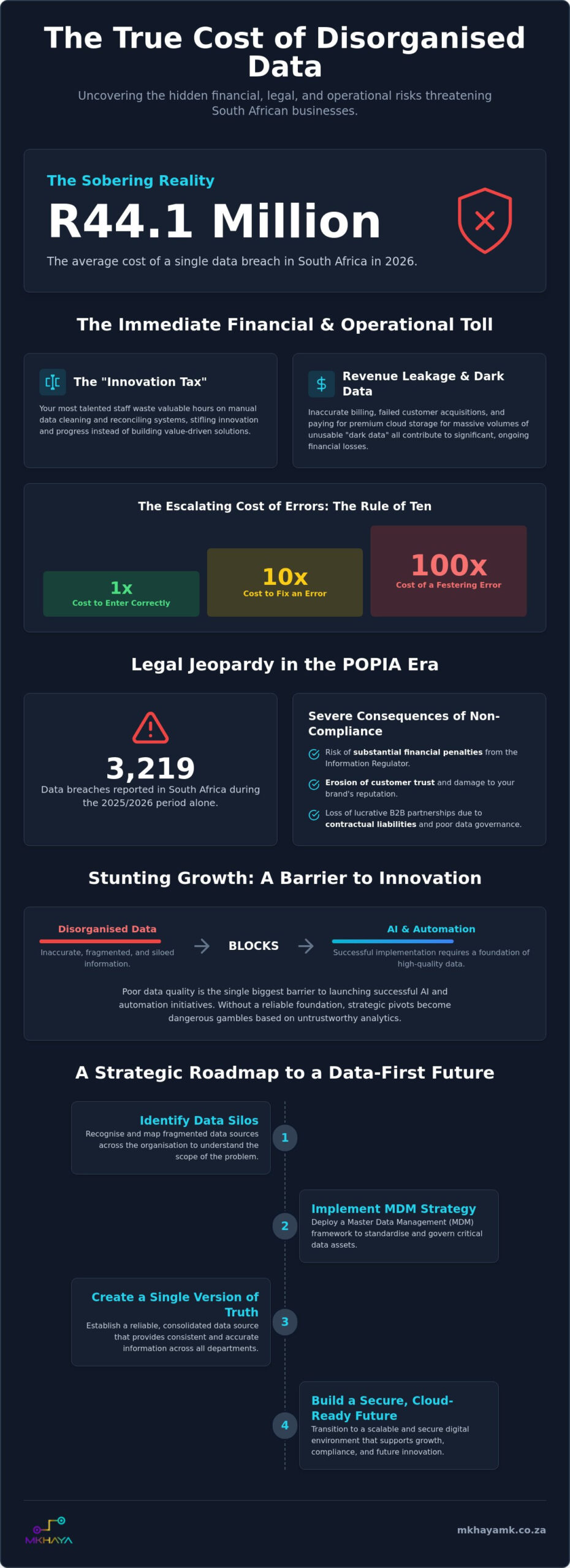
Did you know that the average cost of a single data breach in South Africa has reached R44.1 million in 2026? It’s a sobering figure that highlights why the consequences of poor data management are no longer just an IT headache but a fundamental risk to your business survival. You’ve likely felt the strain of high operational overhead from manual data cleaning, or perhaps you’re feeling the weight of anxiety over POPIA compliance as the Information Regulator adopts a more proactive stance.
We understand that you want to move beyond these hurdles and finally unlock the potential of AI and automation. In this article, you’ll discover the hidden financial and legal risks of disorganised data and learn the strategic steps to secure your digital future. We provide a clear roadmap to help you justify the necessary investment for data projects, moving your organisation from a state of chaos to being fully prepared for the next wave of technological innovation.
Key Takeaways
- Understand how manual data cleaning acts as a hidden tax on your team’s productivity and learn how to quantify these operational losses.
- Explore the severe legal consequences of poor data management under the latest POPIA enforcement standards, including the risk of substantial financial penalties.
- Discover why high-quality, organised data is the non-negotiable foundation for launching successful AI and automation initiatives.
- Learn how to implement a Master Data Management strategy that creates a reliable, single version of truth across your entire enterprise.
- Identify the strategic roadmap required to transition from fragmented data silos to a secure, cloud-ready digital environment that scales with your ambition.
The Immediate Financial and Operational Toll of Poor Data Management
At its core, poor data management represents a fundamental failure to accurately capture, store, and utilise the information assets that drive your business. It isn’t just about messy spreadsheets; it’s a structural flaw that prevents your organisation from reaching its full potential. Robust data management ensures that every piece of information is a reliable asset rather than a liability. When this foundation is weak, the consequences of poor data management ripple through every department, creating a heavy “Innovation Tax”. Your most talented staff end up spending their hours manually correcting errors or reconciling systems instead of building new solutions that move the needle.
To better understand the tangible impact of data quality on your business, watch this helpful video:
Beyond the drain on human capital, disorganised systems lead to immediate revenue leakage. Inaccurate billing cycles or failed customer acquisitions often stem from duplicated contact details or lost purchase histories. There’s also the silent, ongoing cost of “Dark Data”. Many South African enterprises pay for premium cloud storage for massive volumes of unlabelled, unusable information. This data provides zero value whilst increasing your digital footprint and storage overheads every month.
Inaccurate Decision-Making and Skewed Analytics
Strategic pivots become dangerous gambles when your dashboards are untrustworthy. When the numbers don’t add up, leadership teams often revert to “gut feelings” rather than data-driven insights. This reliance on intuition over evidence leads to flawed forecasting. You might find your business overstocking inventory based on ghost demand or missing out on critical market shifts because the data was too outdated to signal a change. Strategic agility requires a foundation of precision that messy data simply cannot provide.
The Escalating Cost of Operational Inefficiency
The “Rule of Ten” remains a stark reminder of operational reality. It costs ten times more to fix a record than it does to enter it correctly at the start, and a hundred times more if that error is left to fester. For customer service centres, the lack of a single source of truth means agents struggle to resolve queries, leading to frustrated clients and higher churn. Fragmented IT systems also require redundant maintenance and custom patches to talk to one another. By exploring AI and data automation, you can begin to bridge these silos and turn your data into a streamlined driver of growth.
Legal Jeopardy and the Erosion of Trust: Compliance in the POPIA Era
In South Africa, the legal landscape has shifted dramatically. The Protection of Personal Information Act (POPIA) is no longer a distant requirement; it’s a daily operational reality. The Information Regulator reported 3,219 data breaches in the 2025/2026 period alone, a figure that represents a sharp increase from previous years. This surge highlights the severe consequences of non-compliance with POPIA for those who fail to secure their digital estates. Disorganised data often acts as the primary catalyst for these incidents. When information is scattered across unmanaged silos, maintaining strict access controls becomes nearly impossible. This lack of oversight leads to accidental leaks or unauthorised entry, placing your entire organisation in jeopardy.
It’s vital to remember that POPIA protects juristic persons as well as individuals. This means your business-to-business data is under the same scrutiny as consumer information. Poorly managed data creates contractual liabilities with partners who demand high governance standards. If you can’t prove how you handle sensitive third-party information, you risk losing lucrative partnerships. This erosion of professional standing is one of the most overlooked consequences of poor data management in the current enterprise environment. Without a clear handle on where your data lives, you simply cannot guarantee its safety to those who trust you with their business.
Regulatory Fines and Legal Sanctions
The financial sting of a POPIA violation is significant and multi-layered. The Information Regulator has moved beyond reacting to complaints; they now conduct proactive compliance assessments and can issue administrative fines of up to ZAR 10 million. For the most serious offences, directors may face personal liability and criminal penalties, including imprisonment for up to 10 years. Beyond the fine, your business must bear the cost of mandatory forensic audits and public notifications. These expenses quickly escalate, particularly when you consider that the average cost of a data breach in South Africa has climbed to R44.1 million in 2026.
The Long-Term Cost of Customer Churn
Legal fees and fines are only part of the story. Trust is the currency of the digital economy, and it’s easily spent. Some industry professionals report that up to 60% of customers will leave a brand after a single security incident. Rebuilding that reputation in a competitive market is a gruelling, multi-year process. Additionally, poor data quality leads to “unprofessional” customer interactions, such as sending marketing emails with incorrect names or expired offers. These small frictions erode loyalty long before a major breach even occurs. Transitioning to managed cloud solutions can provide the secure, organised infrastructure needed to protect both your clients and your brand’s future.
Stunting Growth: How Disorganised Data Blocks AI and Automation
Whilst previous sections detailed the financial and legal penalties of messy records, the long-term consequences of poor data management are perhaps most visible in your inability to scale. AI and automation are no longer optional extras for South African enterprises; they’re the engines of modern competitiveness. However, these engines require high-octane fuel. When your data is fragmented, inconsistent, or unverified, you’re essentially feeding “garbage” into sophisticated systems. The “Garbage In, Garbage Out” (GIGO) principle remains the ultimate truth in machine learning. If your foundational data is flawed, your AI outputs will be equally unreliable, rendering your technological investments useless.
This friction is particularly evident when implementing Robotic Process Automation (RPA). Robots thrive on predictability. If your data formats vary across different departments, such as inconsistent date structures or varying currency codes, the automation breaks. Instead of a streamlined workflow, you end up with a system that requires constant human intervention to fix “exceptions”. This stunting of growth extends to your marketing efforts as well. Without clean data, creating a “360-degree customer view” is impossible. You can’t personalise experiences or predict customer behaviour if your insights are trapped in disconnected silos. These operational consequences of poor data management effectively lock your business out of the modern digital economy.
The Failure of AI-Driven Business Intelligence
Large Language Models (LLMs) are revolutionary, but they’re prone to “hallucinations” when trained on poor internal data. If your proprietary information is contradictory or outdated, the AI will confidently provide incorrect answers to your staff or customers. There’s also the significant risk of automated bias. In sectors like financial services or facility management, flawed data can lead to algorithms that unfairly penalise specific groups or overlook critical maintenance needs. True success in AI & Data Automation requires a meticulous data cleansing process before the first line of code is even written.
Hindering Digital Transformation Efforts
Many legacy modernisation projects stall indefinitely because of data migration complexities. It’s a common story: an organisation invests in a high-end cloud platform only to find that their source data is too “dirty” to move. This friction prevents you from adopting DevOps practices and scaling your operations at pace. Integrating modern ERP solutions becomes a nightmare when your data architecture is fundamentally broken. Centralising enterprise information is the only way to ensure that your digital transformation remains a driver of success rather than a costly, unfinished project.
Turning the Tide: A Strategic Framework to Organise Enterprise Data
Whilst the risks of disorganised records are severe, they aren’t insurmountable. To avoid the long-term consequences of poor data management, South African enterprises need a structured recovery path. Turning the tide requires a shift from reactive firefighting to a proactive, aspirational framework. At the heart of this transition is Master Data Management (MDM). By implementing MDM, your organisation creates a single version of truth that spans every department. This ensures that when a customer updates their details in one system, the change reflects everywhere, preventing the fragmented interactions that erode brand trust. It also provides the high-quality fuel your AI models require to function effectively.
Establishing clear governance policies is the next logical step. This involves defining who owns specific data sets and how that information should be handled throughout its lifecycle. When you treat data as a strategic asset rather than an IT burden, you empower your team to maintain high standards. Leveraging cloud-native tools for real-time validation further strengthens this foundation. These tools allow your systems to catch and correct errors before they propagate through your network, ensuring long-term stability and precision.
Step 1: The Data Audit and Discovery Phase
You can’t manage what you don’t know exists. A comprehensive audit is the starting point for any successful recovery. This phase involves mapping your entire digital estate, including on-premises servers, cloud environments, and the often-overlooked “Shadow IT”; those unsanctioned apps staff use to get work done. Classifying this information by its sensitivity and business value allows you to prioritise security and compliance efforts. Our digital transformation consulting starts with this thorough discovery process to ensure total clarity.
Step 2: Implementing Automated Data Governance
Manual spreadsheets are where data quality goes to die. To truly secure your future, you must move towards automated validation workflows. These systems monitor your data quality metrics in real-time, alerting your team to inconsistencies the moment they occur. This technical shift must be accompanied by a cultural one. Training your staff to recognise the importance of data integrity ensures that every entry is handled with precision. If you’re ready to move from data chaos to AI-readiness, contact our team today to begin building your roadmap.
Building a Data-First Future with Mkhaya MK
The journey from data chaos to digital excellence is one we walk alongside our clients. As we’ve explored, the consequences of poor data management in 2026 are too severe to ignore, ranging from R44.1 million breach costs to the total stagnation of AI initiatives. However, these challenges also present an opportunity to rebuild your organisation on a foundation of precision and reliability. We don’t just offer tools; we provide a visionary partnership designed to turn your information into your greatest competitive advantage. By focusing on long-term stability, we help you construct a digital estate that is both secure and ready for the next wave of innovation.
Our approach centres on practical execution and methodical refinement. Whether you’re struggling with fragmented silos or outdated storage, our managed cloud solutions ensure your data is scalable and organised. We also recognise that many South African enterprises face a significant skills gap. Through our staff augmentation services, we provide the expert data engineers and analysts your team needs to maintain high standards. This collaborative model ensures that your internal capabilities grow whilst we work together to mitigate the consequences of poor data management within your infrastructure.
Custom Solutions for Complex Data Challenges
Every industry has unique requirements that off-the-shelf software often fails to meet. We specialise in software engineering that is tailored to your specific operational logic. By building custom bridges between your legacy systems and modern platforms, we ensure that information flows seamlessly across your business. For those in the financial sector, integrating specialised tools like our loan management systems can immediately streamline operations and improve data accuracy. These bespoke interventions are essential for transforming “dark data” into actionable business intelligence.
Partnering for National Success
Mkhaya MK is deeply rooted in the South African landscape. We understand the nuances of the local regulatory environment, particularly the shifting demands of POPIA and the Information Regulator’s proactive stance. This local expertise allows us to act as a stable anchor for your business in a rapidly changing technological world. We value transparency and commitment, ensuring that every project leads to a concrete path forward for your enterprise. Don’t let disorganised data hold your vision back. Contact us today to begin your journey toward data excellence and secure a prosperous digital future for your organisation.
Securing Your Digital Legacy Through Strategic Precision
The path to enterprise resilience in 2026 requires more than just better storage; it demands a fundamental shift in how you value and organise your information assets. By addressing the consequences of poor data management now, you protect your organisation from escalating financial leaks and the heavy hand of POPIA enforcement. You also clear the technical hurdles that currently prevent your team from harnessing the true power of AI and automation. Moving from data chaos to a streamlined, cloud-ready environment is essential whilst you navigate the complexities of a modern digital economy. It’s a commitment to your long-term stability and competitive edge.
As end-to-end digital transformation experts with national South African coverage, we’re ready to help you navigate this transition. We bring deep POPIA expertise and a visionary approach to AI integration, ensuring that your data becomes a reliable engine for growth. Your journey toward excellence starts with a single, strategic step toward better governance. We’re here to provide the steady, professional guidance you need to turn today’s data challenges into tomorrow’s successes.
Secure your enterprise future with Mkhaya MK’s Data Solutions
Frequently Asked Questions
What are the main consequences of poor data management?
Financial loss, legal penalties, and operational friction are the primary results of disorganised information. The consequences of poor data management often manifest as a hidden “Innovation Tax”, where your staff waste hours manually correcting errors instead of driving growth. These inefficiencies drain your resources and erode the competitive edge your business needs to thrive in a digital economy.
How does poor data quality affect business decision-making?
Decisions based on flawed data lead to strategic errors and missed market opportunities. When dashboards are untrustworthy, leadership teams often lose confidence in their analytics and revert to “gut feelings” rather than data-driven insights. This reliance on intuition over evidence can result in overstocking, inaccurate forecasting, and failed pivots that jeopardise your long-term stability.
Is poor data management a legal risk in South Africa?
Yes, POPIA mandates strict data governance for all companies and trusts in South Africa. The Information Regulator has adopted a proactive stance in 2026, with the power to issue administrative fines of up to ZAR 10 million. Gross negligence in managing personal information can also lead to criminal penalties and personal liability for directors, making data governance a boardroom priority.
Can poor data management prevent my company from using AI?
AI systems cannot function effectively without a clean and organised data foundation. Large Language Models produce hallucinations when trained on poor internal data; whilst Robotic Process Automation breaks when it encounters inconsistent record formats. To unlock the potential of AI and automation, your organisation must first address the underlying structural issues within its data architecture.
What is the cost of poor data management for a large enterprise?
Large enterprises face data breach costs that have reached an average of R44.1 million in 2026. Beyond these catastrophic events, the daily operational cost is significant. Many organisations lose a substantial portion of their revenue through billing errors, failed customer acquisitions, and the ongoing expense of storing “Dark Data” that provides no business value.
How can I fix my company’s poor data management?
Start by conducting a comprehensive data audit to identify silos and quality gaps. Implementing Master Data Management (MDM) allows you to create a single version of truth across your entire digital estate. Partnering with experts for custom software development or cloud solutions can help you automate validation workflows, ensuring your information remains a reliable strategic asset.
What is the difference between data management and data quality?
Data management is the overarching framework for capturing, storing, and utilising information; whilst data quality refers specifically to how accurate and reliable that information is. Think of management as the system or architecture, and quality as the standard that the system must maintain. Both are essential for mitigating the consequences of poor data management in a modern enterprise.
How does cloud migration help with data management?
Cloud migration centralises your information and provides built-in tools for real-time validation and cleaning. It eliminates the physical silos that often lead to duplicated or outdated records, making your data easier to govern and protect. Modern cloud environments also support DevOps scaling, allowing your organisation to grow without compromising the integrity of your information architecture.