

With over 127 million active cellular connections in South Africa, your audience isn’t just connected; they’re living through their mobile devices. Yet, it’s a sobering reality that many high-budget applications fail to retain users because they don’t account for the unique local landscape. You’ve likely experienced the frustration of trying to bridge the gap between complex business requirements and the actual needs of a user navigating inconsistent data speeds or a mid-range smartphone.
Partnering with a specialised mobile app design company south africa allows you to move past these obstacles with confidence and precision. This guide provides a clear roadmap to help you organise your design process for maximum impact in 2026. You’ll discover how to create an interface that feels both intuitive and valuable to your customers whilst ensuring your digital tools align perfectly with your internal business automation. We’ll explore the essential steps for building trust through POPIA-compliant design and strategies for maintaining high performance across South Africa’s diverse device ecosystem.
Key Takeaways
- Understand why user experience design is the essential foundation for South African apps, serving as the key differentiator that drives long-term user retention.
- Master a collaborative 5-step framework with a mobile app design company south africa to ensure your digital tools remain perfectly aligned with your strategic business goals.
- Navigate local infrastructure constraints by prioritising offline-first functionality and data-efficient designs that cater to the diverse South African user base.
- Evaluate the strategic trade-offs between native and cross-platform development to deliver precise, high-performance interactions across a fragmented device landscape.
- Future-proof your investment by integrating AI-driven personalisation and ensuring your mobile application scales seamlessly with your core ERP solutions.
Why User Experience Design is the Foundation of South African Mobile Apps
User experience (UX) design is far more than a technical requirement; it’s the process of creating a product that provides meaningful and relevant experiences to your users. Within our local market, this discipline acts as the primary differentiator between an application that merely occupies storage and one that becomes an essential daily tool. While many competitors focus solely on creating “beautiful apps”, a professional mobile app design company south africa understands that true success lies in how a user interacts with your digital solution under real-world conditions.
Investing in robust design early in the mobile app development process reduces long-term expenses by identifying usability hurdles before a single line of code is written. It’s much cheaper to move a button on a wireframe than to refactor an entire database or fix logic errors after launch. In 2026, user experience design serves as the indispensable bridge between complex technical capability and tangible business value.
To better understand the impact of professional design on your project’s trajectory, watch this helpful video:
The Strategic Value of User-Centric Design
Aligning your app’s features with your core business objectives ensures that every swipe and tap contributes to your digital transformation goals. Professional design builds deep trust amongst South Africa’s diverse user base by acknowledging local nuances and accessibility needs. When an interface is intuitive, you’ll find a significant reduction in the need for extensive user training. This allows your team or customers to adopt the tool with minimal friction, ensuring your mobile app design company south africa delivers a product that scales with your ambition.
UI vs. UX: Understanding the Distinction
It’s easy to confuse these terms, but the difference is vital for your project’s health. User Interface (UI) focuses on the visual “colour”, typography, and layout that users see. UX, however, is the invisible journey they take. Before visual aesthetics are even considered, wireframing acts as a structural blueprint for the entire experience. It maps out how a user moves from point A to point B without getting lost. Collaborating with a UI UX design services South Africa partner ensures these two elements work in perfect harmony, resulting in a product that’s as functional as it is polished.
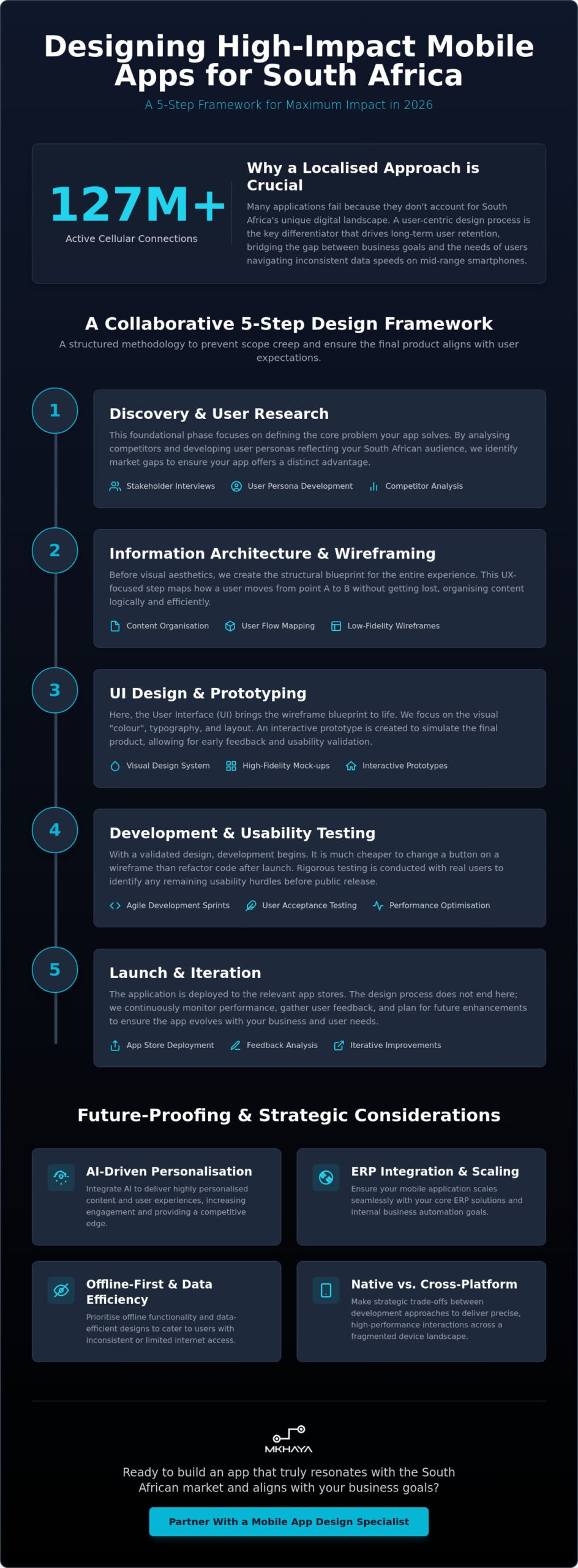
How to Organise Your Mobile App Design Process: A 5-Step Framework
Success in mobile app design isn’t a matter of chance; it’s the result of a highly structured, collaborative methodology. When you work with a leading mobile app design company south africa, you involve stakeholders from your business, design, and engineering teams from the very beginning. This approach effectively prevents the common pitfalls of scope creep and technical debt. Each phase of this framework is designed to produce a tangible deliverable that serves as a stable foundation for the next, ensuring the final product aligns with user expectations.
Step 1: Discovery and User Research
We start by conducting in-depth stakeholder interviews to define the specific “Job to be Done” for your application. This phase focuses on the core problem your app solves rather than just a list of features. We develop user personas that reflect the actual behaviours of your target South African audience, often referencing local academic insights regarding user-preferred app features. By analysing your competitors, we identify specific gaps in the national market, ensuring your application offers a distinct advantage.
Step 2: Information Architecture and Wireframing
Once the research is complete, we organise content and features into a logical hierarchy that minimises cognitive load for the user. Low-fidelity wireframes act as a functional blueprint, mapping out the entire journey without the distraction of visual aesthetics. We validate this flow through early-stage testing to ensure that the navigation feels natural and intuitive. If you’re ready to start this journey, following a proven engagement process ensures every decision is backed by data.
Step 3: Prototyping and Visual Design
In this stage, wireframes transform into high-fidelity designs that truly reflect your brand identity. We develop interactive prototypes that simulate the actual app experience, allowing stakeholders to interact with the product before the software engineering phase begins. This ensures the design is responsive across various screen sizes and device specifications, which is vital for the South African market. Partnering with a professional mobile app design company south africa ensures that your visual design is always balanced with technical feasibility.
Step 4: User Testing and Iteration
Before moving to development, we put the prototype in the hands of real users. This step identifies any remaining friction points and allows us to refine the interface based on actual user feedback. Iterating at this stage is far more cost-effective than making changes after the app has been built, ensuring the final product is polished and user-ready.
Step 5: Design Handoff and Specification
The final step involves preparing the design for the engineering team. We create comprehensive documentation and design specifications that include every asset, colour code, and interaction detail. This seamless handoff ensures that the vision established during the design phase is accurately translated into the final, functional software product.
Native vs. Cross-Platform: UX Design Considerations
The choice of your technology stack significantly impacts how a mobile app design company in South Africa approaches the user experience. It’s not merely a technical decision; it’s a strategic one that dictates how fluidly your users can interact with your brand. In South Africa’s mobile-first economy, where over 90% of internet users access the web via mobile devices, the performance and accessibility of your application form the bedrock of your digital reputation.
Native development, which focuses on iOS or Android individually, allows for the most precise use of device-specific gestures and animations. This path is often chosen when the highest level of performance is non-negotiable. Conversely, cross-platform frameworks like Flutter or React Native offer a faster time-to-market whilst maintaining exceptionally high design standards. Ultimately, the best choice for your project depends on your specific user behaviour and performance requirements.
When to Choose Native Design
Native design is the preferred route for projects requiring complex animations or heavy reliance on hardware features like the camera, biometric sensors, or GPS. If your application targets a user base where a platform-specific look and feel is a “favourite” requirement for adoption, native development ensures every interaction feels natural on the device. This approach is particularly effective for high-intensity enterprise tools or gaming applications where every millisecond of latency matters. By building natively, you’re investing in a stable, high-performance anchor that leverages the full power of the underlying operating system.
The Rise of Cross-Platform Efficiency
Modern frameworks have revolutionised the industry by allowing for a single design codebase that looks and feels premium on both major platforms. This efficiency allows you to balance cost-effectiveness with the need for a bespoke user experience that doesn’t feel like a compromise. Strategic custom software development South Africa involves choosing the right path that aligns with your budget and long-term scaling plans.
Cross-platform solutions are ideal for businesses that need to reach a broad audience quickly without sacrificing the visual polish expected in 2026. A skilled mobile app design company south africa can create a unified experience that adapts beautifully to different screen sizes. This ensures your brand remains consistent across the fragmented local device landscape. This collaborative approach ensures your digital tool provides immediate value whilst remaining agile enough to evolve with your business needs.
Addressing South African Challenges in Mobile App Design
South Africa presents a unique set of hurdles that require more than just a standard global design template. Varying data costs and inconsistent network connectivity mean that a “one-size-fits-all” approach often leads to high abandonment rates. A visionary mobile app design company in South Africa will prioritise these local nuances from day one. Design must account for “offline-first” functionality to ensure the app remains useful without a constant signal. Whether a user is in a remote area or a high-rise lift, the interface should remain responsive and functional.
Partnering with a dedicated mobile app design company south africa ensures that your product is built with these specific constraints in mind. When you design for the edge cases of connectivity, you create a more resilient product for every user. This methodical focus on local reality is what separates successful digital tools from those that fail to gain traction.
Optimising for Data Sensitivity
With prepaid mobile data revenue increasing by 7.7% in 2025, South Africans are acutely aware of their data consumption. We implement “light” versions of assets and icons to reduce the burden on the end-user’s wallet. Caching strategies are essential here. They ensure core information stays available whilst the user is offline, syncing only when a stable connection is found. It’s also vital to provide clear feedback. Users should know exactly when they’re about to perform a data-intensive task, such as downloading a large report. This transparency builds long-term trust and prevents “bill shock” for your customers.
Accessibility and Inclusive Design
If you’re ready to build a tool that truly resonates with the local market, reach out to our team to start your project with a partner who understands the South African landscape.
Future-Proofing Your App with AI and Strategic Scaling
AI is no longer a futuristic concept but a functional necessity for mobile applications in 2026. It enables a shift toward predictive UX, where the interface anticipates user needs before they are explicitly stated. This level of sophistication requires a mobile app design company south africa that looks beyond the surface to the underlying data structures. When your front-end experience is tightly integrated with robust ERP solutions South Africa, you create a seamless flow between customer interactions and your core business operations.
Design is a living process that demands a commitment to long-term stability and refinement. By viewing your app as a stable anchor for your business, you ensure it remains relevant even as technology shifts. Successful scaling involves more than just adding features; it requires a methodical approach to maintaining high performance whilst your user base expands. This forward-looking strategy ensures your digital tools continue to deliver value in an increasingly competitive landscape.
Integrating AI into the User Journey
Leveraging AI and data automation allows us to simplify complex user tasks through smart defaults and predictive paths. Instead of overwhelming users with endless choices, the app presents the most likely next step based on historical behaviour. This significantly reduces cognitive load and increases user retention. We also focus on conversational UI and chatbots to enhance customer support efficiency. These tools provide immediate assistance to your users, ensuring they feel supported whilst freeing up your internal resources for more complex tasks.
Scaling Through Continuous Improvement
Launching your app is simply the start of a collaborative journey. We use heatmapping and detailed analytics to identify exactly where users encounter friction after the initial release. As your requirements grow, you might need to quickly inject specialised talent into your project. Utilising staff augmentation provides the agility to scale your design team without the overhead of permanent hires. This ensures your app design evolves in lockstep with your broader digital transformation strategy.
Partnering with an expert mobile app design company south africa provides you with a visionary guide for this ongoing process. We help you interpret real-world data to make informed design adjustments that reflect changing market conditions. This methodical execution ensures that your mobile application remains a reliable, high-end tool that continues to achieve your strategic business goals; for a look at how this applies to specialised sectors, check out Build App | building management software — collection, maintenance, and tenants in one place as a benchmark for functional excellence.
Building Your Digital Legacy in the South African Market
Your journey toward a successful mobile application requires a methodical plan that balances high-end aesthetics with functional accessibility. We’ve explored how a robust 5-step framework and a deep understanding of local challenges, such as data sensitivity and connectivity, can transform your digital presence. By choosing to work with an experienced mobile app design company south africa, you aren’t just building a tool; you’re creating a stable anchor for your business’s future growth.
Mkhaya MK serves as a national leader in end-to-end digital transformation. We specialise in custom software engineering and AI automation, ensuring that your digital assets remain resilient in a rapidly changing landscape. Our focus on long-term stability and mutual success means we’re deeply invested in your personal journey. It’s time to bridge the gap between your strategic business requirements and the needs of your users. Partner with Mkhaya MK for Visionary Mobile App Design and take the first step toward a product that truly resonates with the South African audience. We’re ready to help you turn your vision into a practical, high-impact reality.
Frequently Asked Questions
How much does mobile app design cost in South Africa?
The cost of mobile app design depends on the complexity of the application, the number of custom features, and the depth of user research required. A professional design phase is a strategic investment that prioritises long-term user retention and brand alignment over a generic interface. Factors such as the integration of AI automation or complex database structures will influence the final scope of the design project.
How long does the mobile app design process typically take?
A comprehensive design process usually takes between 4 and 12 weeks to complete. This timeline includes the initial discovery phase, wireframing, and the creation of high-fidelity interactive prototypes. Smaller projects or MVPs might move through these stages faster, whilst complex enterprise tools require a more deliberate pace to ensure every user journey is thoroughly validated before development begins.
Should I design for iOS or Android first in South Africa?
In the South African market, Android typically holds the dominant share of active connections, making it a common starting point for many businesses. However, the most effective strategy often involves a cross-platform design approach that ensures a premium experience for all users regardless of their device. Your specific target demographic and their preferred device habits should ultimately guide this decision.
What is the difference between a mobile app design company and a development company?
A design company focuses on the user experience (UX) and the visual interface (UI) to ensure the app is intuitive and valuable. A development company handles the technical coding, server architecture, and logic that makes the app functional. Partnering with a full-service mobile app design company south africa ensures that your visual vision is perfectly aligned with technical feasibility from the start.
Can I use a template for my business mobile app design?
While templates offer a quick solution, they often lack the precision needed to solve specific business problems or accommodate South Africa’s unique connectivity challenges. Bespoke design allows you to build a tool that is a stable anchor for your brand, offering a level of customisation that templates cannot match. This ensures your application can scale and evolve alongside your business transformation goals.
How do I know if my current app needs a UX redesign?
High user abandonment rates, negative feedback, and difficulty in completing core tasks are the most common signs that your app needs a refresh. If your current interface feels cluttered or fails to leverage modern capabilities like AI-driven personalisation, a UX redesign can significantly improve user engagement. Regularly reviewing your app’s performance data helps identify specific friction points that hinder your strategic goals.
What are the most important UX trends in South Africa for 2026?
The most critical trends include AI-driven predictive interfaces, dark mode for battery conservation, and robust “offline-first” functionality. There is also a heightened focus on trust-centred design, driven by intensified POPIA enforcement and a need for transparent data handling. A leading mobile app design company south africa will integrate these trends to ensure your application remains modern, secure, and highly accessible.
How does mobile app design impact my overall digital transformation?
Effective design serves as the primary interface for your digital transformation, making complex backend systems accessible to your team and customers. It ensures that your investment in digital tools, such as ERP solutions or data automation, results in a tool that people actually enjoy using. By focusing on the user, you bridge the gap between technical capability and tangible business value.