

What if your most significant IT expense isn’t the technology itself, but the hidden cost of simply finding the people to build it? You likely recognise that traditional recruitment has become a frustrating bottleneck, characterised by exorbitant agency fees and long lead times that stall your momentum. It’s exhausting to manage rising office overheads and expensive benefit packages whilst trying to keep your digital projects on track. This guide explores how you can reduce IT costs with staff augmentation by shifting from fixed labour expenses to a more agile, high-impact investment strategy.
We’ll show you how to eliminate those recruitment headaches and optimise your budget through a partnership that values precision and long-term stability. You’ll learn how to achieve a lower total cost of ownership for your software and a faster time-to-market for your products. By the end of this article, you’ll have a clear path to accessing pre-vetted senior expertise without the traditional hiring risks, ensuring your organisation remains a stable anchor in a shifting technological landscape.
Key Takeaways
- Uncover the true cost of technical vacancies and why traditional recruitment fees represent a significant drain on your digital transformation budget.
- Discover how to reduce IT costs with staff augmentation by leveraging a flexible model that eliminates the overheads of permanent employee benefits and office space.
- Compare the total cost of ownership between internal hires and augmented experts, accounting for South African specificities like the 13th cheque and performance bonuses.
- Learn how to scale your tech team with precision by targeting specialist skill gaps and fostering knowledge transfer within your core internal workforce.
- Evaluate the financial benefits of customisable engagement models, including remote and on-site options, to suit your specific project requirements and budget.
The Hidden Financial Burden of Traditional In-House Scaling
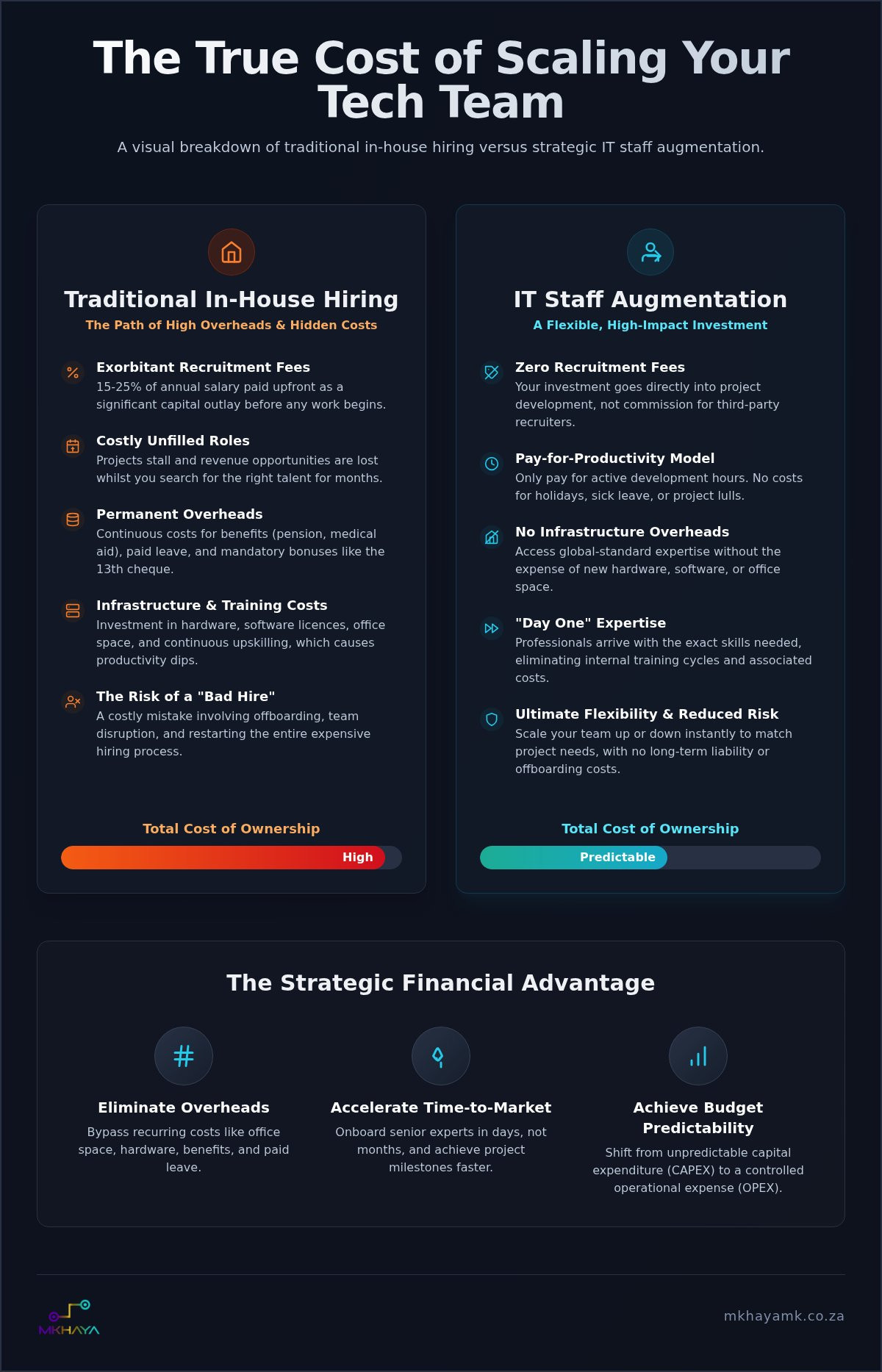
Traditional scaling often feels like an uphill battle against rising expenses. When you decide to hire internally, the financial clock starts ticking long before a developer writes their first line of code. Recruitment agency fees typically range from 15% to 25% of a candidate’s annual salary. For a senior engineer, this represents a substantial upfront capital outlay that offers no immediate return on investment. However, the most damaging expense is often the “Cost of Vacancy”. Whilst a critical technical role remains unfilled, your digital products stall and revenue opportunities vanish. This invisible leak in your budget is a primary reason why forward-thinking leaders look to reduce IT costs with staff augmentation.
Beyond recruitment fees, you must consider the infrastructure required for every new internal hire. High-end hardware, specialised software licenses, and physical office equipment add up quickly. These assets require ongoing maintenance and eventual replacement, creating a cycle of perpetual expenditure. Onboarding and training expenses for permanent staff can take months to amortise, meaning you’re often paying for potential rather than immediate output. To understand the foundational differences between these staffing models, it helps to define what is staff augmentation compared to traditional permanent hiring.
The Reality of Permanent Overhead
A permanent salary is just the tip of the iceberg. In the South African context, employee benefits such as pension contributions and medical aid subsidies significantly inflate the total cost of employment. You also carry the burden of providing office space and utilities; these remain fixed costs regardless of your current project volume. Perhaps the greatest risk is a “bad hire”. The financial impact of offboarding an unsuitable candidate, combined with the subsequent search for a replacement, can be devastating to a project’s bottom line. It’s a risk that many businesses simply cannot afford to take repeatedly.
Skill Obsolescence and Training Costs
Technology moves at a relentless pace. Upskilling internal teams requires a continuous investment in bespoke training programmes that often struggle to keep pace with global trends. Whilst your permanent employees are in training, their productivity drops to zero. This creates a double loss: the direct cost of the course and the indirect cost of lost development time. By choosing to reduce IT costs with staff augmentation, you bypass these training cycles entirely. You bring in pre-vetted professionals who arrive with the exact expertise your project requires, ensuring momentum remains high and costs remain predictable.
Quantifying the Savings: How IT Staff Augmentation Trims the Budget
Transitioning from the heavy burdens of traditional hiring to a partner-led model allows your organisation to reclaim significant portions of its budget. When you choose to reduce IT costs with staff augmentation, you effectively bypass the advertising expenses and high commission fees mentioned in the previous section. Instead of paying a massive upfront premium to a recruitment agency, you invest directly in technical output. This model provides access to global-standard expertise without the “senior talent” salary premium that often accompanies permanent local hires, ensuring your projects benefit from high-level precision from day one.
The “Pay-As-You-Go” advantage is perhaps the most immediate financial benefit. Unlike permanent employees who incur costs during holiday periods, sick leave, or project lulls, augmented professionals are typically billed only for active development hours. This ensures that your financial resources are strictly aligned with project progress. Industry leaders often utilise this approach to increase software team productivity, as it removes the administrative friction that typically slows down internal departments. When a specific project phase concludes, you can scale down your team instantly, leaving you with zero long-term liability or offboarding costs.
From CAPEX to OPEX: A CFO’s Perspective
Modern financial leadership values agility and predictability. By shifting IT labour from a fixed capital expenditure (CAPEX) to a variable operating expense (OPEX), you gain far greater control over your cash flow. This transition allows you to align costs directly with project milestones rather than maintaining a static, expensive payroll regardless of your current needs. It also drastically reduces the administrative burden on your HR and payroll departments, as the augmentation partner handles the complexities of contracts and compliance. If you are looking to refine your financial strategy, you might consider how to discuss your specific budget requirements with a strategic partner.
Speed as a Cost-Saving Mechanism
In the digital economy, time is quite literally money. The process of hiring remote developers through an established partner can reduce your time-to-market by weeks or even months. Every day saved in the development cycle is a day of saved operational costs and a day closer to revenue generation. Augmented staff are pre-vetted and accustomed to rapid integration, meaning they hit the ground running without the lengthy “learning curve” that often stalls internal teams. This immediate productivity acts as a safeguard against project delays, which are the most common cause of budget overruns in complex software engineering projects.
Comparing Total Cost of Ownership: Internal Hire vs. Augmented Professional
A permanent salary is often a misleading figure when evaluating your bottom line. Whilst a monthly payslip might seem more economical at first glance, it’s merely the visible portion of a much larger financial commitment. To truly reduce IT costs with staff augmentation, you must adopt a Total Cost of Ownership (TCO) perspective. In the South African market, an internal hire often costs the business significantly more than their base pay once you factor in the 13th cheque, performance bonuses, and mandatory employer contributions. An augmented professional’s hourly rate might appear higher initially, but it represents a “clean” cost that eliminates these compounding financial layers.
Productivity loss is another critical, yet often ignored, variable. Permanent employees are entitled to annual leave, sick pay, and numerous public holidays, during which your project momentum slows whilst your overheads remain constant. When you utilise an augmented model, you’re paying for active progress and direct output. Furthermore, the true cost of management for internal teams is substantial. The time your leadership spends on HR compliance, performance reviews, and administrative oversight is time diverted from strategic innovation. By shifting these responsibilities to a partner, you reclaim that executive capacity for higher-value activities.
The “All-In” Cost Framework
Beyond the payslip, every internal hire requires a significant investment in infrastructure. This includes high-performance hardware, specialised software licences, and physical office space. These are non-trivial expenses that scale linearly with your headcount and require ongoing maintenance. By integrating augmented experts, custom software development costs become far more predictable because your partner absorbs these operational overheads. This framework provides a vital buffer in a fluctuating national economy, allowing you to maintain a lean, agile operation that can pivot without the friction of asset liquidation or office downsizing.
Reducing Risk and Compliance Costs
South Africa’s labour landscape is notoriously complex. Mitigating the legal risks associated with labour disputes or potential retrenchments carries a high price tag in terms of legal fees and management stress. When you partner with a specialist provider, they assume responsibility for all payroll taxes, statutory compliance, and contract management. You gain the financial benefit of a pre-vetted, guaranteed talent pool without the long-term liability. This approach ensures your organisation remains resilient and focused on delivery, effectively turning potential legal and administrative risks into a managed, outsourced stability.
Strategic Implementation: Maximising ROI whilst Scaling Your Tech Team
Achieving the full potential of your investment requires more than just filling seats; it’s about precision. When you seek to reduce IT costs with staff augmentation, the focus should shift from simple headcount to strategic right-sizing. By targeting specific specialist gaps rather than just adding extra hands, you ensure that every hour billed contributes directly to high-value architectural progress. This approach naturally fosters a culture of knowledge transfer. Your internal team gains exposure to global best practices as they work alongside pre-vetted experts, effectively turning the engagement into a long-term upskilling programme that adds value well beyond the initial contract.
The synergy between human expertise and machine efficiency is a significant cost-saving lever. Integrating AI automation solutions allows your developers to offload repetitive tasks, significantly enhancing their creative output and reducing the time spent on manual coding. To ensure these gains are realised, you must establish clear KPIs. Tracking metrics such as sprint velocity and bug-to-code ratios provides a transparent view of the financial impact your augmented team delivers, allowing for data-driven decisions that protect your budget.
Integrating Augmentation into Digital Transformation
Accelerating cloud migration services often requires niche skills that aren’t needed once the transition is complete. Augmentation allows you to bridge this gap without permanent hiring. Maintaining architectural consistency is vital, so your augmented staff should work within your existing DevOps frameworks. This alignment helps reduce long-term maintenance costs and prevents the accumulation of technical debt, ensuring your infrastructure remains stable and cost-effective as you scale.
Best Practices for Vendor Management
Choosing a partner with a strong national presence ensures they understand the specific nuances of the South African market. Cultural alignment is equally critical, as it prevents friction that can lead to lost productivity. Transparent reporting cycles allow you to track budget utilisation in real-time, ensuring your project remains financially lean. If you’re ready to see how these strategies can work for you, get in touch with our team to explore a model that fits your specific needs.
Partnering with Mkhaya MK for Cost-Effective Digital Excellence
Mkhaya MK stands as a stable anchor for businesses seeking to navigate the complexities of modern tech scaling. We provide high-calibre technical professionals across South Africa, ensuring you don’t just fill a vacancy but advance your strategic vision. Our tailored engagement models offer the flexibility your budget requires. You can choose on-site experts for sensitive projects, remote professionals for cost efficiency, or a hybrid model that balances both. By choosing to reduce IT costs with staff augmentation through our partnership, you leverage our deep software engineering expertise to refine your digital products and build long-term stability.
Our promise is rooted in transparency and methodical execution. We understand that trust is built through reliable delivery and mutual success. This quiet confidence allows us to act as a supportive partner, focusing on your specific journey whilst ensuring your tech stack remains modern and precise. We don’t just provide labour; we provide a pathway to sustainable growth.
Why National Enterprises Choose Mkhaya MK
We possess a profound understanding of the South African technology landscape. This local insight allows us to provide professionals who aren’t just technically proficient but also culturally aligned with your organisation’s goals. Our track record in end-to-end digital transformation proves that we’re a visionary guide for complex projects. You gain immediate access to a diverse pool of pre-vetted developers, analysts, and engineers. This allows you to reduce IT costs with staff augmentation whilst maintaining the high standards your stakeholders expect.
Getting Started with Your Team Expansion
The Mkhaya MK process is deliberate and thorough. It begins with a comprehensive needs analysis to ensure we understand your unique challenges before moving toward deployment. This structured approach ensures that our experts integrate seamlessly with your existing internal workflows, preventing the friction that often accompanies external scaling. We focus on creating a rhythmic sense of momentum, leading your project from a broad vision toward concrete, high-impact results. Our goal is to make your expansion feel like a natural extension of your core team, rooted in integrity and commitment.
Contact Mkhaya MK today to optimise your IT costs and discover how our collaborative model can secure your organisation’s technological future.
Secure Your Technological Future with Strategic Agility
Building a high-performance development team shouldn’t be a drain on your organisation’s resources. By choosing to reduce IT costs with staff augmentation, you shift from the restrictive weight of fixed overheads to a model defined by precision and scalability. This guide has highlighted how you can eliminate the hidden expenses of traditional recruitment whilst maintaining the momentum necessary for rapid digital transformation. You now have the framework to convert technical labour into a variable, high-impact investment that aligns perfectly with your project milestones.
Mkhaya MK is here to act as your visionary guide in this journey. We provide access to top-tier national technical talent and offer flexible on-site or remote professional placement to suit your specific budget. Our end-to-end digital transformation expertise ensures that your organisation remains a stable anchor in a rapidly changing landscape. It’s time to move beyond the limitations of traditional hiring and embrace a partnership built on transparency and mutual success. Scale your tech team and reduce overheads with Mkhaya MK to begin your journey toward sustainable, cost-effective excellence.
Frequently Asked Questions
How does staff augmentation actually reduce IT costs compared to hiring?
Staff augmentation reduces costs by eliminating the substantial upfront recruitment fees and long-term benefit obligations associated with permanent payroll. You effectively convert fixed labour costs into variable project expenses, paying only for the specific expertise required for your current roadmap. This model allows you to reduce IT costs with staff augmentation by avoiding the financial drain of the “cost of vacancy” and the ongoing administrative burden of traditional HR management.
Is staff augmentation more expensive in the long run than permanent staff?
Whilst hourly rates for augmented experts are typically higher than a base salary, they are often more economical when you calculate the Total Cost of Ownership. You avoid paying for idle time, 13th cheques, medical aid subsidies, and physical office overheads. For project-based work, the flexibility to ramp down immediately ensures you aren’t carrying expensive, underutilised headcount once a specific development milestone is achieved.
What are the hidden costs I should watch out for when augmenting my team?
Potential hidden costs often arise from poor communication or a lack of clear architectural standards, which can lead to technical debt. You should also verify whether your partner includes management oversight in their service rates. We prioritise transparency at Mkhaya MK to ensure your internal leadership doesn’t spend excessive time managing augmented professionals, which protects your budget from the creep of administrative overheads.
Can staff augmentation help with cloud migration and digital transformation costs?
Staff augmentation allows you to access niche expertise specifically for the duration of a migration without committing to a permanent hire. This precision helps you reduce IT costs with staff augmentation by ensuring the transition is handled correctly the first time. It prevents the long-term expense of fixing architectural errors often made by generalist internal teams who may lack specific cloud-native engineering experience.
How quickly can I scale my tech team with augmented professionals?
Scaling typically happens within a few weeks rather than the months required for traditional recruitment cycles. Established partners maintain a pre-vetted talent pool of engineers and analysts ready for immediate deployment. This speed allows your organisation to respond to market shifts or project demands instantly, ensuring you don’t lose potential revenue whilst waiting for a permanent position to be filled through standard channels.
Does staff augmentation include the cost of equipment and software licences?
This depends on the specific engagement model, though most remote augmentation partners provide their staff with the necessary high-end hardware. Software licences for your specific internal tools are usually your responsibility to ensure security compliance. However, you save significantly on the physical office costs and utility overheads that a permanent on-site employee would require, contributing to a much leaner operational budget.
How do I ensure that augmented staff provide a high return on investment?
Establishing clear KPIs and integrating augmented professionals into your existing DevOps workflows is essential for success. Focus on output-based metrics like sprint velocity and code quality rather than simply tracking hours worked. By fostering a culture of knowledge transfer, the augmented experts upskill your permanent staff, creating a secondary return on investment that continues to add value long after the contract concludes.
What is the difference between staff augmentation and traditional outsourcing?
Staff augmentation involves professionals who work directly under your management and integrate with your internal team. Traditional outsourcing usually involves handing over an entire project to an external provider who manages the process independently. Augmentation offers you greater control over the development cycle and architectural decisions, ensuring the final product aligns perfectly with your organisation’s long-term digital strategy and internal standards.